
Proposal: Video playback
Milestone: Gameplay toolkit (G16) · Status: ⬜ planned ·
Depends on: M7 audio (buses, generator voices), GPU resources (upload queue,
deletion queue), M8 game UI (engine:// textures), Native libraries (if the chosen
decoder is native) · Related: Game export (G5), World-space UI (G11: GPU
textures on meshes), Accessibility (G14: subtitles), Mobile core (M12),
Consoles, Rendering backend abstraction (M11)
Problem
Section titled “Problem”Games need intro logos, cutscenes, menu backgrounds and in-world screens. The engine cannot play a video file. A
search of MainframeEngine/, MainframeEngine.Editor/ and Examples/ for video, webm, mp4, theora and codec names
finds nothing. The editor maps no video extension to a file kind; .ogg is always audio
(MainframeEngine.Editor/Src/FileSystem/FileKind.cs:60) and thumbnails exist only for StbImageSharp formats
(FileKind.cs:75). .mp4 is an LFS pattern (.gitattributes:17) but nothing reads it.
What exists and what video should build on:
- Streaming audio. The streaming thread decodes files ahead of playback into per-voice SPSC rings, so the game
and audio threads never allocate (
MainframeEngine/Src/Audio/Threading/AudioStreamer.cs:3-8,AudioStreamChannel.cs:3-23). Decoders open whole files by extension: WAV, Ogg Vorbis (NVorbis), MP3 and FLAC (MainframeEngine/Src/Audio/Decoding/AudioDecoder.cs:106-131). There is no packet-level entry point for an audio track that a video container demuxes. - Pushed audio and a clock.
AudioStreamGeneratorplays frames that any one thread pushes into a lock-free ring, on a bus, resampled to the device rate (MainframeEngine/Src/Audio/Synthesis/AudioStreamGenerator.cs:5-15,PushFrames:112,ClearBuffer:141).FramesConsumed(:106) counts frames the audio thread actually played, which is the master clock video needs.AudioServer.GetPlaybackPositionis per audio block (MainframeEngine/Src/Audio/AudioServer.cs:520-526). The null device runsRealtimeorManualfor tests (MainframeEngine/Src/Audio/Devices/AudioOutput.cs:273-280). Game code never calls SoundFlow. - CPU textures re-upload by recreating.
Texture2D.SetPixelsbumpsVersion(MainframeEngine/Src/Rendering/Resources/Texture2D.cs:317). Every consumer then disposes and recreates the GPU texture from a fresh RGBA copy:TextureGpu.Update(MainframeEngine/Src/Rendering/Meshes/MeshGpuResources.cs:221-240) and the canvasUpload(MainframeEngine/Src/Rendering/Canvas/VulkanCanvasRenderer.cs:221-224). Video throughSetPixelswould allocate, convert colour on the CPU and create aVkImageevery frame. - GPU-owned textures, partly.
Texture2D.FromViewport(Texture2D.cs:254) is a texture with no CPU pixels. The canvas skips its upload and binds the sub-viewport target (VulkanCanvasRenderer.cs:208-209,:620-629).MeshRenderer.AcquireTexturehas no such branch (MainframeEngine/Src/Rendering/Meshes/MeshRenderer.cs:468-481), so 3D materials cannot sample a GPU-produced texture today. RmlUi can:UiServer.RegisterTexturepublishes aGpuTexture, aSubViewport, aRenderTargetor an internalFunc<UiTextureView>asengine://name(MainframeEngine/Src/UI/UiServer.cs:343-368). - Uploads.
UploadQueue.UploadImagecopies a whole image’s pixels into the 32 MiB staging ring and records the copy at frame start (MainframeEngine/Src/Rendering/Vulkan/Memory/UploadQueue.cs:25,:99-128). That is a second CPU copy of every decoded frame.FormatInfoknowsR8_UNORMandR8G8_UNORMbut notR16_UNORM(10-bit planes;MainframeEngine/Src/Rendering/Vulkan/Memory/FormatInfo.cs:11-12).MaxFramesInFlightis 2 (MainframeEngine/Src/Rendering/Vulkan/IVulkanContext.cs:18). The renderer has no compute pipelines; full-screen fragment passes overContent/Shaders/Post/Fullscreen.vk.vert.slangare the house pattern.RenderServer.RenderOffscreenruns before any pass samples (MainframeEngine/Src/Servers/RenderServer.cs:384). - Full-screen overlays.
LoadingScreen : UiLayeris a modal RmlUi layer over everything (MainframeEngine/Src/Scene/Loading/LoadingScreen.cs:5-23).GameHostshows it while the start scene loads on a worker (MainframeEngine/Src/Project/GameHost.cs:365-369), configured by theloadingsection ofproject.mfproj(MainframeEngine/Src/Project/ProjectSettings.cs:80,:534-545). Gamepad B reaches RmlUi as Escape (MainframeEngine/Src/UI/UiInputMap.cs:25-36). - Servers and importers. Frame servers implement
IFrameServer.Process(MainframeEngine/Src/Servers/ServerRegistry.cs:12-15); the engine registers servers inbase.OnLoad()(MainframeEngine/Src/Core/Engine.cs:391-431), dedicated servers inHeadlessHost(MainframeEngine/Src/Project/HeadlessHost.cs:43-52). Importers register by extension (MainframeEngine/Src/Resources/Import/AssetImporters.cs:25-33). Editor custom inspectors with previews exist (MainframeEngine.Editor/Src/Inspector/ZzfxStreamInspector.cs:24). - No codec anywhere. NuGet audio is NVorbis and SoundFlow (
Directory.Packages.props:28-29). The only Xiph natives are libogg and libvorbis inside the editor-onlymfplughost(natives.md).
- A
VideoStreamresource (imported from a file,.metasettings) and aVideoPlayernode: play, pause, stop, seek (exact or keyframe), loop,Finished, preroll, playback statistics. - A
VideoTexture(aTexture2Dwith no CPU pixels) usable bySprite2D, 3D materials and RmlUi (engine://). - A
Cutscenehelper: a full-screen, letterboxed, optionally skippable video layer, and intro videos inproject.mfprojthat play while the start scene loads. - The audio track plays as a voice on an
AudioServerbus (volume, mute, pause, user volume from G4) and is the master clock for A/V sync. Without audio, the clock is game time (deterministic under--fixed-fps). - Decode on a worker thread into a bounded frame queue of pooled, persistently mapped staging buffers; copy to plane images through the upload queue; convert YUV → RGB in a Slang shader. No CPU colour conversion during playback, no per-frame allocation on the game thread, no validation warnings.
- A codec-neutral decoder seam, so the pipeline, nodes, editor and tests ship before the codec decision, and platform or licensed decoders can plug in later.
- Editor: import, thumbnails, an inspector preview; export notes.
Non-goals
Section titled “Non-goals”- Encoding, transcoding or recording. Authors encode with their own tools; the docs give
ffmpegrecipes. - Network streaming (HLS, DASH), DRM, and arbitrary user files (
.mp4/.movfrom players’ disks). - HDR video (PQ/HLG, BT.2020 wide gamut output). 10-bit SDR is in scope if the codec has it.
- Alpha video, 4:2:2/4:4:4, interlaced content, variable playback speed beyond 0.5–2× with pitch shift.
- Subtitles inside the container. Captions come from G14 (Accessibility) on the same clock.
- Choosing the codec in this document. See Codec and decoder.
Design
Section titled “Design”Overview
Section titled “Overview”| Type (all new) | Where | Role |
|---|---|---|
VideoStream, VideoInfo, VideoImporter | Src/Video/ | Resource over a file, probe results, video importer |
VideoPlayer | Src/Video/Nodes/ | Node: transport, clock, signals, audio voice owner |
VideoTexture : Texture2D | Src/Video/ | The frame as a GPU-only texture |
Cutscene : UiLayer | Src/Video/Nodes/ | Full-screen, skippable presentation; intro videos |
VideoServer : IFrameServer | Src/Video/ | Worker threads, frame selection per frame, statistics |
IVideoDemuxer, IVideoDecoder, IVideoAudioDecoder | Src/Video/Decoding/ | Codec seam (internal; one implementation per format) |
Y4mDemuxer | Src/Video/Decoding/ | Uncompressed YUV4MPEG2 for tests and development |
VideoFramePool, VideoFrameQueue | Src/Video/Threading/ | Pooled plane buffers, bounded SPSC queue |
VideoRenderer | Src/Rendering/Video/ | Plane images, upload, YUV → RGB pass; owned by RenderServer |
Video/VideoYuv.vk.frag.slang | Content/Shaders/ | Conversion shader (with Post/Fullscreen.vk.vert.slang) |
flowchart LR
    F["file (Content/…)"] --> D["worker: demux → decode<br/>(IVideoDecoder)"]
    D -- "planes into pooled<br/>mapped staging buffer" --> Q["VideoFrameQueue<br/>(bounded, SPSC)"]
    D -- "PCM" --> A["audio ring → voice on bus<br/>(AudioServer)"]
    A -- "FramesConsumed = clock" --> S["VideoServer.Process<br/>(main thread): pick frame ≤ clock"]
    Q --> S
    S --> U["frame start: copy buffer → plane images<br/>(UploadQueue, no staging copy)"]
    U --> C["RenderOffscreen: YUV → RGB pass<br/>into VideoTexture's RGBA8 image"]
    C --> X["Sprite2D · materials · RmlUi"]
Public API
Section titled “Public API”namespace MainframeEngine;
/// <summary>A video file and how to play it (Godot's VideoStream). Imported by the "video" importer.</summary>[EditorIcon("device-tv")]public class VideoStream : Resource{ [Export(File = "*.y4m")] // the codec's extensions join after the decision (e.g. *.webm) public string? File { get; set; } // path or UID, resolved through AssetDatabase.Current like AudioStream [Export] public bool Loop { get; set; } [Export] public VideoColorSpace ColorSpace { get; set; } = VideoColorSpace.Auto; // Auto, Bt601, Bt709, Bt2020 [Export] public VideoRange Range { get; set; } = VideoRange.Auto; // Auto, Limited, Full [Export] public string AudioBus { get; set; } = "Music"; [Export] public bool Mipmaps { get; set; } // for screens seen at a distance; costs a blit chain per frame
public static VideoStream Load(string path); // applies the .meta settings public bool Preload(); // probes the container (header only) public VideoInfo? Info { get; } // null until probed public string? LoadError { get; }}
public sealed record VideoInfo(int Width, int Height, double FrameRate, double Length, string Codec, int BitDepth, VideoColorSpace ColorSpace, VideoRange Range, bool HasAudio, int AudioChannels, int AudioSampleRate);
public enum VideoSeekMode { Exact, Keyframe }
[EditorIcon("device-tv")]public class VideoPlayer : Node{ [Export] public VideoStream? Stream { get; set; } [Export] public bool Autoplay { get; set; } [Export] public bool Loop { get; set; } // in addition to VideoStream.Loop [Export(Range = "-80,24,0.1")] public float VolumeDb { get; set; } [Export] public string? Bus { get; set; } // null = Stream.AudioBus [Export(Range = "0.5,2,0.01")] public float Speed { get; set; } = 1f; // pitch follows [Export(Range = "2,16,1")] public int QueueFrames { get; set; } = 4;
public VideoTexture Texture { get; } // stable for the node's lifetime; black until the first frame public bool Playing { get; } public bool Paused { get; set; } // in addition to tree pause (ProcessMode) public bool IsReady { get; } // first frame decoded and audio prerolled public double Position { get; } // seconds on the playback clock public double Length { get; } public VideoPlaybackStats Stats { get; } // decoded, dropped, late, queue depth, decode ms, A/V offset
public void Play(double fromSeconds = 0); public void Prepare(double fromSeconds = 0); // decode and preroll without starting the clock public void Stop(); public void Seek(double seconds, VideoSeekMode mode = VideoSeekMode.Exact);
[Signal] public event Action? Ready; // IsReady became true [Signal] public event Action? Finished; // played to the end (not on Stop, not when looping) [Signal] public event Action? Looped; [Signal] public event Action<string>? Failed; // decode or I/O error; the texture keeps its last frame}
/// <summary>A video frame on the GPU. Has no CPU pixels (DecodePixels throws, like a viewport texture).</summary>public sealed class VideoTexture : Texture2D { public VideoPlayer? Player { get; } }
// New member on UiServer (sealed today): publishes a video as engine://name for <img> and image() decorators.public void RegisterTexture(string name, VideoTexture texture);VideoPlayer is not a visual node: show its Texture with any consumer (Sprite2D.Texture,
StandardMaterial3D.AlbedoTexture/EmissionTexture, an RmlUi engine:// image) or use Cutscene. In
SceneTree.EditMode it is inert like the audio players; the editor previews videos itself.
Decoder seam and threading
Section titled “Decoder seam and threading”internal interface IVideoDemuxer : IDisposable // one per open stream, worker thread only{ VideoInfo Info { get; } IVideoDecoder CreateVideoDecoder(); IVideoAudioDecoder? CreateAudioDecoder(); // null without an audio track bool ReadPacket(out VideoPacket packet); // pooled buffers; false at the end void SeekToKeyframe(double seconds, out double keyframeSeconds);}
internal interface IVideoDecoder : IDisposable{ /// <summary>Decodes into the frame's mapped planes; false when it needs more input.</summary> bool Decode(in VideoPacket packet, ref VideoFrame frame); void Flush();}- One worker per playing video (a dedicated thread,
IsBackground, named after the file), like the audio streamer. Decoders that thread internally (dav1d, libvpx) get a thread budget fromVideoServer.MaxDecodeThreads. - Frame pool. At
Play, the pool allocatesQueueFrames + MaxFramesInFlight + 1buffers throughIVulkanContext.AllocatorwithGpuMemoryUsage.Staging(persistently mapped; allocation stays on the main thread, the worker only writes mapped memory). Plane rows are padded tooptimalBufferCopyRowPitchAlignment. Headless and tests use abyte[]pool allocated at open instead. - Queue.
VideoFrameQueueis an SPSC ring of(pts, duration, poolIndex). The worker blocks when it is full; it never blocks the main thread. A pool buffer returns to the worker only after the GPU frame that copied it has completed (tagged withIVulkanContext.FrameNumber, released where the upload queue releases its staging ring). - Main thread (
VideoServer.Process, duringTree.Tick): pops every frame whose pts ≤ clock, keeps the newest, returns the others (counted as dropped), and hands the chosen buffer toVideoRenderer. No allocation: the per-video state is created atPlay. - Headless (
HeadlessHost, no renderer): the worker demuxes and decodes audio only, skips video packets, and the clock still runs, soFinishedfires on time for dedicated servers and logic tests. - Errors end that video (
Failed), log once and never take the game down, asAudioStreamdoes.
Clock and A/V sync
Section titled “Clock and A/V sync”- Audio master. With an audio track and an audio device:
clock = FramesConsumed / rate − outputLatency, where the latency estimate is the device period (AudioOptions.BufferMilliseconds). Video follows audio; audio is never resampled to chase video. - Game-time clock. Without audio, on the
Manualnull device, or headless: the sum of the tree’s process deltas ×Speed, stopped while paused. Under--fixed-fpsthis makes frame selection deterministic (render tests). - Preroll.
Playstarts the worker; the clock and the audio voice start together once the first video frame is queued and the audio ring holds 100 ms (Ready).Preparedoes the same without starting, for frame-exact cues. - Late frames. If the clock is more than 0.5 s ahead of the newest decoded frame (a hitch, a slow machine), the
worker skips to the next keyframe after the clock (
Stats.Late). - Seek. The worker flushes the queue,
SeekToKeyframe, then (Exact) decodes and discards up to the target. The audio ring is cleared (ClearBuffer) and refilled from the same point. The texture keeps the old frame until the new one arrives, so seeks never flash black. - Loop. The worker restarts at the end without a gap and offsets pts by the length, so the clock is monotonic;
Loopedfires on the main thread when the wrap is presented.
Audio track
Section titled “Audio track”The demuxed audio decodes on the video worker (Opus, Vorbis or MP2, depending on the codec decision) into an internal
VideoAudioSource, the same shape as AudioGeneratorSource: a per-play ring sized 0.5 s that the audio thread
consumes on the chosen bus. VideoPlayer implements the internal IAudioVoiceOwner, so tree pause, ProcessMode,
Paused, VolumeDb and bus mute behave like AudioPlayer; G4’s AudioBus.UserVolume applies for free. If a voice
cannot be had (all voices busy at higher priority), the video plays silent on the game-time clock and logs once. The
null device plays nothing but advances FramesConsumed, so sync stays exercised in CI.
GPU path
Section titled “GPU path”- Plane images.
VideoRenderercreates, perVideoTexture, one image per plane:R8_UNORMY, U, V (3-plane 4:2:0), orR8G8_UNORMUV (NV12, from platform decoders);R16_UNORMfor 10-bit (FormatInfogains it). The copy from the pool buffer is a new upload-queue operation,CopyBufferToImage(GpuBuffer, offset, rowLength, image), recorded with the other uploads at frame start; no bytes pass through the staging ring. - Conversion. In
RenderServer.RenderOffscreen, before sub-viewports, each texture with a new frame gets one full-screen draw into its output image:R8G8B8A8_UNORMwithMUTABLE_FORMATand an extraR8G8B8A8_SRGBview (GpuImageDesc.ViewFormat). Push constants: the 3×4 YCbCr → R’G’B’ matrix (BT.601/709/2020 non-constant luminance), range offsets and scales, the bit-depth scale and the chroma siting offset. The output is gamma-encoded R’G’B’; the BT.709 transfer is treated as sRGB (documented, as other engines do). Optional mips are blitted after. No new frame this frame: nothing is recorded; the image keeps the last frame. Barriers follow the upload queue’s “readers are the source stages” rule, so one output image suffices with two frames in flight. - Why a shader and not
VK_KHR_sampler_ycbcr_conversion. The sampler path needs immutable samplers baked into every consuming layout, and format support varies on MoltenVK. A plain shader is portable to M11’s D3D12 and WebGPU backends and to lavapipe. - Consumers.
- Canvas:
VulkanCanvasRenderer.Prepare/TextureSetgain aVideoTexturebranch next to the viewport one (UNORM view; the canvas works on sRGB-encoded values). - 3D:
MeshRenderer.AcquireTexturegains external textures: aTextureGputhat borrows a view (sRGB for albedo and emission) and bumpsGenerationonly when the image is recreated (size change), so material descriptor sets are not rewritten per frame. G11 needs the same for UI on meshes; whichever lands first builds it. - RmlUi:
UiServer.RegisterTexture(name, VideoTexture)wraps the internalFunc<UiTextureView>path; opaque.
- Canvas:
- Shader rules. Slang,
mul(v, M),SV_VulkanVertexID, committed.spv+shaders.lock(shaders.md). Engine shaders resolve throughContentPaths.Resolve.
Cutscenes and intro videos
Section titled “Cutscenes and intro videos”public class Cutscene : UiLayer // like LoadingScreen: modal, above game UI{ public const string DefaultSource = "Content/UI/video/cutscene.rml"; [Export] public VideoStream? Stream { get; set; } [Export] public bool Skippable { get; set; } = true; [Export(Range = "0,3,0.05")] public float HoldToSkipSeconds { get; set; } = 0.6f; // 0 = any press skips [Export] public string? SkipAction { get; set; } // an InputMap action; Escape/B always work [Export(Range = "0,3,0.05")] public float FadeSeconds { get; set; } = 0.3f; [Signal] public event Action<bool>? Finished; // true when skipped public static Cutscene Play(SceneTree tree, VideoStream stream, bool skippable = true);}The document draws the video as a decorator: image(engine://cutscene-N contain) on a black body (letterboxed at
any aspect) and binds a cutscene data model (skippable, hold 0–1, prompt). The prompt is
Tr._("Hold to skip"), shown after the first input, never before. G12 can swap in a glyph. The video pauses with
the tree only if ProcessMode says so (default Always, as LoadingScreen).
project.mfproj gains optional keys in the existing loading section (no format bump):
"loading": { "intro": ["Content/Video/studio_logo.webm", "Content/Video/engine_logo.webm"], "introSkippable": true }GameHost plays them in order while the start scene loads on its worker (ADR 0183). The loading screen appears only
if the load outlasts them. --hidden, --max-frames and QA runs skip intros (GameHostOptions.SkipIntro).
Editor
Section titled “Editor”- Import.
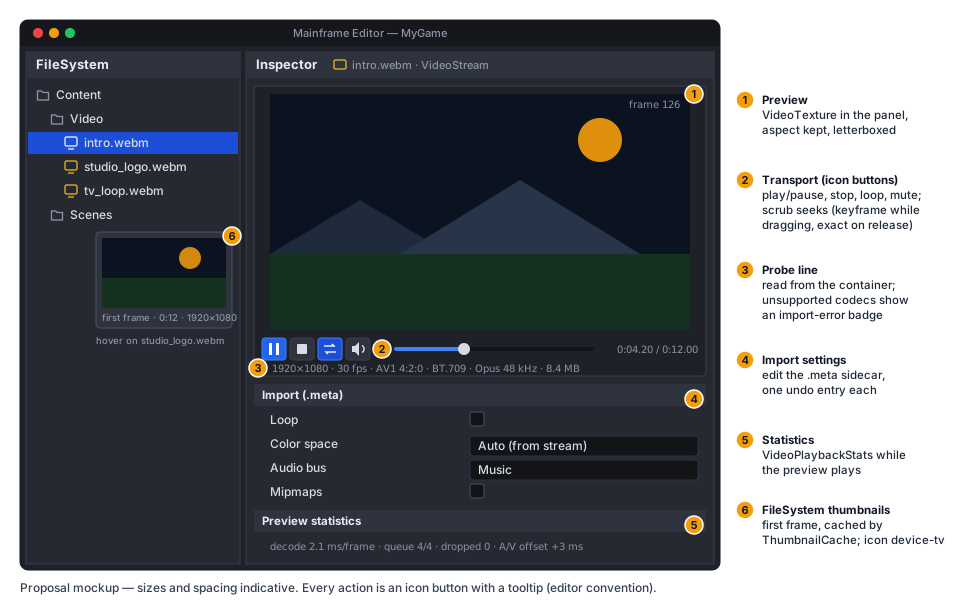
VideoImporter(video) registers the chosen codec’s extensions plus.y4m..metasettings:{"importer": "video", "settings": {"loop": false, "colorSpace": "auto", "range": "auto", "audioBus": "Music", "mipmaps": false}}. The probe runs at import; an unsupported codec inside a known container sets the FileSystem’sImportErrorbadge with the reason (“VP8 is not supported; re-encode as …”). - FileSystem.
FileKind.Video, icondevice-tv(added toContent/icons/icons.txt;videois Camera3D’s). The first frame becomes aThumbnailCacheentry through the CPU reference converter (tools only; playback never converts on the CPU). Play/Stop in the context menu as for audio. - Inspector.
VideoStreamInspector([CustomInspector(typeof(VideoStream))],IWorkspaceInspector): preview, icon-button transport with tooltips, scrubber (keyframe seeks while dragging, exact on release), probe line, import settings (one undo entry each) and live statistics. The preview plays on the editor’s ownAudioServerthrough a hiddenVideoPlayerthe workspace owns; it stops on selection change and before code reload.
Export and packaging
Section titled “Export and packaging”- Videos ship through the preset’s
includeglobs like anyContent/file (Game export). Archives store already-compressed video without deflate (CompressionLevel.NoCompressionby extension). - Validation (
ExportIssue):video-source-format(a.mov/.mp4/.y4munderContent/that the game cannot play: warning, with anexcludefix),video-large(over 200 MB: warning about Steam patch sizes). - A native decoder ships in
MainframeEngine/runtimes/<rid>/nativelikemfrmlui; its licence text joinsTHIRD_PARTY_NOTICES.mdand the credits list. Mobile and console builds link it statically (mobile.md, consoles.md).
Codec and decoder (the decision)
Section titled “Codec and decoder (the decision)”The pipeline above is codec-neutral (4:2:0 planes in, RGB out). The decoder is a dependency choice for the user. Sizes are approximate and need measuring in the spike; ⚠ marks claims to verify.
| Option | Code licence | Patents / royalties | Added size | Platforms (now → M12 → consoles) | Effort |
|---|---|---|---|---|---|
| A. AV1 via dav1d (+ libopus), WebM | BSD-2 (dav1d), BSD-3 (libopus) | AOMedia royalty-free licence; ⚠ Sisvel runs an AV1 pool aimed mainly at device makers | ~1–2 MB per arch with assembly | C99 + asm (SSE/AVX2, NEON): desktop, Android/iOS (Android itself uses dav1d ⚠), consoles as plain C | Medium: dav1d builds with Meson + nasm (our natives are CMake/Ninja), WebM demux |
| B. VP9 via libvpx, WebM | BSD-3 | Google’s royalty-free grant | ~1–2 MB decoder-only ⚠ | Everywhere; broad hardware VP9 on Android | Medium: configure/make build, yasm/nasm |
| C. Theora + Vorbis, Ogg (libtheora, libogg) | BSD-3 | VP3 patents granted royalty-free by On2 | ~0.3 MB | Everywhere, plain C; Godot’s only built-in format; FNA’s Theorafile (zlib) is a precedent | Low: CMake-friendly, libogg already a submodule |
| D. MPEG-1 + MP2 via a C# port of pl_mpeg | MIT | Expired | ~0.1 MB IL, no natives | Everywhere .NET runs, NativeAOT and consoles on day one | Medium: port ~4k lines, SIMD for IDCT/motion compensation |
| E. Platform decoders: Media Foundation, AVFoundation/VideoToolbox, MediaCodec; Linux via VA-API/GStreamer | OS | The OS vendor’s licences cover H.264/HEVC ⚠ (Windows N lacks codecs without the Media Feature Pack) | 0 | Hardware decode, best battery; Linux has no single API; consoles via NDA SDKs | High: four backends, NV12 GPU interop to avoid readbacks |
| F. FFmpeg (libavcodec/libavformat) | LGPL-2.1+ (GPL if GPL parts enabled) | Per enabled codec; shipping an H.264/HEVC decoder exposes the distributor | 2–5 MB minimal custom build; tens of MB full | Desktop and mobile; LGPL relinking obligations clash with static linking on consoles and iOS | Medium build, ongoing licence compliance |
| G. Bink 2 (RAD/Epic) | Commercial, per title | Covered by the licence | Vendor’s | Standard on consoles | Game-supplied: plugs into IVideoDecoder, never an engine default |
Notes:
- Quality per bit, roughly: AV1 > VP9 > H.264 > Theora ≈ MPEG-4 Part 2 > MPEG-1. A 1080p cutscene at good quality is a few Mbit/s in AV1 and several times that in Theora or MPEG-1, which matters for download size.
- Decode cost: dav1d plays 1080p60 on a few desktop cores and 1080p30 on mid-range phones ⚠; Theora and MPEG-1 are cheaper per pixel but need more bits. Platform decoders use fixed-function hardware.
- Audio: WebM pairs with Opus (libopus native, or the managed Concentus port — a new NuGet package) or Vorbis (NVorbis, if its packet API can take Matroska frames ⚠ spike). Ogg Theora pairs with Vorbis, which NVorbis already decodes from Ogg. MPEG-1 pairs with MP2 (in the pl_mpeg port).
- Demux: WebM is a small Matroska subset; a managed EBML reader (~600 lines) avoids a C++ libwebm dependency.
- Authoring:
ffmpeg -i in.mov -c:v libsvtav1 -crf 35 -g 120 -pix_fmt yuv420p -c:a libopus -b:a 128k out.webm(A);-c:v libtheora -q:v 7 -c:a libvorbis out.ogv(C);-c:v mpeg1video -q:v 4 -c:a mp2 out.mpg(D). A keyframe every 2–4 s keeps seeks and loops fast.
Recommended default (needs approval): A, AV1 via dav1d with Opus in WebM, in one new native shim mfvideo
(dav1d + libopus, C ABI, built in natives.yml, static for iOS and consoles), with a managed WebM demuxer. Reasons:
the best quality per bit, permissive licences with no relinking duty, a royalty-free codec, one decoder for every
platform including consoles, and a codec with a future (hardware AV1 decode is spreading). Platform decoders (E) can
follow as optional IVideoDecoder backends for battery on M12, behind the same seam. If the user prefers minimal
native work, C (Theora) is the low-effort fallback; D is the no-native fallback. Until the decision, G16.1–G16.4
build and test everything on .y4m.
Vulkan Video (future)
Section titled “Vulkan Video (future)”VK_KHR_video_decode_queue with H.264/H.265 (2022) and AV1 (2024) profiles decodes on the GPU straight into images,
which would remove the upload. It needs a decode-capable queue family, our own bitstream header parsing and DPB
management, and it is unavailable on MoltenVK and lavapipe; the engine targets Vulkan 1.2. It could become an
IVideoDecoder backend on Windows/Linux/Android after M11, which brings D3D12 Video for the same role. Not planned.
Testing
Section titled “Testing”- Unit (
Tests/MainframeEngine.Tests/Video/), on tiny.y4mfixtures (64×36, 30 frames, a frame counter pattern; a few tens of KB, generated by a test helper rather than committed where possible):Y4mDemuxer: header parsing (rates, 4:2:0, colour tags), seeking, truncated files →Failed.VideoFrameQueue/VideoFramePool: SPSC ordering under stress, buffers return only after their GPU frame, worker blocks when full and the main thread never does.- Clock and selection with a fake clock: drop counting, late skip, preroll, pause, seek (exact/keyframe), loop pts
offset and
Looped,Finishedonce,StopwithoutFinished. - Audio: the
Manualnull device drivesFramesConsumed; A/V offset stays within one audio block; tree pause pauses both; bus mute; voice starvation falls back to game time. - Headless:
HeadlessHostplays a stream, decodes no video, firesFinishedon time. - CPU reference YUV → RGB (thumbnails) against known values for BT.601/709 and both ranges.
- Allocation gate:
VideoServer.Process,VideoPlayerprocessing and the render path, steady state.
- Codec (after the decision): conformance clips from the codec’s test suite decode bit-exact (decoder output
planes hashed); a WebM/Ogg demux test set (lacing, unknown-size clusters, missing cues); a benchmark
(
Tests/MainframeEngine.Benchmarks) of 1080p decode per frame againstbaseline.json. - Render tests (goldens per driver,
just golden-update):video-yuv-bt709(colour bars in both ranges through the shader),video-sprite2d,video-material3d(a screen in a lit scene, sRGB view),video-rmlui(engine://letterboxed), all seeking to a fixed frame under--fixed-fps. Validation gate stays at zero warnings. - UI (
SerialRmlUi):Cutscenehold-to-skip with synthetic Escape and gamepad B,Trprompt inqps. - Editor: importer and
.metaround trip,FileKind.Video, thumbnail generation, inspector bind and undo; QA step inTests/QA/editor-walkthrough.qa(select a video, play, scrub, stop). - Demo: a
videoscene (a TV in 3D, a 2D sprite, an RmlUi panel, a cutscene button);Demo.TestschecksFinished;just demo-screenshotsaddsvideo.png.
Acceptance
Section titled “Acceptance”- A game plays a video full screen with one call (
Cutscene.Play) and on a 3D material, aSprite2Dand an RmlUi element through the sameVideoTexture; play, pause, seek, loop,Finishedand skip behave as specified. - Audio plays on its bus, obeys tree pause, mutes and user volume, and stays within 40 ms of the picture (one audio block plus a frame at 30 fps), measured by the stats on a 10-minute clip.
- The game thread allocates nothing per frame during playback; colour conversion runs only in the shader; zero validation warnings on MoltenVK and lavapipe.
- Intro videos from
project.mfprojplay while the start scene loads. - The editor imports video files, shows thumbnails and previews them in the inspector.
- The chosen codec builds for win-x64, linux-x64 and osx (universal) in
natives.ymlwithnatives.lockprovenance and notices; a 1080p30 clip plays without drops on the CI baseline machines. just build, Release build,just test,just test-render,just format-check,just shaders-checkpass.- Docs updated when it ships: a new
docs/design/video.md;audio.md(video voices),gpu-resources.md(CopyBufferToImage, external textures),game-ui.md(engine://video,Cutscene),materials-and-meshes.md(external textures),asset-pipeline.md(thevideoimporter),natives.md(mfvideo),project-and-gamehost.md(loading.intro),editor.md,demo.md,future/game-export.md(validation codes).
Task list
Section titled “Task list”- G16.1 Core and seam:
VideoStream,VideoInfo, importer,IVideoDemuxer/IVideoDecoder,Y4mDemuxer, worker,VideoFramePool(CPU flavour),VideoFrameQueue,VideoServer(registration inEngineandHeadlessHost),VideoPlayerwith the game-time clock, signals; unit tests + allocation gate. - G16.2 GPU path:
VideoTexture, mapped staging pool,UploadQueue.CopyBufferToImage,R16_UNORMinFormatInfo,VideoRenderer,VideoYuv.vk.frag.slang(+.spv,shaders.lock), conversion inRenderOffscreen, canvas branch; goldensvideo-yuv-bt709,video-sprite2d. - G16.3 Other consumers: external textures in
MeshRenderer(shared with G11),UiServer.RegisterTextureoverload, optional mips; goldensvideo-material3d,video-rmlui. - G16.4 Audio and sync:
VideoAudioSourceon a bus,IAudioVoiceOwner, audio master clock, preroll, seek and loop with audio, stats, starvation fallback; tests on theManualnull device. - G16.5 Codec spike and decision: measure sizes, speed and build effort of the approved option(s); record an ADR.
- G16.6 Codec: the approved decoder and demuxer (e.g.
Native/Videoshimmfvideoover dav1d + libopus,natives.yml,natives.lock, notices; managed WebM demuxer); conformance tests, benchmark, LFS pattern. - G16.7 Cutscenes and intros:
Cutscene+Content/UI/video/cutscene.rml, hold-to-skip,Trstrings,loading.intro/introSkippable,GameHostOptions.SkipIntro; UI tests. - G16.8 Editor:
FileKind.Video,device-tvicon, thumbnails,VideoStreamInspector, FileSystem Play/Stop, import-error reasons; editor tests, QA step. - G16.9 Demo, export, docs: Demo
videoscene and test, export validation codes and stored compression, design docvideo.mdand the updates listed in Acceptance.
Open questions
Section titled “Open questions”- Codec and decoder (blocking G16.6). Approve A (AV1/dav1d + Opus, WebM, native
mfvideo), or choose B–F. G is always game-supplied. Should platform decoders (E) be planned for M12 regardless? - Audio codec for WebM. libopus inside
mfvideo, the managed Concentus (a new NuGet package), or require Vorbis in WebM and feed NVorbis packets (needs a spike on NVorbis’ packet-provider API)? - Building dav1d. Add Meson and nasm to
natives.ymlandNative/build.sh, or maintain a CMake build of dav1d’s sources (as some ports do) to keep one toolchain? - Patent risk tolerance. Is the Sisvel AV1 pool acceptable for a game engine shipping a software decoder, or does the user want only codecs with expired patents (C/D)?
- Thumbnails and preview colour. Is the CPU reference converter for editor thumbnails acceptable, or should the editor render thumbnails on the GPU (exact match with the game, more code)?
- 10-bit. Support 10-bit 4:2:0 (AV1/VP9 profile 2) in G16, or 8-bit only until HDR output exists?
- Video on loading screens. Should
LoadingScreendocuments be allowed to bind a looping video background, or isloading.introenough? - Intro skipping rules. Skippable on first launch too, or only after the game has run once (a common platform
expectation for logos)? This would need G4’s
UserSettings.
Related
Section titled “Related”- Audio: streaming thread,
AudioStreamGenerator, buses, voices - GPU resources: allocator, upload and deletion queues
- Color pipeline: sRGB vs linear views; Shaders: Slang rules
- Game UI:
UiLayer,engine://textures, data models; Localization:Tr - Asset pipeline: importers,
.meta; Native libraries: shims, CI, licences - Project and GameHost:
loadingsection, headless host - Gameplay toolkit siblings: Game export (G5), Save games and settings (G4: user volume), World-space UI (G11: external textures), Haptics and input glyphs (G12: skip glyph), Accessibility (G14: captions)
- Mobile core (M12), Consoles, Rendering backend abstraction (M11: D3D12 Video, WebGPU)