
Proposal: Forest visual quality (the Unreal look: probe GI, soft shadows, volumetric light, cinematic post, Ez Tree foliage, water, art, upscaling)
Milestone: Gameplay toolkit (G8e) · Status: ⬜ planned ·
Depends on: Forest showcase (G8d; current state in forest.md); ADR 0163 (the
post-processing system: PostEffect stages AfterPrepass / BeforeTonemap / AfterTonemap, SceneTextures, the
depth prepass, motion vectors and projection jitter); SSAO/GTAO (G6.6) and TAA
(G8d.8), both now on Vulkan ahead of M11; Procedural trees
(G8b: TreeImpostor); Water (G8c: refraction, SSR, falls) · Related:
Rendering features (G6.3 particles, G6.4 LOD), Terrain (G8a),
Rendering backend abstraction (M11: compute), ADR 0149,
ADR 0164
Problem
Section titled “Problem”Brogan, 2026-10-08: “I want the forest level to look like it was made in Unreal Engine.” The slice
(forest.md) is playable and its five reference shots
(docs/images/forest/r1-glade.png … r5-floor.png) show where it falls short:
- Flat shade. Indirect light is the sky’s irradiance looked up by normal only
(
MainframeEngine/Content/Shaders/include/environment.slang:20), times material AO (MainframeEngine/Content/Shaders/include/lights.slang:175). Nothing knows that a point under a pine canopy sees a tenth of the sky an open glade sees, so the Forest raisesAmbientEnergyto 1.6 to keep the shade readable (Examples/Forest/Forest/Src/World/ForestScene.cs:79, “no GI”). R1 and R5: shade under the canopy is as bright and as blue as shade in the open; trunk bases and boulders do not ground (R2’s rocks float). - Short, hard-edged sun shadows. The Forest affords 2 × 1024² cascades to 60 m (
ForestScene.cs:46-48) because alpha-tested leaves make every cascade texel expensive (procedural-trees.md → Cost). The filter is a fixed-radius Poisson disc (include/shadows.slang:53,:96), so leaf shadows 20 m below the canopy are as sharp as a trunk’s at its base. Past 60 m nothing casts: R4’s far slopes are evenly lit, and the ridges never shadow the valley under a 21° sun. - Light shafts only from visible sky. The shafts are a screen-space radial blur of sky pixels near the sun
(
MainframeEngine/Src/Rendering/Post/LightShafts.cs:60, color-pipeline.md → Light shafts): they vanish when the sun leaves the screen, cannot be lit or shadowed in the air between trunks, and read as a milky veil in R1. The fog is analytic and unshadowed (include/fog.slang). - A plain post chain.
Tonemapperis the engine’s ACES fit or Godot’s ACES (MainframeEngine/Src/Rendering/Post/PostProcessSettings.cs:4); there is no LUT, depth of field, vignette or grain, and the glow’s first level has no anti-flicker filter. - Leaf cards. Ez Tree emits one or two crossed quads per leaf from one leaf PNG
(
MainframeEngine/Src/Trees/Generation/TreeParams.cs:114,TreeGenerator.cs:630): a canopy of thousands of identical cards, visibly so at 10–40 m (R1, R4). Wind is a per-leaf flutter plus a translation downwind weighted by height (include/wind.slang:117-121): no trunk sway, no branch rotation. Translucency is a view-dependent back-light with no thickness (Foliage/Foliage.vk.frag.slang:44). Mips are box-filtered blits (Rendering/Resources/Texture2D.cs:48), so alpha coverage drops with distance and canopies speckle. No impostors yet (procedural-trees.md → TreeScatter); four species. - Water and the fall. No refraction or SSR (water.md → Not yet): the pond reflects only the
sky (R4).
River3Dhas no falls (MainframeEngine/Src/Scene/Nodes3D/Water/River3D.cs:16): R2’s fall is a steep, tiled ribbon without spray. - Art. Props meet the terrain at a hard seam (R2 boulders, R3 log); ground clutter is one stone and one fern; there is no grade.
- No headroom. At 2560 × 1440 the slice already runs p50 18.4 ms on an Apple M5 (forest.md → Performance), over the 16.7 ms frame before any of the above.
The engine has no compute pipelines (MainframeEngine/Src/Rendering/Vulkan/PipelineCache.cs:74 only mentions them), no
3D textures and no MSAA (MainframeEngine/Src/Rendering/Vulkan/RenderTarget.cs:254). Every design below works within
that.
- The eight phases Brogan approved (ADR 0164), in order: G8e.1 baked sky occlusion and bounce (
LightProbeVolume) with GTAO, G8e.2 shadow quality, G8e.3 volumetric light, G8e.4 cinematic post, G8e.5 Ez Tree foliage extensions, G8e.6 water, G8e.7 an art pass, G8e.8 TAA upscaling. - 60 fps at 2560 × 1440 output on an Apple M-series Pro (MoltenVK) and an RTX 3060 with every phase on, 0 B per frame, validation clean.
- Reference-shot criteria per phase (Acceptance), signed off by Brogan next to Unreal sample scenes.
- Godot names for settings where Godot has the feature; everything off by default, so existing scenes and goldens do not change.
Non-goals
Section titled “Non-goals”- Lumen, Nanite, virtual shadow maps, hardware ray tracing, MegaLights. See Honest limits.
- Dynamic GI (DDGI, SSGI, VoxelGI/SDFGI) and a day-night cycle; the bake supports one sun direction.
- Compute. Froxel fog, FSR 2/3 and GPU culling wait for M11’s compute.
- DLSS, XeSS and MetalFX (G8e.8); HDR display output; clouds; tessellation or displacement.
- Quixel Megascans content (licensing).
The Unreal look, technique by technique
Section titled “The Unreal look, technique by technique”| Unreal technique | What it does for a forest | Our equivalent | Phase |
|---|---|---|---|
| Lumen GI, or Volumetric Lightmap + sky light occlusion (UE4) | dark, green-brown shade under the canopy; bright glades; bounce off sunlit ground | LightProbeVolume: baked SH L1 bounce + sky visibility, terrain-following | G8e.1 |
| GTAO with bent normals, specular occlusion | trunks and rocks ground themselves; no sky glare in crevices | lane S GTAO + bent normals, combined with the probes | G8e.1 |
| Cascaded shadows with caching, far cascades | crisp near, stable far, without the cost | staggered cascade updates, 4 × 2048² to 140 m | G8e.2 |
| Source-angle soft shadows (contact hardening) | dappled light: leaf shadows soften with distance | PCSS from LightAngularDistance | G8e.2 |
| Screen-space contact shadows | grass, pebbles, the gap under a log | march in the prepass depth | G8e.2 |
| Distance-field / heightfield shadows | ridges shadow the valley far away | static far-shadow atlas tile (terrain + canopy) | G8e.2 |
| Volumetric fog with shadowed sun | shafts in the air between trunks, from any view | ½-res ray march of the cascades, temporal | G8e.3 |
| Post Process Volume: filmic tonemap, LUT, bloom, DoF, vignette, grain, fringe | the film look | AgX/ACES, .cube LUT, HQ glow, bokeh DoF, film effects | G8e.4 |
| SpeedTree: frond clusters, hierarchical wind, subsurface leaves, LOD dither, billboards | dense, soft canopies that move as one tree | Ez Tree + cluster cards, pivot wind, thickness maps, dither fades, TreeImpostor | G8e.5 |
| Single Layer Water, SSR, caustics; Niagara falls | pools that show the bed and the trees | SceneTextures refraction + SSR, caustics, falls + spray | G8e.6 |
| Megascans + Runtime Virtual Texture blending | scanned clutter that sits in the ground | CC0 scans, terrain macro texture (RVT-lite) | G8e.7 |
| TSR / TAAU | 1440p from a 1080p render | TAAU in the TAA resolve; FSR 1 fallback | G8e.8 |
| Lumen reflections | reflections of the forest in everything | not provided: SSR on water; sky IBL × probe visibility elsewhere | — |
| Nanite, virtual shadow maps | unlimited geometry and shadow detail | not provided: LODs, impostors, cached CSM | — |
Honest limits
Section titled “Honest limits”- No Lumen. Lumen traces software distance fields and screen space every frame, with compute, for fully dynamic GI and reflections. That needs compute, a GPU scene representation and a denoiser; the engine has none of them before M11. G8e.1 is static: move the sun far, or move a boulder, and the bake is stale.
- No Nanite, VSM or hardware ray tracing. Geometry stays LOD chains and impostors; shadows stay cascades.
- Why static is fine here. The valley is static: terrain, rocks and trees never move, and wind displaces leaves by centimetres, well below the 2 m probe spacing. There is one sun at a fixed morning angle. What GI adds to a forest is low-frequency: sky occlusion under the canopy and green-brown bounce, which is what a probe volume stores. Fine occlusion comes from GTAO and contact shadows every frame. UE4-era forests were lit this way (static lighting with a Volumetric Lightmap for movable objects).
- The honest gap is local reflections (water only) and indirect light at under 2 m (GTAO’s screen-space radius).
Design
Section titled “Design”Budget and order
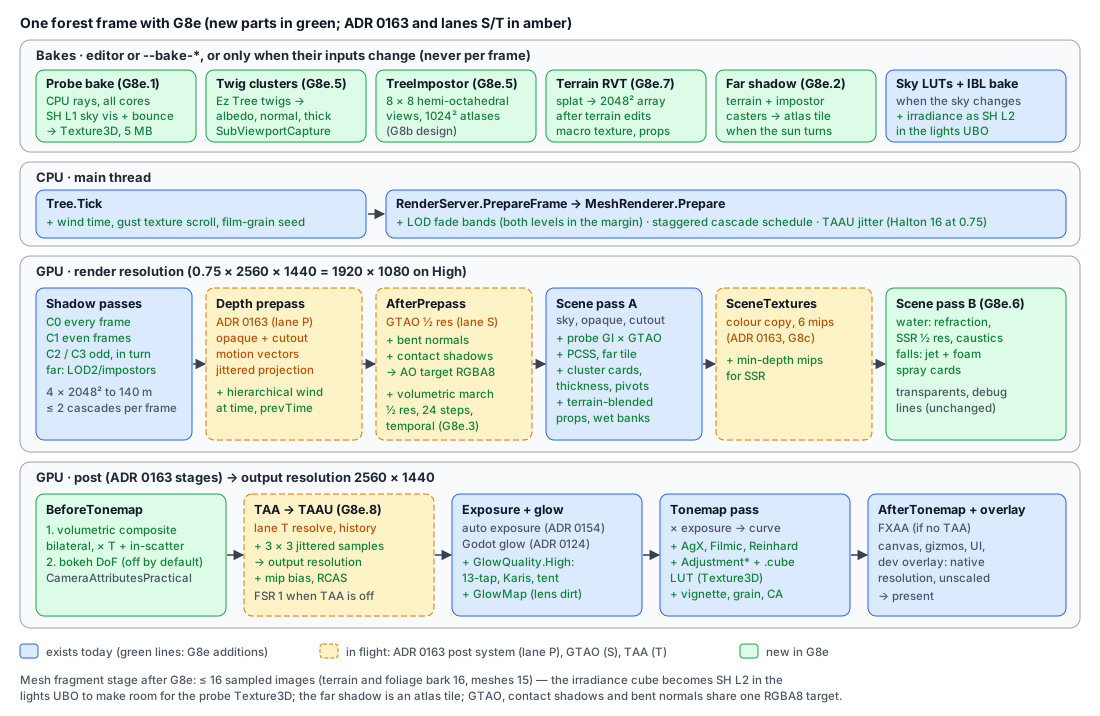
Section titled “Budget and order”- Target: 2560 × 1440 output, 60 fps: p50 ≤ 14 ms GPU, p99 ≤ 16.7 ms frame, on an M-series Pro and an RTX 3060. The scene renders at 0.75 scale (1920 × 1080) and G8e.8 upscales; 1.0 scale is the “native” option.
- Order and waves (progress log): W5 = G8e.2, G8e.4 (with lanes S and T); W6 = G8e.1, G8e.3, G8e.5, G8e.6; W7 = G8e.8, G8e.7. G8e.8 lands last but its budget is assumed throughout.
- Root world only for post (volumetrics, DoF, TAAU), as today. Probes, shadows, foliage and water are forward shading and work in every view, including the editor viewport.
GPU frame at High (ms at 1440p output, 1920 × 1080 internal; estimates: the slice’s M5 measurements × ≈ 0.6 for a Pro-class GPU; each phase measures its own on both machines):
| Pass | ms | Pass | ms |
|---|---|---|---|
| Slice today at 1080p, minus its shadows, shafts and FXAA | 6.4 | G8e.3 volumetric march + temporal + composite | 0.9 |
| Depth prepass + motion vectors (ADR 0163) | 1.0 | G8e.4 HQ glow, LUT, film effects (DoF off) | 0.3 |
| Prepass reuse in the scene pass (equal test, no cutout discard) | −1.2 | G8e.5 cluster cards and impostors (fewer, larger cards) | −0.8 |
| GTAO + bent normals (S) + contact shadows | 0.8 | G8e.5 hierarchical wind (vertex) | 0.2 |
| G8e.1 probe sampling + combine | 0.3 | G8e.6 colour copy, refraction, SSR ½ res, caustics | 0.8 |
| G8e.2 shadows: staggered 4 × 2048² to 140 m + PCSS | 2.2 | G8e.7 clutter, density, terrain blend | 0.8 |
| G8e.2 far shadow tile (only when the sun moves) | 0 | G8e.8 TAAU resolve + RCAS (replaces TAA) | 0.7 |
| Total | ≈ 12.4 (≈ 4 ms headroom to 16.7) |
Medium (1920 × 1080 output at 0.75, base M-series): volumetric ¼ res and 12 steps, 3 cascades × 1024², no SSR, no PCSS, probes and GTAO kept. Memory added at High: probes 5 MB, cascades 64 MiB (was 8), far tile 16 MiB, cluster atlases ≈ 120 MiB (7 species × 3 maps × 1024² with mips), impostors ≈ 150 MiB, terrain macro 32 MiB, volumetric 16 MiB, TAAU history 59 MiB: ≈ 0.45 GiB, within G8d’s 2 GiB.
Binding budget
Section titled “Binding budget”The mesh fragment stage stays within 16 sampled images and 16 samplers (G6 → Binding budget):
| Fragment stage | Today | After G8e |
|---|---|---|
| Shadows (set 1): cascades, atlas, 4 point cubes | 6 | 6; the cascade array becomes a separate image with a comparison and a point sampler (PCSS’s blocker search), so +1 sampler, no image |
| Material (set 2): albedo, normal, emission, ORM (terrain: 3 arrays + 2 weight maps) | 4 (5) | 4 (5); foliage bark adds a detail array at b6 (5) |
| Frame (set 0): radiance, irradiance, BRDF LUT | 3 | radiance, BRDF LUT, AO (S), probes, terrain macro = 5: the irradiance cube becomes SH L2 in the lights UBO (G8e.1) |
| Worst case | 14 (terrain) | 16 (terrain, foliage bark); meshes 15 |
New per-view data goes into set 0, as G6 decided; set 3 stays free for skinning.
G8e.1 Sky occlusion and bounce light: LightProbeVolume
Section titled “G8e.1 Sky occlusion and bounce light: LightProbeVolume”Choice
Section titled “Choice”| Option | What it gives | Needs | Verdict |
|---|---|---|---|
| DDGI (probe grid updated by ray tracing every frame) | dynamic GI, moving sun | ray tracing or compute ray marching per probe, per frame | no: the engine has neither before M11. The probe layout below keeps the door open |
| SSGI | bounce from what is on screen | prepass, TAA, a denoiser | no: the canopy that occludes the sky is mostly above or behind the camera, off screen; noisy in foliage |
| Lightmaps | sharp static GI on surfaces | a second UV set, per-object texels, a GPU or CPU bake | no: 1 500 instanced, swaying trees and 250k grass instances cannot have lightmaps; the terrain would be the only receiver |
| Baked probe volume | low-frequency sky occlusion and bounce for every receiver, static or moving | a CPU bake, one 3D texture, a few fetches per pixel | chosen |
What a probe stores
Section titled “What a probe stores”Per probe, 16 numbers in four RGBA16F texels (32 B):
- Sky visibility, SH L1 (4 scalars): the fraction of the sky seen in each direction, through the canopy’s transmittance. Shading convolves it with the cosine lobe at N for a visibility in [0, 1], and its linear band gives the probe’s bent direction. Stored apart from the sky’s colour, so a new HDRI or turbidity needs no re-bake.
- Bounce irradiance, SH L1 RGB (12 scalars): light that reached the probe after at least one bounce (sun and sky off terrain, bark, leaves, rocks and water), multi-bounce. It depends on the sun’s direction.
A fifth slab per column holds the ground height (terrain-following layout) and the probe’s validity (bake only).
Layout and node
Section titled “Layout and node”public enum ProbeLayout { Box, TerrainFollowing }
public partial class LightProbeVolume : Node3D // the first visible one in a world is used{ [Export] public Vector3 Size { get; set; } = new(32, 16, 32); // Box: extents around the node [Export] public ProbeLayout Layout { get; set; } = ProbeLayout.Box; [Export] public Vector3 ProbeSpacing { get; set; } = new(2, 2, 2); // m; Y ignored by TerrainFollowing [Export] public float[] LayerHeights { get; set; } = [0.3f, 1.2f, 2.5f, 4.5f, 7.5f, 12, 18, 27]; // m above ground [Export] public NodePath Terrain { get; set; } // TerrainFollowing [Export] public int RaysPerProbe { get; set; } = 256; [Export] public int Bounces { get; set; } = 3; [Export] public float Energy { get; set; } = 1f; // scales bounce (art control) [Export] public LightProbeData? Data { get; set; } // the bake (.mres + .probes binary) public BakeResult Bake(IProgress<float>? progress = null, CancellationToken ct = default); // CPU, all cores}- TerrainFollowing (the Forest): an XZ grid at 2 m over the terrain and
LayerHeightsabove the ground under each column, denser near the ground where receivers are. 256 m → 129 × 129 × 8 = 133k probes, 5.3 MB. A box grid at 2 m up to the canopy would be 666k probes (21 MB) with most of them in the air or the ridges. - Box for anything else (interiors, props scenes): a regular grid.
- Texture: a new
Texture3Dresource (Godot’s name;R16G16B16A16_SFLOAT, no mips): X × (5 · layers) × Z, the five slabs stacked along Y (≤ 2048 per axis, Vulkan’s minimummaxImageDimension3D). Sampling clamps Y to the slab’s texel centres, so hardware trilinear never blends two slabs. Volume transform and layer table go inFrameData(+48 B). GeometryInstance3D.GIMode(Godot:Disabled,Static,Dynamic; defaultStaticfor meshes and terrain,Disabledfor grass):Staticinstances occlude and bounce in the bake; every lit surface, includingDynamicones, samples the probes.
The bake (CPU)
Section titled “The bake (CPU)”ProbeBaker (MainframeEngine/Src/Lighting/Probes/), Parallel.For over probe columns, deterministic for a seed. The
scene becomes ray-traceable proxies through IProbeBakeProxy:
| Source | Proxy | Albedo |
|---|---|---|
Terrain3D | the height field with a min-max mip pyramid (quadtree DDA) | splat layers’ mean colours × weights per cell |
Tree3D, TreeScatter | branches from TreeSkeleton as tapered capsules (BVH); leaves as a 0.5 m leaf-area-density grid per variant, crossed with Beer–Lambert transmittance (G = 0.5) | bark and leaf texture means; leaf transmission 0.15 |
meshes with GIMode.Static | their coarsest LOD’s triangles (BVH) | the albedo texture’s mean × colour |
| water | its plane | 0.05 |
Per probe, RaysPerProbe Fibonacci directions with a per-probe rotation:
- Trace each ray to its first hit, through canopy cells with stochastic leaf events; a miss adds its transmittance to sky visibility. At a hit, one shadow ray to the sun (through the canopy) is cached with the hit’s position, normal and albedo.
- Bounce iteration k: radiance at a hit = albedo / π × (sun irradiance × cached sun visibility × N·L + sky irradiance × visibility of iteration k−1’s nearest probe + bounce of iteration k−1’s nearest probe). Iterations 2 and 3 reuse the cached hits, so they cost probe lookups, not rays.
- Validity and leaks: a probe whose rays hit back faces more than 25 % of the time is inside geometry (a boulder, a trunk) and is replaced by its valid neighbours’ average (dilation), so hardware trilinear needs no per-probe weights. A 3 × 3 × 3 blur over valid probes removes ray noise.
Bake time (estimate, 10–12-core M-series Pro): 34M primary + 34M shadow rays at ≈ 4M rays/s/core: ≈ 2–10 s, plus
proxy build ≈ 1 s. Target ≤ 60 s. Storage: LightProbeData (.mres header with a BakeHash of the inputs, plus a
.probes fp16 blob in LFS).
Editor: a Bake Lighting button on LightProbeVolume (progress, cancel), a probe debug view (spheres showing the
SH, invalid probes red) and an “indirect only” view mode. Headless: --bake-lighting <scene>. The Forest generates its
valley at load, so ForestValley hashes its inputs (ValleyLayout, seed, generator versions); a stale or missing bake
logs one warning and the scene renders with today’s sky-only ambient.
Shading
Section titled “Shading”include/probes.slang (+ include/indirect.slang for the combine), called by every lit shader before fog:
ProbeSample p = sampleProbes(worldPos + Ngeo * 0.3 * spacing + V * 0.1); // 5 fetches: ground height + 4 slabsfloat skyVis = p.skyVisibility(N); // cosine-convolved SH L1, 0..1float3 bentN = normalize(N + p.bentDirection() * 0.5 + gtaoBentNormal);float ao = multiBounceAo(min(gtaoAo, s.ao), s.albedo); // Jimenez 2016 fitfloat3 diffuse = (skyIrradiance(bentN) * skyVis + p.bounce(N) * probeEnergy) * ao;float specOcc = specularOcclusion(skyVis, gtaoBentCone, R, roughness); // cone–cone, Jimenez 2016float3 specular = iblSpecular(R, roughness) * envBrdf * specOcc;- GTAO (lane S) writes AO and a view-space bent normal; G8e.1 widens its target to RGBA8 (R AO, G contact shadow from G8e.2, BA bent normal, octahedral). GTAO is the small scale (< 2 m), the probes the large one; the multi-bounce fit keeps bright leaves and moss from going grey.
- Specular occlusion fixes the second half of the flat look: wet rock and the water under trees no longer reflect the full bright sky.
- Wind-animated foliage samples at its swayed fragment position, so a moving leaf slides through a smooth field; the
bake uses the rest pose, and the sway (≤ 0.35 m) is far below the spacing. Leaves sample twice from the same fetches,
at N and −N: the −N side lights their translucency (G8e.5), so a sunless canopy still glows green from below.
Custom0.w’s ellipsoid canopy AO drops toCanopyAoStrength0.4: the probes now carry canopy occlusion. Impostors sample at their reconstructed fragment position. Particles and butterflies sample at their centre. - No volume, or a stale bake:
sampleProbesreturns visibility 1 and no bounce, which is today’s frame exactly.
Sky irradiance as SH
Section titled “Sky irradiance as SH”The 32² irradiance cube (sky.md → Image-based lighting) becomes nine SH L2 RGB
coefficients (112 B) in the lights UBO, projected by the IBL bake into a 9 × 1 target, read back when its frame slot
comes round (as the shadow timestamps are; no stall) and written into the UBO by the CPU; until then the previous
coefficients stay. L2
matches a cosine-convolved sky within ≈ 2 % (Ramamoorthi and Hanrahan 2001). It frees a set-0 image for the probes, and
skyIrradiance(bentN) becomes 9 multiply-adds.
Cost: ≈ 0.3 ms at 1080p internal (5 fetches, ≈ 60 ALU). MoltenVK: 3D textures are core. Mobile: the
probes are cheaper than SSAO; rendering.probes = Off on Low.
G8e.2 Shadow quality
Section titled “G8e.2 Shadow quality”Today: 2 × 1024² cascades to 60 m, 2.0 ms GPU on an M5 at 1080p. The cost is cascades × resolution² × canopy overdraw, redrawn every frame.
Setting (DirectionalLight3D) | Default | Forest | Notes |
|---|---|---|---|
ShadowCacheMode | Off | Staggered | engine name; Godot has none |
ShadowCascades, ShadowResolution, ShadowMaxDistance | 4, 2048, 100 | 4, 2048, 140 m | |
LightAngularDistance | 0 | 0.5° | Godot’s light_angular_distance; > 0 enables PCSS on High |
ContactShadows, ContactShadowLength | false, 0.5 m | true, 0.4 m | G8d.7’s design |
FarShadowEnabled, FarShadowDistance, FarShadowResolution | false, 0 (= the terrain’s bounds), 2048 | true | engine names |
- Staggered cascades. Cascade 0 renders every frame; cascade 1 on even frames; cascades 2 and 3 on alternate odd
frames (60 / 30 / 15 / 15 Hz). At most two cascade passes per frame, so there is no spike. Each cascade is sampled
with the matrix it was rendered with (already per cascade in
ShadowUBO), and its fitted sphere grows by the camera’s maximum travel in its interval (10 m/s × 4 frames = 0.7 m) so a stale cascade still covers its slice. Wind in a 4-frame-old cascade lags 67 ms: invisible at 30 m. A camera cut re-renders all four. - Coarse casters far away. Cascades 2–3 draw trees at LOD2 or their impostor caster (G8e.5):
TreeScatter’sShadowMaxLodper cascade instead of per scatter. - PCSS as G8d.5 designs it: a 16-tap blocker search
through the new point sampler, penumbra
(dReceiver − dBlocker) · tan(angle)in texels, then the Poisson filter at that radius (clamped to [FilterRadius, 8 texels], and to the next cascade’s texel size at a blend). With TAA on, the Poisson pattern rotates per pixel and per frame (interleaved gradient noise), so 8 search + 12 filter taps converge like 16 + 16; without TAA it stays fixed (no crawl, ADR 0072). Leaf shadows 20 m down blur into dapples; trunk bases stay sharp. - Contact shadows (G8d.7): 12 steps toward the sun over
ContactShadowLengthin the prepass depth at ½ res, with 0.2 m thickness and IGN jitter, upsampled with GTAO’s bilateral pass into the AO target’s G channel. Grass blades, pebbles and the underside of the bridge log. - Far shadow (the terrain heightfield). The terrain’s coarsest chunk level plus tree impostor casters render once
into a 2048² tile of the shadow atlas, orthographic along the sun over the terrain’s bounds (12.5 cm texels over
256 m), re-rendered only when the sun turns by more than 0.1° or a static caster changes.
dirShadowblends to it past the last cascade with a wide filter (4 texels): the west ridge shadows the valley floor at sunrise, and far tree lines shade their slopes. A ray-marched heightfield (Unreal’s heightfield shadows) would need the height map in set 1 (one more image) and would miss the trees; the atlas tile costs no binding.
Cost (est., Pro-class, 1080p internal):
| Configuration | Coverage | GPU per frame | Memory |
|---|---|---|---|
| Today: 2 × 1024², every frame | 60 m | ≈ 1.2 ms | 8 MiB |
| Engine default: 4 × 2048², every frame | 100 m | ≈ 8 ms | 64 MiB |
| G8e.2: 4 × 2048², staggered, coarse far casters, + PCSS | 140 m + far tile to 256 m | ≈ 1.8 + 0.4 ms (contact shadows 0.3, counted with GTAO) | 80 MiB |
Medium: 3 × 1024² staggered to 90 m, Poisson 16, far tile at 1024², contact shadows off.
G8e.3 Volumetric light
Section titled “G8e.3 Volumetric light”| Froxel volume | Screen-space ray march (chosen) | |
|---|---|---|
| Resolution | 160 × 90 × 64 cells: one cell is 16 px at 1440p | ½ res per pixel, 24 steps per ray |
| Thin shafts between branches | smeared | sharp |
| Without compute | a 2D-atlas volume plus a 6-pass prefix scan over (scatter, optical depth) | 3 fragment passes |
| Transparent surfaces | fogged correctly (forward lookup) | approximated (see below) |
| Local lights | yes | sun only |
The forest has one light, its look is thin shafts, and its only transparent surface is shallow water. Froxels wait for M11’s compute (as G8d decided), when they can also serve local lights.
- March (
AfterPrepass, ½ res): from the camera to min(prepass depth,VolumetricFogLength), 24 steps with exponential spacing (VolumetricFogDetailSpread) and an IGN offset that rotates each frame. Per step: density = the height fog’s function (include/fog.slang) ×VolumetricFogDensity× a 32³ wind-scrolled noiseTexture3D; sun visibility = one comparison tap of the cascade (or the far tile) at that point; phase = Henyey–Greenstein (VolumetricFogAnisotropy); ambient in-scatter = sky irradiance × the probes’ sky visibility (G8e.1), so the air under the canopy is darker than the glade’s. Output RGBA16F: in-scattered light, transmittance. - Temporal (½ res): reproject with the previous view-projection from depth (ADR 0163’s camera motion), clamp to the
3 × 3 neighbourhood, blend
VolumetricFogTemporalReprojectionAmount(0.9); ping-pong history. - Composite (
BeforeTonemap, first): a depth-aware bilateral upsample,color · T + inscatter.
- Beyond
VolumetricFogLengththe forward analytic fog takes over:applyFogstarts its integral at the length when volumetrics are on, so nothing is counted twice and distant hills keep G8d.2’s aerial perspective. - Water does not write the prepass, so the march runs to the stream bed: the in-scatter of ≤ 2 m of “air” under the surface is added on top. Accepted and documented.
- Light shafts:
LightShaftsEnableddefaults off in the Forest when volumetrics are on (open question 5); Medium keeps the screen-space shafts instead. WorldEnvironment(Godot 4 names and defaults):VolumetricFogEnabled(false),VolumetricFogDensity(0.05),VolumetricFogAlbedo(white),VolumetricFogEmission(black),VolumetricFogAnisotropy(0.2),VolumetricFogLength(64),VolumetricFogDetailSpread(2),VolumetricFogAmbientInject(0),VolumetricFogSkyAffect(1),VolumetricFogTemporalReprojectionEnabled(true),VolumetricFogTemporalReprojectionAmount(0.9); engine additionsVolumetricFogNoiseScale(8 m) andVolumetricFogNoiseStrength(0). Forest: density 0.02, anisotropy 0.6, length 64 m, noise 0.4.rendering.volumetricFogQuality: High ½ res × 24, Medium ¼ res × 12, Off.- Cost: ≈ 0.6 ms march (≈ 10M shadow taps), 0.1 temporal, 0.15 composite. MoltenVK: three encoders.
G8e.4 Cinematic post chain
Section titled “G8e.4 Cinematic post chain”On ADR 0163’s stages, in this order: BeforeTonemap — volumetric composite, DoF, TAA/TAAU (lane T, G8e.8), auto
exposure, glow; the tonemap pass — exposure, tonemapper, LUT, film effects; AfterTonemap — RCAS or
FXAA, then the overlay.
- Tonemappers.
Tonemapper { Engine, GodotAces, Linear, Reinhard, Filmic, Agx }(existing values keep their numbers; the new ones are Godot 4’sTONE_MAPPER_*), ported from Godot 4.4’s tonemap shader (MIT, credited in THIRD_PARTY_NOTICES) withTonemapWhite. AgX desaturates bright highlights the way film does, so the sun through leaves goes white instead of ACES’ saturated yellow; the Forest picks between ACES and AgX in G8e.7. - Colour grading (G8d.4’s
.cubedesign under Godot’s names):AdjustmentEnabled,AdjustmentBrightness,AdjustmentContrast,AdjustmentSaturation(1) andAdjustmentColorCorrection, aTexture3D(G8e.1) imported from.cube(any N³), applied after the curve on the display-encoded value with hardware trilinear. An identity LUT reproduces the input within ±1. - Glow quality.
GlowQuality { Standard, High }(engine; Standard is today’s Godot glow): High downsamples with the 13-tap filter and a Karis average on the first level (no fireflies from sun glints under TAA) and upsamples with a 3 × 3 tent (Jimenez 2014). Godot’sGlowMapandGlowMapStrengthadd a lens-dirt texture. - Depth of field on
CameraAttributesPractical(Godot’s resource, onCamera3D.AttributesorWorldEnvironment.CameraAttributes; the camera’s wins):DofBlurFarEnabled,DofBlurFarDistance(10),DofBlurFarTransition(5),DofBlurNearEnabled,DofBlurNearDistance(2),DofBlurNearTransition(1),DofBlurAmount(0.1). CoC from the prepass depth; ½-res prefilter with separate near and far layers; a golden-angle gather (16 taps High, 32 for shots) for circular bokeh; TAA cleans the noise; composite by CoC. Subtle by design and off by default. - Film effects (engine names; inside the tonemap pass, so no extra pass), on
CameraAttributesPractical:VignetteIntensity(0),VignetteRoundness(1);FilmGrainIntensity(0),FilmGrainSize(1.5 px), seeded by the frame index so--fixed-fpsframes are deterministic;ChromaticAberrationIntensity(0, in pixels at the corner: red and blue sampled radially apart). All off by default; the Forest uses vignette 0.2 and grain 0.015, no aberration. - Cost: HQ glow +0.1 ms, LUT and film effects 0.05 ms, DoF 0.6 ms when on.
G8e.5 Foliage quality: Ez Tree extensions
Section titled “G8e.5 Foliage quality: Ez Tree extensions”Can Ez Tree reach Unreal or SpeedTree quality? The skeleton, trunk and branches: yes. Ez Tree grows a parametric branch hierarchy (levels, children, angles, gnarliness, twist, taper, a growth force), which is the same kind of model SpeedTree’s generators use, and its ring meshes are what SpeedTree emits; root flares and collars are below. The leaves: no. One quad per leaf cut from one PNG is the web-demo look; production trees use cluster cards (twigs carrying many leaves, with normal, thickness and AO), hierarchical wind, translucency maps and LOD down to impostors. So the generator stays and grows these extensions (ADR 0164: no SpeedTree, no Megascans).
Leaf-cluster cards
Section titled “Leaf-cluster cards”TwigOptions: a small Ez Tree preset per species (one branch level of twigs at real leaf size, 20–60 leaves), grown by the sameTreeGenerator.TreeClusterBaker(editor and--bake-tree-clusters): renders 8 twig variants orthographically into a 4 × 2 atlas (1024², 256 × 512 cells) throughSubViewportCapture(ADR 0136) with G8b’s linear bake target and three output modes: albedo + alpha; card-space normal (the twig’s real leaf normals, so a flat card shades like a twig); thickness and AO (layered alpha through the twig, and depth-based self-occlusion). Edges dilated.Content/Trees/Clusters/ <species>_{albedo,normal,thick}.png, ≈ 3 MB per species.- Generator:
TreeLevel.LeafMode { Single, Cluster }. InClustermode the last level’s leaf slots become cards of the cluster’s size, fewer and larger (≈ 400 instead of 4 000 per oak): two crossed quads or a V-bent card, oriented by the branch. Normals blend toward the canopy ellipsoid (ClusterNormalRounding0.6, SpeedTree’s trick) for a soft canopy silhouette. Cards keepCustom0and get the wind streams below. Fewer, larger cards also cut cutout overdraw, the forest’s main cost.
Hierarchical wind (Pivot Painter-like)
Section titled “Hierarchical wind (Pivot Painter-like)”- Data. Two new optional streams,
MeshSurface.Custom1andCustom2(RGBA16F each, layoutMeshInstancedExt2at binding 3, 16 B per vertex): the object-space pivot of the vertex’s level-1 branch and a stiffness, then the pivot of its level-2 branch and a stiffness.TreeSkeletonalready has every branch’s origin and parent. Directions are derived, not stored: level 1 heads from pivot 1 to pivot 2, level 2 from pivot 2 to the vertex. Without the streams, today’s wind runs. - Motion (
include/wind.slang,windHierarchy), from the root down, each a rotation (not a translation, so branches keep their length):- Trunk sway around the instance origin: angle ∝ strength × height² / trunk stiffness, 0.2–0.4 Hz, phased by the instance origin’s hash, plus the gust below.
- Branch bend around pivot 1, axis
cross(branchDir, wind): a downwind lean plus an oscillation at a frequency ∝ 1/√length, phased per branch (Custom0.z). - Twig bend around pivot 2, faster and smaller.
- Leaf flutter: Ez Tree’s three sines, unchanged.
- Gusts: a 256² tileable gust texture (generated, no asset) scrolled along the wind in world XZ and sampled per instance in the vertex stage (set 0, vertex-only), so gusts roll across the meadow and the treetops together; grass (G8a) uses it too.
- Shadow casters, the depth prepass and motion vectors run the same function (at
timeandprevTimefor velocity, as G8d.8 designs). Cost ≈ 40 ALU per vertex.
Bark detail
Section titled “Bark detail”- Root flare: the trunk’s ring radius ×
RootFlare(1.6) overRootFlareHeight(0.8 m), with five buttress lobes from a hashed angular profile. - Branch collars: a child’s base radius blends up to
CollarScale× (1.25) overCollarLength(2 × its radius), welding the joint. - Moss on top:
FoliageMaterial3D.MossCoverage(0) masks up-facing bark (world normal · up, plus noise andCustom0.xso the trunk base gets most): moss albedo and normal from aDetailLayersTexture2DArrayat set 2 b6 (layers: moss albedo + height, moss normal, bark detail normal), the one image the budget allows. - Detail normals: layer 2, tiled
DetailScale(6×) over the bark UVs, blended with UDN.
Two-sided leaves with a translucency map
Section titled “Two-sided leaves with a translucency map”The back-light becomes thickness-driven wrap transmission: albedo · TranslucencyColor · (1 − thickness) · wrap(dot(−N, L), 0.5) · (0.5 + 0.5 · pow(saturate(dot(V, −L)), TranslucencyScatter)) · shadow, plus ambient
transmission from the probes at −N. The thickness comes from the cluster atlas, so the dense centre of a twig stays dark
and its edges glow.
Alpha coverage
Section titled “Alpha coverage”- Coverage-preserving alpha mips (Castaño 2010):
TextureImportSettings.PreserveAlphaCoverageandAlphaCoverageCutoff; at import each mip’s alpha is scaled until the fraction of texels above the cutoff matches mip 0. Distant canopies keep their density instead of speckling away. - Alpha to coverage needs MSAA, which the engine does not have (single-sample targets,
RenderTarget.cs:254).FoliageMaterial3D.AlphaAntialiasingMode(Godot’salpha_antialiasing_mode:Off,AlphaToCoverage) therefore mapsAlphaToCoverageto the TAA-era equivalent on single-sample targets: the cutoff is sharpened by derivatives ((a − cutoff) / fwidth(a) + 0.5, stable at any distance) and dithered acrossAlphaAntialiasingEdge(Godot’s name, 0.3) with the frame’s IGN, so TAA resolves edges to fractional coverage. True A2C needs an MSAA path (open question 8).
LOD cross-fade and impostors
Section titled “LOD cross-fade and impostors”- Every LOD transition fades, not only mesh to impostor: Godot’s
GeometryInstance3D.VisibilityRangeBeginMargin,VisibilityRangeEndMarginandVisibilityRangeFadeMode(Disabled,Self). Inside the margin both levels draw; each instance computes its own distance in the shader and discards against complementary dither thresholds (TreeScatterchunks overlap their batches in the band). TAA turns the dither into a fade. TreeImpostorexactly as procedural-trees.md → TreeImpostor designs it: hemi-octahedral 8 × 8 views in a 1024² atlas (albedo + alpha, normal + depth), lit live, chained after LOD2 atImpostorScreenHeight120 px, dithered switch. G8e adds an impostor shadow caster for cascades 2–3 and the far tile, and probe sampling at the depth-reconstructed position.
Species
Section titled “Species”New presets birch, spruce, fir and beech (small, medium, large), with:
TreeLevel.LengthProfile(engine-only, aCurveof child length over the position along the parent): the conical spruce and fir silhouettes; beech’s layered, spreading crown;- needle clusters for spruce and fir (twigs of many thin “leaves”);
- bark and leaves from CC0 sources: ambientCG bark sets and leaf scans where they exist, generated leaves otherwise.
Licensing and content
Section titled “Licensing and content”Quixel Megascans trees are licensed for use in Unreal Engine only. Poly Haven (CC0) has very few trees. So the rule
stays “CC0 + procedural”: Ez Tree (MIT) grows every tree, cluster atlases are baked from it, bark and leaf images come
from ambientCG or Poly Haven (CC0), and every file is listed in NOTICE.md.
G8e.6 Water
Section titled “G8e.6 Water”- Refraction and SSR through
SceneTextures, as water.md →SceneTexturesand G8c.6–8 design them, now on ADR 0163’sSceneTextures(Vulkan now, as SSAO and TAA). SSR at ½ res: a view-space march (24 steps, binary refine, IGN jitter, TAA resolves it) against a min-depth mip chain built with fragment passes; misses fall back toiblSpecular× the probes’ sky visibility, so the pond reflects a dark tree line instead of bright sky even off screen.rendering.waterSsr(Off on Medium). - Caustics: in the water’s own fragment shader. The refracted bed position comes from the scene depth; a generated
tileable caustic pattern (two scrolled layers,
minblend) is projected along the sun onto the bed’s world XZ, scaled by the bed’s sun shadow andexp(−absorption · depth), and added to the refracted colour. The pattern shows only through water, needing no decal pass. - The fall: G8c.3’s falls (lip, a ballistic jet, a plunge with foam) for
River3D, with aWaterfallMaterialvariant ofWaterMaterial3D(flow down the jet, streaked foam, aerated white at the base), plus spray:SprayCards(ships first, no dependency): 6–10 camera-facing soft cards at the plunge with scrolling noise alpha, depth-faded against the scene, lit by the probes;- G6.3
GpuParticles3Dreplaces them when it lands (G8c’sAmount = clamp(8 × drop × width, 8, 64)).
- Wet banks: the terrain splat darkens albedo and lowers roughness within 0.3 m above the water level (from the
water layer and
River3D’s carve), so the waterline reads.
G8e.7 Art pass
Section titled “G8e.7 Art pass”- Hand-composed shots. R1–R5 recomposed by eye in the editor, plus R6 Under the pines (deep shade: the GI shot) and R7 The fall, close (spray, wet rock, caustics). Each pose stores a FOV and an optional DoF.
- More scans: 6–10 Poly Haven CC0 scans (rocks, roots, branches, pine cones) and an ambientCG debris layer, within
G8d’s 400 MB LFS budget; a near clutter
FoliageType(twigs, cones, small stones, leaf cards) to 15 m. - Prop-to-terrain blending (RVT-lite). A terrain macro texture: the splat material rendered top-down once (and
after edits) into a 2-layer 2048²
Texture2DArray(albedo + height, normal + roughness; 12.5 cm texels), bound in set 0.StandardMaterial3D.TerrainBlend(0) blends a prop’s albedo, normal and roughness toward the macro texel below it overTerrainBlendHeight(0.3 m) above the ground, with noise. Boulders and logs sink into moss and dirt. The macro also shades distant terrain and feeds the probe baker’s albedo. - Grade:
forest_morning.cubeauthored in Resolve or Krita from the R1–R7 renders; ACES or AgX picked. - Density and variety: the new species, understorey saplings and dead branches, per-instance hue and value jitter from the instance origin’s hash (no instance data), denser pine slope.
- Before/after list (
docs/images/forest/g8e/, JPG, ≤ 8 MB): each phase commits R1–R7 before and after.
G8e.8 TAA upscaling
Section titled “G8e.8 TAA upscaling”rendering.scaling3DMode(Godot’sscaling_3d_mode):Bilinear,Fsr(FSR 1),Taau;rendering.scaling3DScale(0.25–1, default 1; the Forest’s High uses 0.75 at 1440p).rendering.fsrSharpness(Godot’s, 0.2).- TAAU in lane T’s resolve: the scene, prepass, GTAO, volumetrics and DoF run at render resolution; the resolve reconstructs each output pixel from the 3 × 3 jittered input samples around it (Blackman–Harris weights by the sub-pixel distance), reprojects the output-resolution history (Catmull–Rom), clips in YCoCg and blends. Halton length becomes 8 / scale², rounded up to a power of two (16 at 0.75). Glow, auto exposure, tonemap and the LUT run at output resolution; the UI is never scaled.
- Mip bias
log2(scale)(−0.42 at 0.75) throughframe.mipBiasin the material sampling helpers, so textures keep their output-resolution sharpness. - RCAS (from FSR 1) after the resolve, replacing G8d.8’s CAS-style sharpen.
- FSR 1 (EASU + RCAS) as the spatial mode when TAA is off.
- Licences: FSR 1 is MIT (AMD FidelityFX) and ports to Slang fragment shaders. FSR 2 and 3 are MIT but compute shaders: after M11. DLSS (NVIDIA SDK licence, closed binaries, RTX only) and XeSS (Intel’s licence) are not open-source and not portable; MetalFX is Metal-only and unreachable through MoltenVK. TAAU is in-house code (MIT).
- Cost: ≈ 0.6 ms resolve at 1440p output + 0.1 ms RCAS; saves ≈ 40 % of every per-pixel pass.
Testing
Section titled “Testing”- Unit (
Tests/MainframeEngine.Tests): SH L1/L2 projection and cosine convolution against numeric integrals; probe layout (box and terrain-following) round trips; the bake on analytic scenes (a probe under an infinite plane sees visibility 0.5; a probe in a closed box sees 0; a sunlit white floor bounces E·ρ/π upward within 3 %); bake determinism per seed and across thread counts; validity dilation; the height-field DDA against brute force; canopy transmittance against Beer–Lambert;LightProbeDataandBakeHashround trips; the staggered cascade schedule (never more than two passes per frame, cuts re-render all) and sphere growth; PCSS penumbra math; the AgX and Reinhard curves against Godot’s reference values; the.cubeimporter (17³, 32³, 33³, identity); coverage-preserving mips keep coverage within 2 % per mip; branch pivots (continuous at junctions, every vertex’s pivots on its own branch chain);LengthProfile; TAAU Halton length and weights; settings round trips. - Render tests (goldens on
moltenvkandlavapipe, self-checks where possible):probes: a roofed box open on one side under a sky; the inside must be darker than the outside by the bake’s visibility ratio ± 10 %, and a red wall must tint the floor next to it;shadow-staggered: a still scene matches the every-frame golden; a moving camera shows no gap for 4 frames;pcss,contact-shadows,far-shadow(a ridge shadows a plane beyond the last cascade);volumetric-fog: a sunlit box with a shadowing slab; in-scatter only in the lit volume; temporal convergence;post-cinematic: each tonemapper, an identity and a channel-swap LUT, DoF, vignette, grain at a fixed frame;tree-clusters,tree-wind-hierarchy(trunk tip moves less than branch tips; two times differ),impostor,lod-fade;water-ssr,water-caustics,waterfall;taau(a static scene at 0.75 within 1.5 dB PSNR of native after 16 frames);forest-minigains the probes, staggered shadows, clusters and TAAU (new golden).
- Gates: allocation 0 B over 300 frames in
forest-miniwith every phase on; validation clean, including a resize with TAAU and a sun turn that re-renders the far tile and re-projects the sky SH; every existing golden unchanged with G8e at its defaults;just forest-benchat 2560 × 1440 High.
Acceptance
Section titled “Acceptance”Per phase, the shots (2560 × 1440, just forest-screenshots) show the criterion, the numbers hold, and Brogan signs off
the before/after pair:
| Phase | Shots | Criterion |
|---|---|---|
| G8e.1 | R5, R6, R1 | Mean luminance of shaded ground under dense pines ≤ 0.5 × shaded ground in the glade (today ≈ 1×); trunk bases darker than trunks at 2 m; no leaks in the probe debug view; AmbientEnergy back to 1 |
| G8e.2 | R1, R5, R4 | Leaf-shadow penumbra measurably wider 15 m below the canopy than at a trunk base; ridge shadow on the far slopes at sunrise; no cascade seams; a still camera shows no shimmer over 2 s; shadows with PCSS ≤ 2.2 ms GPU |
| G8e.3 | R1, R1b (60° off the sun) | Shafts in the air between trunks with the sun off screen; no banding or crawl in motion; ≤ 0.9 ms |
| G8e.4 | all | The grade and tonemapper chosen; film effects at their Forest values; DoF only in R4/R5 photo variants; ≤ 0.35 ms without DoF |
| G8e.5 | R1, R3, R4 | No single-leaf cards readable at 10–40 m; trunk sway and branch motion visible in the fly-through video; no LOD or impostor pop in R4’s spline; four new species placed |
| G8e.6 | R2, R3, R7 | Trees reflected in the pools; the bed refracted with caustics; the fall has a jet, foam and spray |
| G8e.7 | R2, R3, R6, R7 | No hard prop–terrain seams; clutter on the floor; the before/after set committed |
| G8e.8 | benchmark | just forest-bench at 2560 × 1440 High: p50 ≤ 14 ms GPU, p99 ≤ 16.7 ms on an M-series Pro and an RTX 3060; Medium on a base M-series at 1080p the same; 0 B per frame |
Docs: lighting.md, shadow-system.md, color-pipeline.md, sky.md, procedural-trees.md, water.md, terrain.md, forest.md, testing.md; an ADR per phase (0164 records the plan).
Task list
Section titled “Task list”- G8e.1 Probe GI.
Texture3D; sky irradiance as SH L2 in the lights UBO;LightProbeVolume,LightProbeData,GIMode;ProbeBakerwith terrain, tree (capsules + canopy density) and mesh proxies; validity, dilation, blur;include/probes.slangandindirect.slangin every lit shader; GTAO target RGBA8 with bent normals; specular occlusion; Bake Lighting button, debug views,--bake-lighting; the Forest’s bake and hash;probes. - G8e.2 Shadows.
ShadowCacheMode.Staggeredand the scheduler; per-cascadeShadowMaxLod; separate cascade image + point sampler; PCSS fromLightAngularDistancewith TAA rotation; contact shadows into the AO target; the far tile; quality mapping;shadow-staggered,pcss,contact-shadows,far-shadow. - G8e.3 Volumetric light. March, temporal and composite as
PostEffects; noiseTexture3D;applyFogstart distance;VolumetricFog*settings and quality;volumetric-fog. - G8e.4 Cinematic post. Tonemappers (Godot port),
Adjustment*+.cubeimporter,GlowQuality.High,GlowMap,CameraAttributesPracticalwith DoF and film effects;post-cinematic. - G8e.5 Foliage.
TwigOptions,TreeClusterBaker,LeafMode.Cluster;Custom1/2streams andwindHierarchyin mesh, caster, prepass and velocity shaders; gust texture; root flare, collars, moss and detail normals; thickness-driven translucency; coverage-preserving mips andAlphaAntialiasingMode; visibility-range margins and fades;TreeImpostor(G8b.6) with impostor casters; birch, spruce, fir, beech andLengthProfile; tests. - G8e.6 Water.
SceneTexturesrefraction and SSR (G8c.6–8) on ADR 0163; caustics; falls (G8c.3),WaterfallMaterial,SprayCards; wet banks;water-ssr,water-caustics,waterfall. - G8e.7 Art pass. Shots R1–R7 recomposed; scans and clutter; terrain macro texture and
TerrainBlend; grade; density and variety; before/after set;NOTICE.md. - G8e.8 Upscaling.
scaling3DMode/Scale, TAAU in the resolve, mip bias, RCAS, FSR 1;taau; the finalforest-benchbaselines on both machines.
Refresh .spv and shaders.lock in every phase that touches shaders.
Open questions
Section titled “Open questions”- Bake the probes at load instead of committing them? The valley is generated at load, so a background bake
(≈ 5–10 s) could fade in. Default: commit
forest.probes(≈ 5 MB, LFS) from--bake-lighting; a stale hash warns and falls back to sky-only. Revisit if the bake stays under 5 s. - A moving sun. Sky visibility already re-lights with any sky. Default: bounce is baked for one sun; a later version stores bounce for four sun angles and blends.
- Several
LightProbeVolumes (a cave inside the valley). Default: one per world, the first; others warn. - Froxel volumetrics for local lights and transparents. Default: after M11 brings compute.
- Screen-space shafts with volumetrics on. Default: off on High (volumetrics replace them), on for Medium.
- Auto exposure on
CameraAttributesPractical(where Godot 4 keeps it). Default: keep G8d’sWorldEnvironment.AutoExposure*; the camera resource holds only DoF and film effects for now. - DoF in gameplay. Default: off while walking; on in the photo mode and the R4/R5 photo shots.
- An MSAA path for true alpha to coverage. Default: no; TAA with derivative-sharpened, dithered alpha.
- Ship FSR 1. Default: yes, as the spatial mode with TAA off (MIT, small).
- Leaf textures for the new species. Default: ambientCG CC0 scans where they exist, generated leaves otherwise; no non-CC0 sources.
- Wind in stale cascades. Default: cascades 2–3 keep the pose they were rendered with (≤ 67 ms old).
- Dynamic resolution toward the frame budget. Default: no; fixed
scaling3DScaleper tier. - Terrain macro resolution. Default: 2048² over the terrain (12.5 cm); 4096² only if R2’s blends look soft.
- Probe spacing. Default: 2 m in XZ and the eight layers; 1 m (4× the memory and bake) if R6 shows blotches.
Related
Section titled “Related”Milestones · Forest showcase (G8d) · Forest (current state) · Procedural trees (G8b) · Water (G8c) · Terrain (G8a) · Rendering features (G6) · Rendering backend abstraction (M11) · Lighting · Shadow system · Color pipeline · Sky · Materials & meshes · ADR 0164 · ADR 0149 · ADR 0160 · ADR 0072 · ADR 0136