
Proposal: Physics joints and ragdolls
Milestone: Gameplay toolkit (G9) · Status: ⬜ planned ·
Depends on: M6 physics (bodies, spaces, signals), M10 editor (viewport, inspector,
undo), Keyframe animation G1b (Skeleton3D; only for PhysicalBone3D) · Related:
Editor viewport tools (G7.3 handles for limits), Animation authoring
(G1c HumanoidMap/HumanoidLimits seed ragdoll limits), Networking, Demo
Problem
Section titled “Problem”Bodies cannot be connected. Doors, chains, rope bridges, vehicles, breakable props and ragdolls all need joints, and
the engine has none: the physics doc lists “No joints, soft bodies, vehicles or ragdoll tooling” as a known issue
(docs/design/physics.md:358), and a search of MainframeEngine/Src, MainframeEngine.Editor/Src, Examples/Demo
and Tests/MainframeEngine.Tests for joint/ragdoll finds only unrelated uses of the word
(MainframeEngine/Src/Trees/TreeOptions.cs:122, MainframeEngine/Src/Rendering/Post/SsaoEffect.cs:17).
Both libraries ship joints; the engine wraps neither. Verified in the pinned packages
(~/.nuget/packages/jitter2/2.9.0, ~/.nuget/packages/box2d.net/3.1.654):
- Jitter2 2.9.0 (
Jitter2.Dynamics.Constraints): primitive constraints created withWorld.CreateConstraint<T>(body1, body2)—BallSocket,HingeAngle,ConeLimit,TwistAngle,FixedAngle,PointOnLine,PointOnPlane,DistanceLimit,AngularMotor,LinearMotor, plusJitter2.SoftBodies.SpringConstraint(SetSpringParameters(frequency, damping, dt)). CompositeJoints:HingeJoint,PrismaticJoint,UniversalJoint,WeldJoint(Enable/Disable/Remove). Every constraint hasIsEnabled,Softness,Biasand an accumulatedImpulse; limits areAngularLimit/LinearLimit.World.NullBodyis a static body for joints to the world.World.Remove(RigidBody)removes the body’s constraints too, andWorld.ConstraintRemovedfires when a motion-type change leaves neither constrained body dynamic (the constraint is then gone). There is no breaking, no “don’t collide connected bodies” and no 6-DOF joint. - Box2D.NET 3.1.654:
b2CreateRevoluteJoint,…Prismatic…,…Distance…,…Weld…,…Wheel…,…Motor…,…Filter…fromB2*JointDefs that share aB2JointDef @base(bodyIdA/B,localFrameA/B,collideConnected,forceThreshold,torqueThreshold,constraintHertz,constraintDampingRatio). Limits, motors and springs (hertz,dampingRatio) are settable live (b2RevoluteJoint_SetLimits,…_SetMotorSpeed,…_SetSpringHertz, …). A joint whose reaction exceeds a threshold is reported once per step byb2World_GetJointEvents, which wraps the world’s own array (no allocation).b2DestroyBodydestroys the body’s joints;b2Body_SetTypekeeps them.
What joints must fit into:
- Spaces own the library worlds.
PhysicsSpace3Dcreates one Jitter2WorldperWorld3D(MainframeEngine/Src/Physics/3D/PhysicsSpace3D.cs:193-210), creates aRigidBodyper collision object inAddObject(:249,:268), removes it inRemoveObject(:294,:312) and steps inStep(:687). The 2D space does the same with Box2D (MainframeEngine/Src/Physics/2D/PhysicsSpace2D.cs:241-252,:322/:363,:370/:384,:750), converting pixels withPixelsPerMeter. All library calls stay in these files (physics.md → Libraries). - Bodies come and go. A body enters its space in
OnEnterTree, leaves inOnExitTreeand while disabled (MainframeEngine/Src/Physics/3D/CollisionObject3D.cs:109-132).RigidBody3D.Modeswitches Dynamic ↔ Kinematic at run time (RigidBody3D.cs:33,:202) throughPhysicsSpace3D.OnKindChanged(:387), which would silently drop Jitter2 constraints between two kinematic bodies. - Collision filtering. 3D layers go through
LayerFilter : IBroadPhaseFilter, which runs on Jitter2’s worker threads and only reads record fields (PhysicsSpace3D.cs:1197); 2D uses a custom filter callback (PhysicsSpace2D.cs:251). - Signals are queued during the step and dispatched on the main thread after it (
PhysicsSpace3D.cs:904, ADR 0022). - Node paths.
NodePathresolves without allocating (MainframeEngine/Src/Scene/NodePath.cs:9,Node.GetNodeOrNull,Node.cs:441);[Export(NodeType = …)]restricts the inspector’s picker (MainframeEngine/Src/Serialization/Attributes.cs:34,MainframeEngine.Editor/Src/Inspector/InspectorProperty.cs:175). - Editor. The editor turns on the physics debug draw (
MainframeEngine.Editor/Src/EditorApp.cs:93), which draws only collision shapes (PhysicsSpace3D.cs:1146,PhysicsSpace2D.cs:1258); selection gizmos are line drawings inViewportController(MainframeEngine.Editor/Src/Viewport/ViewportController.cs:765-788). Edit mode creates bodies but never steps (MainframeEngine/Src/Scene/SceneTree.cs:76-83). - Nested dynamic bodies teleport. A physics pose write on a parent counts as a user move of its body children
(
CollisionObject3D.cs:141-146), so a ragdoll cannot be a chain of nestedRigidBody3Ds. - No skeletons yet.
Skeleton3D(bones as data) is G1b (docs/design/future/keyframe-animation.md:460-494), which lists ragdolls as a non-goal (:67).
- 3D joint nodes over Jitter2:
PinJoint3D,HingeJoint3D,SliderJoint3D,ConeTwistJoint3D(Godot names), plusDistanceJoint3D(rope/spring) andWeldJoint3D. - 2D joint nodes over Box2D:
PinJoint2D,GrooveJoint2D,DampedSpringJoint2D(Godot names), plusSliderJoint2D,WeldJoint2D,WheelJoint2D(Box2D’s prismatic, weld, wheel). - Godot’s model: a joint is a node whose global transform gives the anchor and axes,
NodeA/NodeBare paths to physics bodies, an empty path means the world; connected bodies do not collide by default. - Limits, motors and springs where the library has them, changeable at run time without rebuilding the joint.
- Breaking:
BreakForce/BreakTorqueand aBrokensignal (main thread, after the step),Rebuild()to restore. - Joints survive their bodies leaving and re-entering the space, being disabled, and Dynamic ↔ Kinematic switches.
- Debug draw for every joint; a richer gizmo for the selected joint in the editor; limit handles once G7.3 lands.
- Ragdolls:
Ragdoll3Dfor rigid-part characters before skinning;PhysicalBone3D+PhysicalBoneSimulator3Don G1b skeletons, with an editor “Create physical skeleton” action. - Zero managed allocation in steady-state physics frames with joints (3D; 2D excludes Box2D’s own step allocations).
Non-goals
Section titled “Non-goals”Generic6DofJoint3Din the first phases: Jitter2 has no 6-DOF constraint (Open questions).- Soft bodies, cloth, vehicles beyond wheel joints (no
VehicleBody3D), destruction/fracture. - 2D ragdolls on Spine skeletons; 2D joints are enough for hand-built 2D rag figures.
- Active ragdolls (motors chasing the animated pose) and partial-body blending beyond
Influence(later phase). - Cross-platform deterministic joints (physics is single precision, ADR 0020).
- Replicating joint state; joints simulate where the bodies do.
- New NuGet packages: none are needed.
Design
Section titled “Design”Code layout
Section titled “Code layout”All new; joint nodes are plain nodes, every library call is in the spaces.
| File | Contents |
|---|---|
Src/Physics/Joints/Joint3D.cs, Joints3D.cs | Joint3D base and the 3D joint nodes |
Src/Physics/Joints/Joint2D.cs, Joints2D.cs | Joint2D base and the 2D joint nodes |
Src/Physics/3D/PhysicsSpace3D.Joints.cs | JointRecord3D, creation, re-creation, breaking, debug draw (Jitter2) |
Src/Physics/2D/PhysicsSpace2D.Joints.cs | JointRecord2D, creation, joint events, debug draw (Box2D) |
Src/Physics/Ragdoll/Ragdoll3D.cs | rigid-part ragdoll (G9.6) |
Src/Physics/Ragdoll/PhysicalBone3D.cs, PhysicalBoneSimulator3D.cs | skeleton ragdoll (G9.8, after G1b) |
PhysicsSpace3D/2D become partial so joints live in their own file.
Library mapping
Section titled “Library mapping”| Node | Jitter2 2.9.0 | Node | Box2D.NET 3.1.654 |
|---|---|---|---|
PinJoint3D | BallSocket | PinJoint2D | revolute joint |
HingeJoint3D | HingeJoint (HingeAngle + BallSocket + AngularMotor) | SliderJoint2D | prismatic joint |
SliderJoint3D | PrismaticJoint (PointOnLine + FixedAngle/HingeAngle + LinearMotor) | GrooveJoint2D | wheel joint, spring off, limit on |
ConeTwistJoint3D | BallSocket + ConeLimit + TwistAngle | DampedSpringJoint2D | distance joint, spring + max length |
DistanceJoint3D | DistanceLimit (+ SpringConstraint when springy) | WeldJoint2D | weld joint |
WeldJoint3D | WeldJoint (FixedAngle + BallSocket) | WheelJoint2D | wheel joint |
Axes follow Godot: the hinge turns about the joint’s local Z, sliders and cone-twist twist along local X; 2D sliders and
wheels run along local X, the groove along local Y. Box2D’s prismatic/wheel axis is localFrameA’s X axis (checked in
b2PrepareWheelJoint), so frame A is rotated to match.
Base nodes
Section titled “Base nodes”[EditorIcon("link", Family = EditorIconFamily.Physics)]public abstract class Joint3D : Node3D{ [Export(NodeType = typeof(PhysicsBody3D))] public NodePath NodeA { get; set; } // empty = the world [Export(NodeType = typeof(PhysicsBody3D))] public NodePath NodeB { get; set; } [Export] public bool ExcludeNodesFromCollision { get; set; } = true; [Export] public bool Enabled { get; set; } = true; // false = constraints disabled, kept [ExportGroup("Breaking")] [Export(Range = "0,1000000,1")] public float BreakForce { get; set; } // N; 0 = never [Export(Range = "0,1000000,1")] public float BreakTorque { get; set; } // N·m; 0 = never
public PhysicsBody3D? BodyA { get; } // resolved bodies (null = world or unresolved) public PhysicsBody3D? BodyB { get; } public bool IsActive { get; } // created in a space, not broken public bool IsBroken { get; } public float GetAppliedForce(); // N, last step public float GetAppliedTorque(); // N·m, last step public void Rebuild(); // re-resolve paths, re-capture frames, clear IsBroken
[Signal] public event Action? Broken;}Joint2D is the same in pixels with Godot’s 2D name DisableCollision (default true) instead of
ExcludeNodesFromCollision; forces are kg·px/s² and torques kg·px²/s², converted with PixelsPerMeter like every
other 2D quantity. Infinity would need non-standard JSON, hence “0 = never” for the thresholds.
Joint types
Section titled “Joint types”Angles follow CharacterBody3D.FloorMaxAngleDegrees (CharacterBody3D.cs:57-68): an exported …Degrees property and a
radians property for code. Only the degrees forms are shown.
public sealed class PinJoint3D : Joint3D { }                                  // anchor only
public sealed class HingeJoint3D : Joint3D{    [ExportGroup("Limit")]  [Export] public bool UseLimit { get; set; }    [Export(Range = "-180,180,0.1")] public float LowerAngleDegrees { get; set; } = -90f;    [Export(Range = "-180,180,0.1")] public float UpperAngleDegrees { get; set; } = 90f;    [ExportGroup("Motor")]  [Export] public bool MotorEnabled { get; set; }    [Export] public float MotorTargetVelocity { get; set; }         // rad/s    [Export] public float MotorMaxTorque { get; set; } = 100f;     // N·m    [ExportGroup("Spring")] [Export] public bool SpringEnabled { get; set; }    [Export] public float SpringFrequency { get; set; } = 2f;      // Hz    [Export] public float SpringDampingRatio { get; set; } = 0.5f;    [Export] public float SpringTargetAngleDegrees { get; set; }    public float GetAngle();                                        // radians, relative to the authored pose}
public sealed class SliderJoint3D : Joint3D       // UseLimit, Lower/UpperDistance (m), motor (m/s, N), spring{    [Export] public bool AllowTwist { get; set; }                   // false: Jitter2 "pinned" (FixedAngle)    public float GetPosition();}
public sealed class ConeTwistJoint3D : Joint3D{    [Export(Range = "0,180,0.1")] public float SwingSpanDegrees { get; set; } = 45f;    [Export(Range = "0,180,0.1")] public float TwistSpanDegrees { get; set; } = 180f;  // ± around local X}
public sealed class DistanceJoint3D : Joint3D     // rope or spring between the joint origin and AnchorB{    [Export] public Vector3 AnchorB { get; set; }                   // in the joint's local space    [Export] public float MinLength { get; set; }                   // m; 0 = slack allowed    [Export] public float MaxLength { get; set; }                   // m; 0 = the authored distance    [Export] public float SpringFrequency { get; set; }             // Hz; 0 = no spring (a rope)    [Export] public float SpringDampingRatio { get; set; } = 0.5f;}
public sealed class WeldJoint3D : Joint3D { }                       // glue; usually with BreakForce
// 2D (pixels, radians in code, degrees exported):public sealed class PinJoint2D : Joint2D           // UseLimit + Lower/UpperAngleDegrees, motor, spring (as HingeJoint3D)public sealed class SliderJoint2D : Joint2D        // limit (px), motor (px/s, kg·px/s²), spring + target translationpublic sealed class GrooveJoint2D : Joint2D        // Length = 50, InitialOffset = 25 (px), Godot semanticspublic sealed class DampedSpringJoint2D : Joint2D  // Length = 50 (max), RestLength = 0 (= Length), SpringFrequency, ratiopublic sealed class WeldJoint2D : Joint2D          // LinearFrequency, AngularFrequency (0 = rigid), damping ratiospublic sealed class WheelJoint2D : Joint2D         // suspension spring (Hz, ratio), limit, drive motor (rad/s, torque)
Springs are frequency + damping ratio in both dimensions: Box2D’s hertz/dampingRatio and Jitter2’s
SpringConstraint.SetSpringParameters(frequency, damping, dt) take exactly that, so one model covers both (Godot’s
stiffness/damping would need a mass-dependent conversion; see open question 1). A DampedSpringJoint2D with
SpringFrequency = 0 is a rope (Box2D: spring off, limit on). Jitter2 has no angular or prismatic spring:
HingeJoint3D/SliderJoint3D springs are an engine PD torque/force applied in PreStep (equal and opposite on both
bodies, effective mass from the bodies’ inertia about the axis), with the frequency clamped to a quarter of the physics
tick rate to stay stable (open question 2).
Motors are always created for joint types that have one (HingeJoint(…, hasMotor: true)); “off” is a maximum
force of 0, which clamps the motor’s impulse to zero (AngularMotor.MaxLambda = MaxForce / idt). Toggling a motor is
then a field write, not a rebuild. Live changes: limits (HingeAngle.Limit, b2RevoluteJoint_SetLimits), motor speed and
force, spring parameters, thresholds and collision exclusion. A rebuild is needed only for NodeA/NodeB, the joint’s
transform, AllowTwist, and the type-shaping fields (DistanceJoint3D.AnchorB, GrooveJoint2D.Length).
Space integration
Section titled “Space integration”flowchart LR
J["Joint3D enters tree / changes"] -->|AddJoint / MarkJointDirty| S["PhysicsSpace3D"]
S -->|"Flush (before step or query): resolve paths, capture frames, create"| L["Jitter2 constraints"]
B["body leaves / disabled / Kinematic"] -->|record.Joints| S
L -->|"after step: impulses → Broken (2D: b2World_GetJointEvents)"| E["event queue → Dispatch"]
- Records. A
JointRecord3Dholds the node, the twoBodyRecord3Ds (or the world), the created constraints (an array sized at creation), the frames captured per body, and flags (Pending,Broken,DroppedByLibrary). EachBodyRecord3Dgains a smallJointRecord3D[]list of the joints attached to it. - Creation is deferred.
Joint3D.OnEnterTreeregisters the record with its viewport’s space (PhysicsServer3D.For, like bodies,PhysicsServer3D.cs:67). The record is created in the space’sFlush(before a step or a query), after body shapes and masses are rebuilt, so tree order between a joint and its bodies does not matter. Paths are resolved withGetNodeOrNullon the joint node. A path to a node that is not aPhysicsBody3D, both paths empty, or both pointing at the same body logs one error and leaves the joint pending. An empty path usesWorld.NullBodyin 3D and a per-space static “world” body without shapes in 2D (created on first use). - Frames. On first creation the joint’s global transform (scale ignored) is stored in body A’s and body B’s local
space: the authored pose. Box2D takes these as
localFrameA/B. Jitter2’sInitializemethods take world-space anchors and axes and capture the current relative rotation as rest (HingeAngle,TwistAngle,FixedAngle), so re-creation after the bodies moved setsBallSocket.Anchor1/Anchor2from each body’s stored frame, uses the two-axisConeLimit.Initialize(axisBody1, axisBody2, limit), and offsets hinge/twist limits by the current angle measured from the authored relative rotation. Weld and pinned slider re-lock at the current relative rotation (documented). - Bodies leaving. When a body leaves its space (
RemoveObject), its joints are marked pending first: Jitter2’sWorld.Remove(body)and Box2D’sb2DestroyBodyalready destroy the constraints, so the record only forgets its handles (no double destroy). When the body joins again (re-enters, re-enabled), its pending joints are re-created at the next flush from the stored frames. A freed joint node removes its constraints immediately. - Kinematic bodies.
OnKindChangedmarks the body’s joints dirty. In 3D the space subscribes toWorld.ConstraintRemovedonce (a cached delegate) and marks records whose constraints Jitter2 dropped asDroppedByLibrary; they are re-created when either body becomes dynamic again. Box2D keeps joints acrossb2Body_SetType, so 2D does nothing. - Collision exclusion. 2D sets
collideConnected = !DisableCollision(Box2D applies it before the custom filter). 3D extendsLayerFilter: eachBodyRecord3Dgets anExcludedarray of records it must not collide with, replaced (copy-on-write, main thread, between steps) when exclusions change; the worker-thread filter only reads it. Turning exclusion on also clears the pair’s cached contacts (ClearContactCache, as layer changes do). - Enabled / disabled.
Enabled = falseor a disabled joint node (ProcessMode.Disabled) setsIsEnabled = falseon every constraint (Jitter2Joint.Disable()); 2D destroys the joint and re-creates it on enable, because Box2D 3.1 has no joint enable flag. - Edit mode. Joints are created in edit-mode worlds like bodies (so the debug draw shows them) and never step.
Breaking
Section titled “Breaking”- 3D: for joints with a threshold (a
_breakablelist, so the cost is O(breakable joints)), afterWorld.Stepthe space sums the linear impulses (BallSocket,PointOnLine,DistanceLimit,LinearMotor) and the angular ones (HingeAngle,FixedAngle,ConeLimit,TwistAngle) of the last substep and divides by the substep length (delta / SubstepCount). The values are kept forGetAppliedForce/Torque. - 2D:
forceThreshold/torqueThresholdare set on the def (converted to Box2D units; 0 →float.MaxValue, Box2D’s “never”); afterb2World_Stepthe space readsb2World_GetJointEventsand maps each event’suserData(B2UserData.Ref(record), set once at creation) back to its record.GetAppliedForcereadsb2Joint_GetConstraintForce/b2Joint_GetConstraintTorque. - A breaking joint is disabled (3D) or destroyed (2D) at once,
IsBrokenbecomes true and aJointBrokenevent is queued.DispatchemitsBrokenafter the step’s sleep changes, in joint creation order; handlers may free nodes (queued events of freed joints are skipped, as for bodies).Rebuild()clearsIsBrokenand re-creates.
Debug draw and editor
Section titled “Debug draw and editor”- Debug draw.
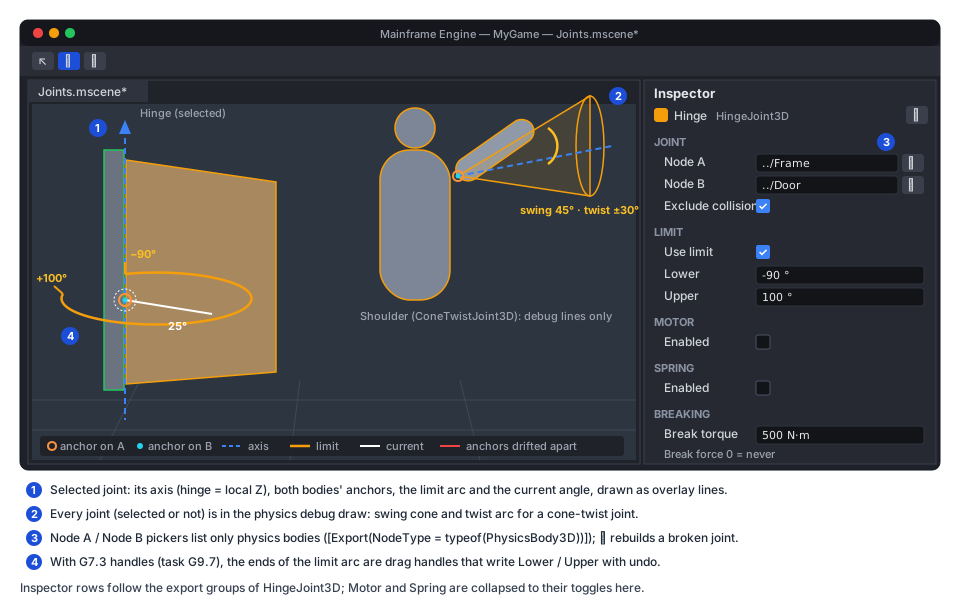
PhysicsSpace3D/2D.DrawDebugalso draws joints intoDebugLineswhen debug draw is on: anchors of both bodies (they separate when the joint is overstretched; red when more than 5 cm/5 px apart), axes, limit arcs (hinge, pin 2D), swing cones and twist arcs, slider ranges, distance/spring segments. Colours: joints amber, broken joints grey. Anchors are computed from the bodies’ interpolated poses and stored frames, so lines match the render. - Selected joint (figure):
ViewportControlleradds overlay lines for the selectedJoint3D/Joint2D: thick axis, current angle or position, labels at the limit ends, and a line from the joint to each resolved body (red when a path does not resolve). Unresolved paths also show as a node warning in the scene tree. - Inspector.
NodeA/NodeBuse the existing node-path picker restricted toPhysicsBody3D/PhysicsBody2D. A custom inspector section adds icon buttons with tooltips: Rebuild (rotate) and “Swap A/B” (arrows-horizontal). New icons inMainframeEngine.Editor/Content/icons/icons.txt:pin,cone,arrows-horizontal,wave-sine,link-off,steering-wheel,accessible; all joints useEditorIconFamily.Physics. - Handles (G9.7, after G7.3). An
IHandleProviderper joint type exposes the limit ends, swing span and slider range asEditorHandles (G7.3), so limits are dragged in the viewport with undo. - Dev overlay. The Physics panel (
MainframeEngine/Src/Debugging/DevOverlay/DevOverlayPanels.cs:238) gains a joint count and broken-this-second count.
Ragdolls
Section titled “Ragdolls”What ships before skinning: Ragdoll3D. A node that turns its direct RigidBody3D children (the parts) into a
ragdoll. Parts are flat siblings because nested dynamic bodies teleport (see Problem); visuals hang under each part.
Joints between the parts are ordinary joint nodes under the ragdoll. This covers rigid-part characters (capsule
mannequins, robots, low-poly figures), hanging signs and chains.
[EditorIcon("accessible", Family = EditorIconFamily.Physics)]public class Ragdoll3D : Node3D{ [Export] public bool Simulating { get; set; } // false: parts kinematic, following their nodes [Export] public bool ExcludePartCollisions { get; set; } = true; // parts never collide with each other public void StartSimulation(); // parts → Dynamic, keeping their kinematic velocity public void StopSimulation(); // parts → Kinematic at their current pose public void ApplyImpulse(RigidBody3D part, Vector3 impulse, Vector3? position = null); [Signal] public event Action? SimulationStarted; [Signal] public event Action? SimulationStopped;}While not simulating, an AnimationPlayer (G1a) or code moves the parts; kinematic moves become velocities
(physics.md → interpolation), so they push props and, on StartSimulation, the parts carry that motion into the fall.
Jitter2 drops the joints between two kinematic parts; the re-creation rules above restore them with the authored limits.
What waits for G1b: PhysicalBone3D and PhysicalBoneSimulator3D (Godot 4.3’s structure).
public sealed class PhysicalBoneSimulator3D : Node3D       // child of a Skeleton3D; PhysicalBone3D children{    [Export(Range = "0,1,0.01")] public float Influence { get; set; } = 1f;   // blend: animated pose ↔ simulated    public bool IsSimulating { get; }    public void PhysicalBonesStartSimulation(ReadOnlySpan<string> bones = default);  // empty = all bones    public void PhysicalBonesStopSimulation();}
public sealed class PhysicalBone3D : RigidBody3D{ [Export] public string BoneName { get; set; } = ""; [Export] public Transform3D BodyOffset { get; set; } = Transform3D.Identity; // body relative to the bone [Export] public PhysicalBoneJointType JointType { get; set; } // None, Pin, ConeTwist, Hinge, Slider [Export] public Transform3D JointOffset { get; set; } = Transform3D.Identity; // joint frame relative to the body // Swing/twist spans, hinge limits, slider range: the same exports as the joint nodes, grouped "Joint".}- The simulator creates one internal
JointRecord3Dper bone with a joint type, to thePhysicalBone3Dof the nearest ancestor bone that has one (walkingSkeleton3D.BoneParents); no joint nodes are added to the scene. - Simulated bones: in
OnProcess(with a process priority afterAnimationPlayer, beforeRenderServer.SkinMesheswrites the palettes), each simulated bone’s pose is written from its body’s interpolated global transform: bone global = body global ×BodyOffset⁻¹, then made local to the parent bone withSetBonePosePosition/Rotation, blended with the animated pose byInfluence. - Animated bones: bodies are kinematic; in
OnPhysicsProcessthey move to the animated bone pose ×BodyOffset, so animated characters still push things and are hit by rays. - Create physical skeleton (G9.9). An inspector button (
boneicon, tooltip) onSkeleton3Dbuilds the simulator and onePhysicalBone3Dper bone longer than 5 cm: a capsule from the bone to its first child, radius 20 % of the length, cone-twist 45°/30° joints. With a G1cHumanoidMap(docs/design/future/animation-authoring.md:123), knees and elbows become hinges and limits come fromHumanoidLimits(:110-113). One undo step.
Networking and determinism
Section titled “Networking and determinism”Joints are server-side state like bodies: the server simulates and replicates poses through the game’s
[Replicated] members; clients may run cosmetic ragdolls locally (no authority). With Deterministic and one
thread, joint scenes reproduce on one machine/build like other physics (the render determinism test covers it).
Allocation and threading
Section titled “Allocation and threading”Joint records, constraint arrays, exclusion arrays and Jitter2 Joint objects are allocated at creation only. Per
step: impulse readback, PD springs, joint events and debug draw iterate pre-sized lists. The ConstraintRemoved handler
and the joint-event loop are cached delegates/static callbacks. All joint calls are main-thread; only the exclusion
arrays are read on Jitter2 workers, and they are replaced, never mutated, between steps.
Testing
Section titled “Testing”- Unit,
Tests/MainframeEngine.Tests/Physics/(PhysicsHarness,PhysicsHarness2D):Joints3DTests: pin pendulum period within 2 % of 2π√(L/g); anchors stay within 1 cm under load; hinge limits hold within 1°; motor reaches its target velocity and respectsMotorMaxTorque; PD spring settles at the target angle; slider range andAllowTwist; cone-twist swing/twist spans; distance rope slack and spring period; weld holds a cantilever; world joints (empty path); live limit/motor changes without rebuild.- Lifecycle: joint before its bodies in tree order; body freed (no exception, joint pending), re-added (re-created at
the authored frame); disabled joint and disabled body; both bodies kinematic then dynamic (Jitter2 drop → re-created
with the authored limits); invalid paths log once;
ExcludeNodesFromCollisionon/off for touching bodies. JointBreakTests(3D and 2D): a weld under a falling mass breaks once,Brokenfires on the main thread after the step,IsBroken, freeing nodes inside the handler,Rebuild(); thresholds 0 never break.Joints2DTests: each 2D type, pixel conversion of anchors, limits, motor speeds, forces and thresholds; groove and wheel axes;DisableCollision.Ragdoll3DTests: start/stop simulation, velocity carried over, part collisions excluded, joints intact after kinematic periods.PhysicsSerializationTests: round trips of every joint type andRagdoll3D.- Allocation gates (
PhysicsAllocationTests,Physics2DAllocationTests): 0 B over 300 steps with 200 joints (chains, breakable welds, motors, PD springs, debug draw on); 2D excludes Box2D’s step allocations as today.
- Editor,
Tests/MainframeEngine.Editor.Tests/: path pickers list only physics bodies; Rebuild/Swap A/B undo; “Create physical skeleton” builds the expected bones and undoes in one step (G9.9). - Render tests: a new
physics-jointscatalog scene (Tests/MainframeEngine.RenderTests/SceneTests.csnext tophysics-debug): a hinged chain, a cone-twist mannequin and a broken weld with debug draw on, frame 90, goldens for both drivers. Existing goldens are unchanged. The allocation gate’s showcase scene gains a short hinged chain. - Benchmarks:
JointBenchmarks(100-link chain, 50 ragdolls of 11 parts) added tobaseline.json. - QA and Demo:
physics_3dgains a rope bridge of hinged planks, a breakable welded sign and a capsule mannequin (Ragdoll3D) the crates knock down;physics_2dgains a chain, a car onWheelJoint2Ds and a breakable bridge (Examples/Demo/Demo/Src/Physics/Physics3DScene.cs,Physics2DScene.cs, panels get a “show joints” toggle).Demo.Testschecks that the mannequin falls and the bridge holds;just demo-screenshots. The editor QA script selects the bridge hinge and screenshots its gizmo.
Acceptance
Section titled “Acceptance”- Every listed joint type works in a game and in the Demo, with limits, motors and springs changeable at run time.
- Bodies may leave, re-enter, be disabled and switch Dynamic ↔ Kinematic without losing or distorting their joints.
Brokenfires once per break on the main thread;Rebuild()restores the joint.- The editor shows every joint in the debug draw and the selected joint’s gizmo; paths are picked from physics bodies.
- 3D allocation gate 0 B with joints; 2D engine share 0 B; no validation warnings; render goldens recorded.
- With G1b: a skinned character ragdolls from its animation and back; “Create physical skeleton” gives a usable rig.
- Docs updated when this ships:
docs/design/physics.md(joints, breaking, ragdolls; remove the known issue),docs/design/editor.md(gizmo, inspector buttons, icons),docs/design/scene-graph-and-nodes.md(new nodes),docs/design/demo.md,docs/design/dev-overlay.md,docs/design/testing.md(render test, gate), and an ADR for the joint-frame and re-creation rules.
Task list
Section titled “Task list”G9.1–G9.7 need nothing beyond main (G9.7 waits for G7.3); G9.8–G9.9 wait for G1b.
- G9.1 3D joint core.
JointRecord3D, deferred creation inFlush, path resolution, world joints, stored frames, removal/re-entry,ConstraintRemovedre-creation, collision exclusion inLayerFilter;Joint3D,PinJoint3D,HingeJoint3D(limits, motor); unit tests, serialization, allocation gate. - G9.2 More 3D joints.
SliderJoint3D,ConeTwistJoint3D,DistanceJoint3D(SpringConstraint),WeldJoint3D; hinge/slider PD springs; tests. - G9.3 Breaking. Impulse readback,
GetAppliedForce/Torque,Brokendispatch,Rebuild(); 3D tests. - G9.4 2D joints.
JointRecord2D, world body,Joint2Dand the six 2D types, unit conversion, joint events →Broken, enable/disable by re-creation; tests, allocation gate. - G9.5 Debug draw and editor. Joint debug lines in both spaces, selected-joint overlay, node warnings, inspector
buttons, icons;
physics-jointsrender test and goldens; editor tests; dev overlay counts. - G9.6 Ragdoll3D and Demo.
Ragdoll3D; Demo additions inphysics_3d/physics_2d,Demo.Tests, screenshots; benchmarks; docs (physics.mdand the list in Acceptance); ADR. - G9.7 Limit handles (after G7.3).
IHandleProviders for hinge/pin limits, swing span, slider range; QA step. - G9.8 Physical bones (after G1.8).
PhysicalBone3D,PhysicalBoneSimulator3D, internal bone joints, pose write-back withInfluence, kinematic follow; tests. - G9.9 Create physical skeleton (after G1.10; humanoid limits after G1.12). Inspector action, capsule and joint heuristics, undo; Demo skinned ragdoll.
- G9.10 Later, on demand.
Generic6DofJoint3D, active ragdolls,MotorJoint2D.
Open questions
Section titled “Open questions”- Spring parameters. Frequency + damping ratio (both libraries’ native form, mass-independent) as proposed, or
Godot’s
stiffness/damping(needs an effective-mass conversion that changes when masses change)? - 3D hinge/slider springs. An explicit PD torque in
PreStep(clamped frequency) as proposed, a custom implicit Jitter2 constraint (aConstraint<T>subclass withRegisterFullConstraintfunction pointers, unsafe code inSrc/Physics), or no 3D angular springs until a game asks? Generic6DofJoint3D. Compose from Jitter2 primitives (covers only lock/free/limit combinations the primitives express), write a custom 6-DOF constraint, or leave it out?- Solver tuning. Expose Jitter2’s per-constraint
Softness/Biasand Box2D’sconstraintHertz/DampingRatioas an advanced “Solver” group, or keep library defaults? - Break measurement. Last substep’s impulse (spiky on impacts, like Box2D’s instantaneous check) or an average over a few steps for 3D? Should 2D match whichever 3D uses?
- Moving a joint node at run time. Godot ignores it after creation (as proposed); should a moved joint re-anchor?
- Nested ragdoll parts. Keep
Ragdoll3Dflat, or change the rule that a parent’s physics pose write teleports body children (CollisionObject3D.cs:141-146) so nested hierarchies work? - Ragdoll layers. Should
Ragdoll3D/PhysicalBoneSimulator3Dset the parts’ collision layer from a project setting (“ragdoll” layer), or leave layers to the game?
Related
Section titled “Related”- Physics, Scene graph and nodes, Editor, Networking, Demo, Testing
- Gameplay toolkit siblings: Keyframe animation (G1b skeletons), Animation authoring (G1c humanoid map and limits), Editor viewport tools (G7.3 handles, G7.5 simulate mode for trying joints in the editor), 2D content (G2)