
Vulkan Renderer
Purpose
Section titled “Purpose”VulkanRenderer owns the Vulkan instance, device, swapchain, the HDR scene target and the tonemap /
overlay passes, command buffers, frame synchronization, and the shared GPU services (allocator, upload
and deletion queues, pipeline and shader-module caches, the per-frame descriptor set). Everything else
draws by recording into IVulkanContext.CurrentCommandBuffer between BeginFrame() and EndFrame().
Key types
Section titled “Key types”| Type | File | Visibility |
|---|---|---|
IRenderer | Rendering/IRenderer.cs | public |
IVulkanContext | Rendering/Vulkan/IVulkanContext.cs | public |
VulkanRenderer | VulkanRenderer.cs, VulkanRenderer.Presentation.cs | internal, implements both; the partial holds the colour pipeline passes |
FrameContext, FrameData | Rendering/Vulkan/FrameContext.cs | public — per-frame shared set 0 (camera + lights) |
RenderTarget | Rendering/Vulkan/RenderTarget.cs | public — offscreen colour/depth targets (the scene target is one) |
GpuAllocator, UploadQueue, DeletionQueue, GpuBuffer/GpuImage/GpuTexture, PipelineCache, ShaderModuleCache | see GPU resources | public |
VulkanLoaderBootstrap | Rendering/Vulkan/VulkanLoaderBootstrap.cs | internal — see Build & platforms |
IOverlayRenderer, OverlayOrder | IOverlayRenderer.cs, OverlayRendererList.cs | public — overlay draw order: canvas 0, screen gizmos 100, UI 200 (see Developer overlay) |
UniformRing | Rendering/Vulkan/UniformRing.cs | internal — dynamic-offset UBO ring math (shadow light matrices) |
VkHelpers, VulkanResultExtensions.Check | VkHelpers.cs, VulkanException.cs | internal — depth barriers; result.Check("what") throws VulkanException |
PipelineBuilder | PipelineBuilder.cs | internal — pipelines, layouts, descriptor sets with the engine’s conventions |
ShadowFallback | Shadows/ShadowFallback.cs | internal — “no shadows” set 2, owned by the renderer (see Shadow system) |
PostProcessStack, PostEffect, PostEffectContext, ScenePrepass, SceneColorCopy, IPostProcessHost | Rendering/Post/ | internal — the post effects in stages, the depth prepass and motion vectors (ADR 0163, Post-processing); the renderer owns the main view’s stack |
IRenderer
Section titled “IRenderer”Backend, VSync {get;set;}, OnResize(size), BeginFrame(), EndFrame(),
SetClearColor(r,g,b,a=1), Clear(), EnableDepthTest(), DisableDepthTest(),
RequestCapture(), TryTakeCapture(out capture).
In Vulkan, Clear and the depth toggles are no-ops: clearing is the render pass LoadOp, and depth
state is baked into each pipeline.
IVulkanContext
Section titled “IVulkanContext”Vk, Device, PhysicalDevice, RenderPass (the HDR scene pass), CommandPool, GraphicsQueue,
FrameStarted, FrameSlot, const MaxFramesInFlight = 2, FrameNumber, CurrentCommandBuffer
(default outside a frame), SwapchainExtent (pixels; the scene target has the same size),
SwapchainImageCount, CurrentImageIndex, CurrentFramebuffer (the scene target’s), BeginRenderPass(),
Validation, and since M3: SceneTarget, OverlayRenderPass, OverlayEncodesSrgb, BeginOverlayPass(),
Exposure (+ const DefaultExposure = 1.3), since ADR 0154 AntiAliasing (None/Fxaa/Taa, from
EngineOptions.AntiAliasing), since ADR 0166 TaaSharpness (+ const DefaultTaaSharpness = 0.25) and FrameDeltaTime (set by the engine; auto exposure adapts over it), Frame (FrameContext, with per-view copies and Extent of the
view being drawn), Allocator, Uploads, Deletions, Pipelines, Shaders, MaxSamplerAnisotropy (the
samplerAnisotropy feature is enabled when available). Images for the UI (a SubViewport, shadow maps) go through
UiServer.RegisterTexture (engine://name).
Always guard the cast: if (Renderer is IVulkanContext vk) { ... }.
Initialization
Section titled “Initialization”flowchart LR
A[CreateInstance] --> B[SetupDebugMessenger] --> C[CreateSurface] --> D[PickPhysicalDevice]
D --> E[CreateLogicalDevice]
E --> E2["CreateGpuMemory<br/>allocator, deletion + upload queues,<br/>pipeline cache, shader modules"]
E2 --> F2[CreateSwapchain]
F2 --> K[CreateCommandPool] --> L[CreateCommandBuffers] --> M[CreateSyncObjects]
M --> N["CreatePresentation<br/>swapchain views, present pass + framebuffers,<br/>scene RenderTarget, tonemap pipeline"]
| Step | Detail |
|---|---|
| Instance | API 1.2, window-required extensions (SDL), VK_EXT_debug_utils if validating, VK_KHR_portability_enumeration + flag when available (macOS). Layer VK_LAYER_KHRONOS_validation (dropped with a warning if missing). Validation is requested when EngineOptions.EnableValidation is set — on by default in Debug builds, off in Release. |
| Debug messenger | Warning/Error × General/Performance/Validation → static [UnmanagedCallersOnly] function pointer (no delegate to keep alive) → VulkanValidationLog (IVulkanContext.Validation: counts + first 64 messages, rooted by a GCHandle passed as user data) and Log.Warning/Log.Error. Verbose/info are not subscribed (they would allocate a string per message). |
| Physical device | First device with graphics + present queue families. No feature or extension scoring. |
| Logical device | One queue per unique family. Extensions: VK_KHR_swapchain (+ VK_KHR_portability_subset if advertised; + VK_KHR_swapchain_mutable_format/VK_KHR_image_format_list only when the sRGB+UNORM-view swapchain is requested). Features: shaderSampledImageArrayDynamicIndexing when supported (the lit shaders index their shadow sampler arrays with a loop counter; a warning is logged otherwise). |
| Swapchain | ChooseSurfaceFormat: an 8-bit UNORM format in SrgbNonlinear (the tonemap shader encodes sRGB), else sRGB formats — see Color pipeline. VSync (initially EngineOptions.VSync) → FIFO; else Mailbox → Immediate → FIFO. minImageCount + 1. Extent from the surface, or Engine.FramebufferSize (pixels) when the surface leaves it to the app. Usage ColorAttachment, plus TransferSrc when EngineOptions.EnableFrameCapture is set and supported (frame capture, see Testing). |
| Scene target | RenderTarget with R16G16B16A16Sfloat colour (sampled) + depth (first of D32Sfloat, D32SfloatS8Uint, D24UnormS8Uint; stored and sampled, ADR 0160), swapchain-sized, shared by both frames in flight (render-pass dependencies order the reuse). |
| Command buffers | One primary per frame slot (2), allocated once from a ResetCommandBuffer pool on the graphics family, recorded with OneTimeSubmit. |
| Sync | Per frame slot: imageAvailable[2], inFlight[2] (created signalled). Per swapchain image: renderFinished[imageCount] (a present may still wait on one until that image is re-acquired). |
Every Vulkan call that returns a Result in init, per-frame and recreation paths is checked
(.Check("vkXxx (what)") → VulkanException).
Render passes
Section titled “Render passes”| Pass | Target | Attachments | Pipelines built against it |
|---|---|---|---|
| Shadow passes | shadow maps | depth | ShadowSystem |
| Depth prepass (ADR 0163) | R16G16_SFLOAT velocity + the scene target’s depth | velocity Clear/Store → SHADER_READ_ONLY; depth Clear/Store → DEPTH_STENCIL_READ_ONLY; explicit barrier after (fragment reads, depth tests) | MeshRenderer (MeshDepth, MeshDepthFoliage), the sky velocity: only when a post effect needs it, after RenderOffscreen |
| Sky LUTs (ADR 0154) | transmittance 256 × 64, multiple scattering 32 × 32, sky view 192 × 108 (R16G16B16A16_SFLOAT RenderTargets) | colour Clear/Store → SHADER_READ_ONLY, explicit barrier in End | PhysicalSkyLuts: a physical sky’s, at the start of RenderServer.RenderOffscreen, only when the atmosphere or the sun’s elevation changed |
Scene (RenderPass) | SceneTarget | 0 R16G16B16A16_SFLOAT Clear/Store → SHADER_READ_ONLY; 1 depth Clear/Store → DEPTH_STENCIL_READ_ONLY (ADR 0160: light shafts sample it; ≤ 0.02 ms at 1440p on Apple M5). After a prepass the frame begins ScenePrepass.SceneLoadPass instead: the same attachments and dependencies (compatible), depth Load from DEPTH_STENCIL_READ_ONLY | sky, grid, shapes, Spine, meshes |
| Auto exposure (ADR 0154) | 64², 16², 4², 1² R16_SFLOAT (log2 luminance), 2 × 1² R32_SFLOAT (adapted, previous) | as above | AutoExposure: when the root world’s PostProcessSettings enable it, after the scene pass |
| Glow (ADR 0124) | 7 × 2 RenderTargets (R16G16B16A16_SFLOAT, ½ … 1/128 of the scene) | colour Clear/Store → SHADER_READ_ONLY, explicit barrier in End | GlowEffect: only when the root world’s PostProcessSettings enable glow, between the scene pass and the present pass |
| Light shafts (ADR 0160) | 3 × ½-res R16G16B16A16_SFLOAT RenderTargets (mask, fine blur, coarse blur) | colour Clear/Store → SHADER_READ_ONLY, explicit barrier in End | LightShafts: when the root world’s PostProcessSettings enable them and the sun is in reach, after the glow; they read the scene’s colour and depth |
| Post targets (ADR 0163) | PostTargetPool: scene-relative RenderTargets and ping-pong histories | as above | post effects (TAA’s history, SSAO) |
| Scene colour copy (ADR 0163) | the scene colour image | DontCare/Store, SHADER_READ_ONLY → SHADER_READ_ONLY, explicit barriers | PostEffectContext.CopyToSceneColor (a BeforeTonemap effect’s new HDR image) |
| LDR images (ADR 0154, 0163) | R8G8B8A8_UNORM ping-pong, the swapchain’s size | as above | the tonemap pipelines (a second copy of each) when an AfterTonemap effect is on (AntiAliasing = Fxaa, TAA’s sharpen, the velocity view); the stage’s effects that are not last |
| Present | swapchain image | colour DontCare/Store, UNDEFINED → PRESENT_SRC (or → COLOR_ATTACHMENT when a separate overlay pass follows) | tonemap, or the last AfterTonemap effect (TaaSharpenEffect, FxaaEffect, VelocityDebugView) over the LDR image |
Overlay (OverlayRenderPass) | same pass as Present by default; a separate Load pass on a UNORM view in the SrgbWithUnormOverlay mode | canvas, screen gizmos, UI, dev overlay |
The scene pass’s incoming dependency orders this frame’s writes after the previous frame’s tonemap read
and depth writes; its outgoing one makes the colour visible to the tonemap’s fragment shader. The
swapchain passes wait on the acquire semaphore at COLOR_ATTACHMENT_OUTPUT and end with an outgoing
dependency to TRANSFER. A frame-capture copy recorded afterwards is chained to the colour writes and the
PRESENT_SRC transition.
Between the scene and tonemap passes, and before the capture copy, there is also an explicit pipeline
barrier (colour-attachment writes → fragment-shader / transfer reads). MoltenVK does not wait on render-pass
external dependencies between Metal encoders. Under a heavy first frame (M4: the shadow maps being created), the
tonemap read the scene target’s last tile rows before they were stored, and captures showed black tiles. Every
RenderTarget pass therefore ends with RenderTarget.End, which records that barrier for each attachment it keeps
(by final layout: SHADER_READ_ONLY → fragment-shader reads, TRANSFER_SRC → transfer reads, a sampled depth →
fragment-shader reads): the scene target before the tonemap, an offscreen SubViewport’s HDR target before the
compositor’s tonemap and its LDR target before the UI samples it, and the object-ID target before the readback
copy. The UI renderer’s own passes use global barriers (ADR 0050);
they never touch the HDR image, so the two never overlap. Clear values: SetClearColor (sRGB, converted to linear) and depth 1.
Order within a frame and the colour handling are described in Color pipeline.
Frame graph
Section titled “Frame graph”The passes of one frame, in recording order (dashed: only when enabled). The post-processing stages are described in Post-processing (ADR 0163).
flowchart TD
    U["Upload queue<br/>copies, transitions"] --> SH["Shadow passes<br/>cascades, atlas, cubes"]
    SH --> OF["RenderOffscreen<br/>sky LUTs and capture · sub-viewports · root object ids"]
    OF -.-> PP["Depth prepass<br/>scene depth + velocity · sky velocity"]
    PP -.-> AP["AfterPrepass stage<br/>SSAO → set 0 b5"]
    OF --> SC["Scene pass<br/>(loads the prepass depth after one)"]
    AP -.-> SC
    SC --> UI["UI layers offscreen"]
    UI --> BT["BeforeTonemap stage<br/>TAA · auto exposure · glow · light shafts"]
    BT --> TM["Tonemap<br/>→ swapchain, or → LDR image"]
    TM -.-> AT["AfterTonemap stage<br/>TAA sharpen · FXAA · velocity view (last → swapchain)"]
    TM --> OV["Overlay<br/>canvas · gizmos · UI · dev overlay"]
    AT -.-> OV
    OV --> CP["Frame capture copy (optional)"]
Frame synchronization
Section titled “Frame synchronization”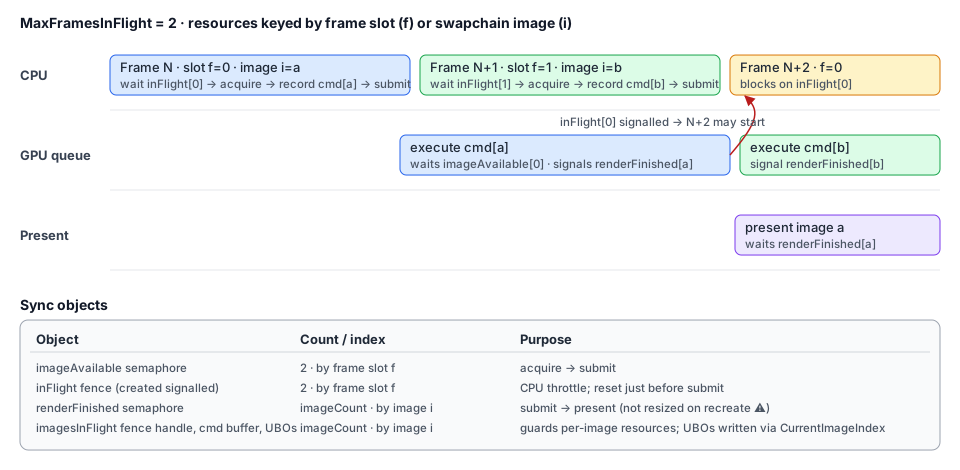
BeginFrame()
- If a resize/VSync change is pending →
RecreateSwapchain(); if that fails (window has no area) return withFrameStarted = false. - Wait
inFlight[slot]— after this the slot’s command buffer and every per-frame resource keyed byFrameSlotare idle; the deletion queue destroys what that slot’s last frame held and the staging ring reclaims its space. AcquireNextImage(imageAvailable[slot]). OnErrorOutOfDateKhr: recreate and return withFrameStarted = false(the fence stays signalled: it is only reset right before a submit).- Reset and begin
commandBuffers[slot](OneTimeSubmit).FrameStarted = true,FrameNumber++. - Record the upload queue’s pending copies, transitions and clears (before any pass reads them).
EndFrame()
- Finish the pass sequence (tonemap if
BeginOverlayPasswas not called), end the pass, optional capture copy,EndCommandBuffer. - Reset
inFlight[slot]. Submit, waitingimageAvailable[slot]atColorAttachmentOutputand signallingrenderFinished[image]. - Present, waiting on
renderFinished[image]. Read back a requested capture (waits that fence) before any recreation, then on OutOfDate, Suboptimal or a pending resize: recreate. slot = (slot + 1) % MaxFramesInFlight.
Per-frame-slot resources
Section titled “Per-frame-slot resources”Subsystems key uniform buffers, dynamic vertex/index buffers and the descriptor sets that point at
them by IVulkanContext.FrameSlot and allocate IVulkanContext.MaxFramesInFlight (2) copies:
the FrameContext (set 0: camera + lights, written once per frame and view for every scene pipeline), the
mesh renderer’s instance buffer and picking readbacks, Spine (main and shadow vertex buffers), the screen gizmos (vertex buffer), the shadow
system (matrices UBO, set 1/2, light-VP ring). All are GpuBuffers in persistently mapped
Dynamic memory. The slot’s
fence is waited in BeginFrame, so the CPU never writes data the GPU is still reading, and nothing
depends on the driver-chosen swapchain image count. Static resources (textures, Spine texture sets,
the shadow fallback set) have a single copy.
Swapchain recreation
Section titled “Swapchain recreation”Triggered by OutOfDate/Suboptimal, OnResize, or setting VSync (present mode).
- If
Engine.FramebufferSizeor the surface’s current extent is 0×0 (minimised), returnfalseand keep the request pending — no busy wait; the engine stops rendering and blocks on window events (see Engine lifecycle). DeviceWaitIdle.- Destroy the swapchain framebuffers and views; create the new swapchain with
OldSwapchain= the current one, then destroy the old one. - If the surface format changed, throw
VulkanException: the tonemap and overlay pipelines are built against the swapchain passes.ChooseSurfaceFormatis deterministic per surface, so this does not happen on the supported platforms. (Scene pipelines no longer depend on the swapchain format.) - Recreate views and framebuffers; resize the scene target (its render pass is kept, so scene
pipelines stay valid) and rewrite the tonemap descriptor. If the image count changed, recreate
renderFinished[]. Collect the deletion queue (the device is idle).
Command buffers, fences, imageAvailable[] and every subsystem’s per-frame-slot arrays are
independent of the swapchain and are not touched. The render tests resize the window and toggle VSync
mid-run (SwapchainRecreationOnResizeAndVSyncToggleIsClean) with the validation gate on.
Disposal
Section titled “Disposal”Dispose() is idempotent and tolerates partially initialised state: DeviceWaitIdle → shadow
fallback, capture buffer, frame context → presentation (scene target, tonemap, passes, views) →
swapchain → flush the deletion queue → upload queue → allocator (frees every block) → shader modules →
pipeline cache (saves the file; first waits for a MoltenVK background load still running, ADR 0176) → semaphores and fences → command pool → device → debug messenger
(only if it was created) → surface → instance → Vk.Dispose() → validation handle. The game must
dispose its own GPU objects (shadow system, sky, grid, nodes) before base.OnClose() disposes the
renderer; renderer-owned objects defer to the deletion queue, so their Dispose never waits.
Known issues
Section titled “Known issues”- Physical device selection does not prefer discrete GPUs or check swapchain support.
EndFrameends the render pass without checking that one was begun (the engine always begins it).- A surface-format change on recreation is fatal (no pipeline-recreation callbacks for the swapchain passes yet).
Related docs
Section titled “Related docs”Engine lifecycle · Coordinate conventions · Shadow system · GPU resources · Color pipeline