
Proposal: Crash reporting (desktop, editor and games)
Milestone: Gameplay toolkit (G15) · Status: ⬜ planned ·
Depends on: M10 projects (GameHost, project.mfproj, log routing, editor link),
M8 game UI (the next-launch prompt) · Related:
M13 mobile services (layer 1 is this proposal; Sentry native SDKs
on mobile), Consoles (plumbing checklist),
Save games and settings (G4: UserSettings holds the upload consent),
Profiler (G10: GPU zones per pass), Game export (G5: symbols),
Release, Native libraries
Problem
Section titled “Problem”When a game or the editor dies, the engine leaves one FATAL log line at best, and nothing at all for a native crash.
Nobody can tell a player’s crash apart from a driver bug, and the editor shows a number.
- Main-thread exceptions end the game with a log line. Node callbacks run without a catch
(
MainframeEngine/Src/Scene/SceneTree.cs:405,:429;Tickonly resets its flag in afinally,:321-378). The exception leavesEngine.OnUpdate(MainframeEngine/Src/Core/Engine.cs:484) andEngine.Run(:670-674), andGameHost.Runcatches it, callsLog.Fatal(e)and returns 1 (MainframeEngine/Src/Project/GameHost.cs:230-233; headless:261-264). The node, callback, scene and frame are not recorded. Thefinallythen disposes the engine (:235-245), which after a lost device can throw again and hide the first error. Because the exception is caught, the runtime’s unhandled-exception path (and any .NET dump setting) never runs. - Other threads have no handler. The engine registers no
AppDomain.UnhandledExceptionorTaskScheduler.UnobservedTaskExceptionhandler; the only one is the editor’s, which writes recovery copies (MainframeEngine.Editor/Program.cs:35-41). An audio-thread exception is stored (MainframeEngine/Src/Audio/Graph/AudioMixRoot.cs:61-66) and logged once (MainframeEngine/Src/Audio/AudioServer.cs:762-766); the game plays on in silence. - The log ring exists but is not used.
MemoryLogSinkis documented as being for “crash reports” (MainframeEngine/Src/Debugging/LogSinks.cs:54-58), but only tests create one.GameHost.Runadds aFileLogSinkin user data (GameHost.cs:217-219) that flushes at least every second and right after errors, and keeps the previous run asgame.1.log(MainframeEngine/Src/Debugging/FileLogSink.cs:7-15). The editor writes no log file; its only sink is the Output panel (MainframeEngine.Editor/Src/Output/OutputLog.cs:164). - No GPU identity. Vendor, device, driver version and driver id are read only to name the pipeline cache file
(
MainframeEngine/Src/Rendering/Vulkan/PipelineCache.cs:310-318); the device name is never read or logged.EngineInfo.Versiondrops the build metadata, so the commit is lost (MainframeEngine/Src/Core/EngineInfo.cs:57-64). The rest exists:ProjectSettings.Version(MainframeEngine/Src/Project/ProjectSettings.cs:32),GameSession.CurrentScenePath(MainframeEngine/Src/Project/GameSession.cs:430),Engine.RenderedFrameCount(Engine.cs:200) andSceneTree.ProcessFrames(SceneTree.cs:131). - A lost device looks like any other failure.
Result.Checkthrows a plainVulkanExceptionwith the result in its message (MainframeEngine/Src/Rendering/Vulkan/VulkanException.cs:26-30), for the fence wait, the submit and the present alike (MainframeEngine/Src/Rendering/Vulkan/VulkanRenderer.cs:237-238,:318,:343-347). Only the swapchain, portability and presentation extensions are enabled (VulkanRenderer.cs:91), andSrc/Renderinghas no debug labels, markers or fault queries, soVK_ERROR_DEVICE_LOSTsays nothing about the pass.DisposecallsvkDeviceWaitIdle(VulkanRenderer.cs:1082). - Native crashes leave nothing. RmlUi/FreeType (
mfrmlui), ThorVG (mfsvg), ENet, miniaudio (SoundFlow), SDL, Steam and the Vulkan driver run in the game process; a segfault there ends it with no report, and the log stops at its last flush. The natives are built-DCMAKE_BUILD_TYPE=Releasewithout debug info (.github/workflows/natives.yml:72,:77). Only the editor’s VST host runs out of process (docs/design/natives.md:147). - The editor sees an exit code. Play marks a non-zero exit it did not cause as
Crashed(MainframeEngine.Editor/Src/Play/PlayService.cs:38-39,:517-526; chip iconMainframeEngine.Editor/Src/UI/Panels.cs:179). After the link drops, raw stderr is shown with a guessed level (MainframeEngine.Editor/Src/Play/PlayController.cs:275-311). Link protocol 3 carries onlyGoodbye(exitCode)(MainframeEngine/Src/EditorLink/EditorLinkProtocol.cs:25-26,:134): no structured crash,134is not shown asSIGABRT, and the Output panel’s click-to-source (MainframeEngine.Editor/Src/UI/OutputPanel.cs:176-181) cannot reach the stack. - Recovery copies are never offered back.
WriteRecoveryCopies(MainframeEngine.Editor/Src/EditorWorkspace.cs:753) fills~/.mainframe/recovery, and nothing reads it. The editor does report one earlier failure on its next start, the update result (MainframeEngine.Editor/Src/Updates/UpdateApplier.cs:64-84, read and deleted at:408-412). - Symbols are not managed. CI builds are deterministic with mapped source paths (
Directory.Build.props:18-19).publish.ymlpublishes ReadyToRun editors (.github/workflows/publish.yml:103-105); neitherbuild/package-editor.shnorbuild/package-game.shdeletes.pdbfiles, so managed frames probably carry lines (⚠ confirm in a release zip). Nothing archives symbols per release, and the natives have none. - Other plans assume this exists. M13’s crash layer 1 is “
CrashReporter.PendingReports” with the last 200 log entries, device, OS and versions (docs/design/future/mobile-services.md:423-447). The consoles checklist forbidsHttpClientandProcess.Startin runtime code outside services (docs/design/future/consoles.md:367-372).
- Every fatal managed error writes a report bundle to user data first: main thread (node callbacks, servers, renderer), other threads, tasks, and the editor. The report names the failing node and callback.
- One versioned report format (
report.json) shared with M13, mapping field for field onto a Sentry event, so an uploader is a small serializer and not an SDK. - Context without per-frame cost: versions, OS, GPU and driver, scene, frames, settings and the last 200 log entries, gathered at crash time or once at start-up.
- Every abnormal end is noticed (native crashes, kills, power loss) through a session sentinel and the previous log.
- Device loss is diagnosed: a typed exception, per-pass GPU breadcrumbs,
VK_EXT_device_faultwhere available. - Native dumps on desktop as an option; the dependency decision stays open.
- The player decides: a next-launch prompt to open the folder or copy the report; nothing is sent without a project endpoint and the player’s agreement.
- The editor shows a game crash as a crash (exception, click-to-source frames, decoded signal, bundle), and its own crashes offer the recovery copies back.
- Symbols per release for engine, editor and natives.
Non-goals
Section titled “Non-goals”- Automatic upload, engine telemetry or a hosted backend. A game that wants reports names its own endpoint.
- Recovering from device loss (re-creating the device). The game reports the loss and exits.
- Isolating game
[Tool]code in the editor; it still runs in the editor process. - Mobile and console native capture. M13 uses Sentry’s native SDKs through its shim; console ports use the platforms’ reporting in private repositories. This proposal fixes the shared managed layer and format.
- Hang detection before G15.9, and a symbol server (symbols are release artefacts; symbolication is offline).
Design
Section titled “Design”Overview
Section titled “Overview”| Type (all new unless noted) | Where | Role |
|---|---|---|
CrashReporter, CrashReporterOptions | Src/Debugging/Crash/ | Install, capture hooks, pending reports, prompt and upload policy |
CrashReport, CrashException, CrashFrame, CrashKind | Src/Debugging/Crash/ | The report model and its JSON (format: 1) |
CrashContext | Src/Debugging/Crash/ | Start-up facts and crash-time providers (scene, node, frames, game keys) |
CrashSession | Src/Debugging/Crash/ | The unclean-exit sentinel |
GpuInfo + IRenderer.Gpu (new member) | Src/Rendering/ | Backend-neutral GPU and driver identity |
VulkanDeviceLostException, GpuBreadcrumbs (internal) | Src/Rendering/Vulkan/ | Device loss as its own type; per-pass markers; fault info |
CrashPrompt : UiDocument + Content/UI/crash/ | Src/UI/Crash/ | The player’s next-launch prompt |
ICrashUploader, HttpCrashUploader, SentryEnvelope | Src/Debugging/Crash/Upload/ | Opt-in sending |
ExitCodes | Src/Core/ | Exit code → signal or NTSTATUS name (shared by the editor and the sentinel) |
Editor link CrashReport (protocol 4), CrashDialog | Src/EditorLink/, MainframeEngine.Editor/Src/UI/ | Game crashes in the editor; the editor’s own next-start dialog |
flowchart LR
    T["Throw in OnProcess"] --> F["SceneTree filter: note node + callback"]
    F --> C["GameHost.Run catch"]
    U["Other thread / task / audio fault"] --> H["UnhandledException handlers"]
    C --> W["CrashReporter.WriteReport"]
    H --> W
    W --> B["crashes/2026-10-11T10-42-07-a1b2/"]
    W --> L["Editor link: CrashReport"]
    W --> S["ICrashSink (M13 Sentry shim)"]
    N["Native fault / kill / power loss"] --> X["Sentinel left behind"]
    X --> P["Next launch: UncleanExit report + game.1.log tail"]
    B --> Q["Next launch: CrashPrompt"]
    P --> Q
Public API
Section titled “Public API”namespace MainframeEngine;
public static class CrashReporter{ public static void Install(CrashReporterOptions options); // idempotent; GameHost.Run, HeadlessHost, the editor public static bool IsInstalled { get; } public static string Directory { get; } // {UserDataDirectory}/crashes; the editor: ~/.mainframe/crashes
// Earlier runs (M13 relies on this name) public static IReadOnlyList<CrashReportInfo> PendingReports { get; } public static CrashReport? Load(CrashReportInfo info); public static void MarkHandled(CrashReportInfo info, CrashDisposition how); // Dismissed, Copied, Sent public static void Delete(CrashReportInfo info);
// This run public static string? WriteReport(Exception exception, CrashKind kind); // fatal path; returns the bundle folder public static void ReportError(Exception exception, string? note = null); // non-fatal; one per type per run public static void SetContext(string key, Func<string?> provider); // game keys; read only at crash time public static event Action<CrashReport>? Crashing; // on the way down: keep it short public static void AddSink(ICrashSink sink); // M13 Sentry shim, console heads
public static bool UploadConsent { get; set; } // the player's choice (persisted by G4 UserSettings) public static ICrashUploader? Uploader { get; set; } // default from project.mfproj crash.upload}
public enum CrashKind{ ManagedException, ThreadException, UnobservedTask, AudioThread, DeviceLost, UncleanExit, NativeDump, Hang,}
public readonly record struct CrashReportInfo(string Folder, string Id, CrashKind Kind, DateTime TimestampUtc, string Summary);
public interface ICrashSink{ bool RunsBeforeWrite => false; // M13's Sentry shim forwards before the local write void OnCrash(CrashReport report); // must not throw}GameHost.Run installs the reporter right after the file log (GameHost.cs:217). Its fatal catch becomes
CrashReporter.WriteReport(e, CrashKind.ManagedException) → Log.Fatal(e) → shutdown, with each shutdown step
guarded so a second exception cannot hide the first. HeadlessHost does the same. Engine subclasses (the editor) call
Install themselves; the render-test host does not, because a crash there fails a test.
Capture points
Section titled “Capture points”-
Main thread: the catch in
GameHost.Run, the reporter’s main entry point. -
Which node.
SceneTreewraps each callback dispatch in an exception filter that records the node and callback and returnsfalse, so the exception propagates unchanged with its stack, and the record is taken before unwinding:try { node.InvokeProcess(gameTime); }catch (Exception e) when (CrashContext.NoteNode(node, NodeCallback.Process, e)) { } // always false: never catchesThis covers
OnPhysicsProcess,OnProcess,OnInput,OnUnhandledInput,OnReady, signals and deferred calls. The non-exceptional path costs nothing;NoteNodestores references, and the node path is built at crash time. -
Other threads:
AppDomain.UnhandledExceptionwrites aThreadExceptionreport, then the process ends as today.OutOfMemoryException, whichGameHost.Rundeliberately does not catch, arrives here too. -
Tasks and audio (non-fatal):
TaskScheduler.UnobservedTaskExceptionand the audio fault (AudioServer.cs:762-766) callReportError, at most one report per exception type per run. -
Not capturable in process:
StackOverflowException,Environment.FailFastand native faults. The sentinel notices all of them; native dumps capture the native ones.
What a report holds
Section titled “What a report holds”{user data}/crashes/├── session-48213.json sentinel of the running process (deleted on a clean exit)└── 2026-10-11T10-42-07-a1b2/ ├── report.json the report (format 1) ├── log.txt the last 200 entries, formatted like the console sink ├── settings.json effective project.mfproj (ProjectSettings.ToJson) + runtime render state ├── game.log.tail UncleanExit only: the last 256 KB of game.1.log └── dump.dmp NativeDump only (G15.6){ "format": 1, "id": "a1b2c3d4…", "kind": "ManagedException", "timestamp": "2026-10-11T10:42:07.123Z", "app": { "name": "Forest Demo", "version": "1.2.0", "engine": "0.42.0", "engineCommit": "92dbb40a", "demo": false, "debugBuild": false, "runtime": ".NET 10.0.1", "rid": "osx-arm64", "headless": false }, "os": { "description": "macOS 27.0", "arch": "Arm64", "cpus": 12, "memoryMB": 36864, "locale": "en-AU" }, "gpu": { "name": "Apple M3 Pro", "vendorId": "0x106b", "deviceId": "0x…", "type": "IntegratedGpu", "driver": "MoltenVK", "driverInfo": "1.3.0", "driverVersion": "0.2.2208", "api": "1.2.296" }, "session": { "uptimeSeconds": 812.4, "renderedFrames": 48211, "processFrames": 48190, "scene": "Content/Scenes/Forest.mscene", "node": "/root/Forest/Player", "nodeType": "Game.PlayerController", "callback": "OnPhysicsProcess", "args": ["--fixed-fps"] }, "exception": [{ "type": "System.NullReferenceException", "message": "Object reference not set to …", "frames": [{ "method": "Game.PlayerController.OnPhysicsProcess(Single)", "file": "Src/PlayerController.cs", "line": 42, "module": "Game.dll", "mvid": "5f0c…", "ilOffset": 37 }] }], "context": { "level": "north-ridge" }, "device": { "tier": null, "thermalState": null }, "gpuLoss": null, "log": "log.txt"}- Exception chain. Inner and aggregate exceptions are flattened, outermost first.
StackFrame.GetILOffsetand the module MVID let a release without PDBs be symbolicated offline. - GPU.
IRenderer.Gpu(GpuInfo) is read once fromVkPhysicalDeviceProperties2andVkPhysicalDeviceDriverProperties, with vendor version packing decoded (NVIDIA 10.8.8.6, Intel on Windows 18.14), and logged at start-up ([Vulkan] GPU: …). The record is backend-neutral for M11’sIGpuDevice. - Settings snapshot: the effective
ProjectSettings(after the demo override), the live renderer state (anti-aliasing, 3D scale, shadows, VSync) and G4’sUserSettingsonce they exist;crash.uploadis left out. device.tier/thermalStateare filled on mobile (M12/M13) and null on desktop, so M13 writes the same file.- Scrubbing: the home folder becomes
~and the user name<user>in every string (local builds put absolute source paths into frames). The machine name is never collected.
Writing on the way down
Section titled “Writing on the way down”- One writer: an
Interlockedflag lets only the first crash write; a crash while writing goes to stderr only. - Headroom:
Installallocates a 1 MB reserve and a 256 KBUtf8JsonWriterbuffer; the writer frees the reserve first, so an out-of-memory report can still be written. - Durable and bounded: written to
<folder>.tmpand renamed (G4’sDurableFileonce it lands); a 2 s budget, skipping providers that throw or stall;FileLogSink.Flush()last.crash.maxReports(10) keeps the newest bundles; bundles over 64 MB, dumps aside, are refused. - Order: own facts,
SetContextkeys,Crashinghandlers, the write, thenICrashSinks. Sinks withRunsBeforeWritego first, as M13 decided for Sentry (mobile services).
The unclean-exit sentinel
Section titled “The unclean-exit sentinel”At start, CrashSession writes crashes/session-<pid>.json (start time, versions, GPU, log path); Engine.OnClose
deletes it after a clean shutdown. On the next start, a sentinel whose process is gone and that has no matching report
becomes an UncleanExit report with the sentinel’s facts and the tail of game.1.log, which FileLogSink already
keeps. It notices segfaults, stack overflows, FailFast, force-quits, OOM kills and power loss on every platform, at no
cost, but gives no stack. Sentinels of instances still running are left alone.
Native crashes on desktop: options
Section titled “Native crashes on desktop: options”| Option | Catches | Costs and risks |
|---|---|---|
| A. Sentinel + previous log (above, always on) | every abnormal end | no stack and no dump |
B. .NET createdump (DOTNET_DbgEnableMiniDump=1, DOTNET_DbgMiniDumpType 1–4, DOTNET_DbgMiniDumpName, DOTNET_EnableCrashReport on Linux/macOS) | native faults and runtime fatal errors, with managed and native stacks | must be set before the runtime starts: a launcher, a relaunch or (⚠ to verify) runtimeconfig.json knobs; heap dumps are hundreds of MB, triage dumps are small and strip memory; read with dotnet-dump, WinDbg or lldb + SOS; not available under NativeAOT; no new dependency |
| C. Supervisor process (Crashpad’s model): the game relaunches itself as a child with B’s variables set and waits on it | everything A does, plus the exit signal, a dump of a hung child (createdump <pid>) and a native message box after the child died | two processes and about 100 ms more start-up; Steam overlay and launcher interplay ⚠; against the consoles’ “no processes” rule, so desktop heads only; antivirus heuristics |
D. Signal handler in the mfrmlui shim (sigaction + sigaltstack, SetUnhandledExceptionFilter) | native faults | the .NET runtime’s own SIGSEGV handler turns managed null dereferences into NullReferenceException; a handler installed in front of it sees every one of them, and chaining correctly is fragile; async-signal-safety; not recommended |
E. sentry-native (MIT, CMake, Crashpad backend) or Crashpad itself (Apache 2.0, gn build) in a native shim | native faults with minidumps from an out-of-process handler | a new native dependency built per RID in natives.yml; Crashpad needs depot_tools; the Sentry variant matches M13’s choice and can upload minidumps; a decision (open question 2) |
Proposed: A always. B for editor-launched games, where the editor sets the variables on the child
(GameLauncher, which is editor code, so the console rule does not apply), with DbgMiniDumpName pointing into the
game’s crashes/ folder. B + C for shipped desktop games as an opt-in, crash.nativeDumps. C is skipped under a
debugger, when the editor launched the game, and for --headless unless asked. E stays open. If the spike shows
runtimeconfig.json can carry the dump settings, C reduces to hang handling.
GPU device loss and breadcrumbs
Section titled “GPU device loss and breadcrumbs”- A typed loss.
Check, acquire and present throwVulkanDeviceLostException : VulkanExceptiononErrorDeviceLost; the report kind isDeviceLost. After a loss the renderer’sDisposeskips waits and never throws. - Breadcrumbs.
GpuBreadcrumbsowns one host-visible, coherent buffer ofuints: frame slot × pass × {begin, end}. Each pass in frame order (uploads, shadows, offscreen, prepass, scene, each post stage, tonemap, overlay) writes the frame number into its cells, withvkCmdWriteBufferMarker2AMD(VK_AMD_buffer_marker; top and bottom of pipe, legal inside render passes) when present, elsevkCmdFillBuffer, which is legal only outside render passes, so markers sit at pass boundaries. That is about 24 small commands a frame, no allocation and no visual change; on by default (crash.gpuBreadcrumbs). After a loss, passes of the last submitted frame withbegin == frameandend != framewere in flight:gpuLoss.inFlight: ["Scene", "Glow"]. Markers sit beside the begin/end of G10’sGpuProfilerzones for the same passes. - Fault info. With
VK_EXT_device_fault, thedeviceFaultfeature is enabled andvkGetDeviceFaultInfoEXTadds the description, faulting addresses and vendor codes (⚠ Silk.NET binding and MoltenVK support to check).VK_NV_device_diagnostic_checkpointsand NVIDIA Aftermath (a proprietary SDK) are not planned. - The player sees the next-launch prompt; the window may be unusable after the loss.
Next-launch prompt (games)
Section titled “Next-launch prompt (games)”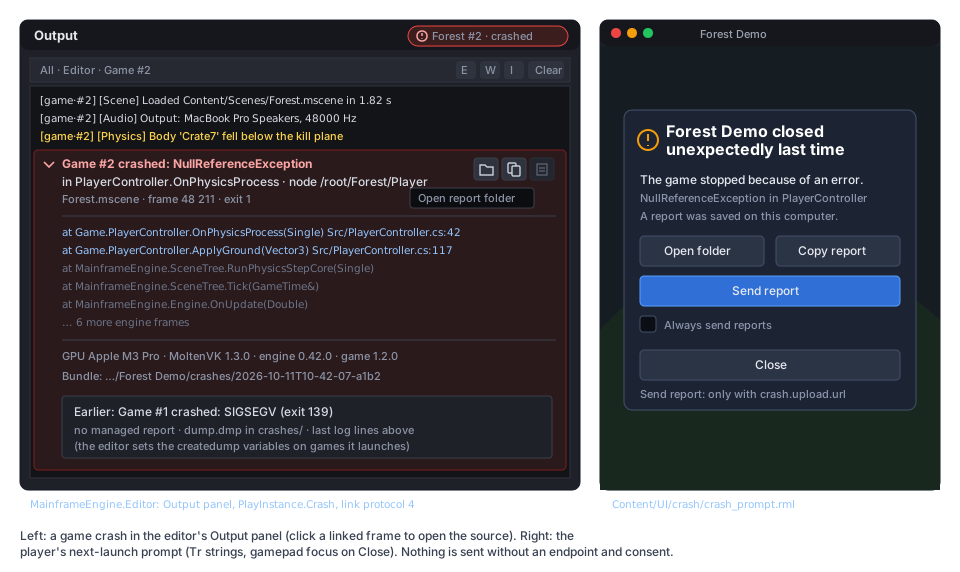
If crash.prompt is "ask" (the default) and PendingReports is not empty, GameHost shows CrashPrompt once the
first scene is on screen (after the loading screen, ADR 0183). It is an engine UiDocument
(Content/UI/crash/crash_prompt.rml) on the widget library, laid out in dp, reachable by gamepad (nav: auto), with
strings through Tr (an engine crash.pot, merged like G4’s settings.pot):
- “{game} closed unexpectedly last time” and a one-line summary (“The graphics driver stopped responding”);
- Open folder (desktop; behind
IAppPlatform.OpenUrlonce M12 adds it), Copy report (UiServer.ClipboardText:report.json+log.txt, never a dump), Send report (only withcrash.upload.url), Close, and “Always send reports” (UploadConsent, persisted by G4’sUserSettings).
Each choice calls MarkHandled, so a report is offered once. Games with their own flow set "prompt": "none" and use
PendingReports, Load and MarkHandled.
Upload (opt-in)
Section titled “Upload (opt-in)”ICrashUploader.SendAsync(CrashReportInfo, CancellationToken)runs on a worker and completes on the main thread.HttpCrashUploaderuses the BCLHttpClient(no NuGet package) and lives in the crash service, as the consoles checklist allows. Formats:"sentry-envelope"(newline-delimited JSON: an event mapped fromreport.json, log entries as breadcrumbs,log.txtandsettings.jsonas attachments, POSTed to/api/<project>/envelope/withX-Sentry-Authfrom the DSN; Sentry, self-hosted Sentry and compatible servers accept it) or"zip"(a multipart POST of the bundle to the game’s own endpoint).- Policy. Nothing is sent without
crash.upload.url. With"mode": "ask"only the player’s Send report sends; with"consented"reports go on the next launch whileUploadConsentis true. Dumps go only withincludeDumps;includeLogcan drop the log for games whose logs hold chat or names. The server sees the player’s IP address, so the game’s privacy policy must say so.
Editor: game crashes and its own
Section titled “Editor: game crashes and its own”- Link protocol 4 adds
CrashReport = 8(game → editor). It carriesreport.jsonwithout the log, which the editor already has, capped at 256 KB. The crash handler sends it with a 1 s timeout beforeGoodbye(GameSession.DisconnectEditor,GameSession.cs:362-373). A protocol 3 game still works; it just sends no report. PlayInstance.Crash(CrashReportInfo?) andExitCodes.Describe(code). Unix exit codes above 128 decode to a signal (134 → SIGABRT,139 → SIGSEGV), Windows codes to NTSTATUS names (0xC0000005access violation,0xC00000FDstack overflow,0xE0434352unhandled .NET exception), for the chip tooltip and the Output row. When no link report arrived, the editor looks for a dump that the variables above put incrashes/.- Output crash row (the SVG above). It is an error row: “Game #2 crashed: NullReferenceException in
PlayerController.OnPhysicsProcess”, with node path and scene. It expands to the frames; game frames with a file are
click-to-source through
Workspace.SourceOpener, and engine frames are muted. It has icon buttons with tooltips: open bundle folder, copy report, open dump folder (when a dump exists). The game’s earlier log rows stay above it. - The editor’s own crashes.
Program.cscallsCrashReporter.Installwith~/.mainframe/crashes, and its recovery-copy hook becomes aCrashinghandler that lists the copies in the report. On the next start,CrashDialog(after theUpdateCleanupresult, the same pattern) shows the summary, the recovery copies with Open each, Copy report, Open folder and Report issue (copies the report and opens the repository’s new-issue page with only the version in the title; no report data goes into the URL). The editor also gains a rotatingFileLogSinkin~/.mainframe/logs, so its sentinel has a previous log to attach.
Symbols
Section titled “Symbols”- Managed: portable PDBs stay next to the assemblies in editor releases and (G5) game exports. They let
Exception.StackTraceshow file and line, ReadyToRun included. Export gains"symbols": "ship" | "separate". Withseparate, the PDBs go into<name>-<version>-symbols.zipbeside the build, andmf-symbolicate(shared with M13’s NativeAOT tool) mapsmvid+ilOffsetback to lines. - Commit:
EngineInfo.Commitreads the+<sha>thatEngineInfo.Versiondrops today (⚠ check that the SDK’s SourceLink adds it in CI builds). - Natives:
natives.ymlbuildsRelWithDebInfoand splits the debug info (dsymutilon macOS,objcopy --only-keep-debugon Linux,/Zi+.pdbon Windows). The stripped binaries are committed as today; the symbols are a workflow artefact recorded innatives.lock.publish.ymlattachesMainframeEngine-<version>-symbols.zip(engine, editor and native symbols) to each GitHub release.
project.mfproj additions
Section titled “project.mfproj additions”{ "crash": { "enabled": true, "prompt": "ask", "logEntries": 200, "maxReports": 10, "gpuBreadcrumbs": true, "nativeDumps": "off", "upload": { "url": "", "format": "sentry-envelope", "mode": "ask", "includeLog": true, "includeDumps": false } }}nativeDumps is one of off | triage | mini | heap. All keys are optional with defaults, so format stays 3
(ProjectSettingsFormat.cs:20). The editor’s Project Settings dialog gains a Crash reports page.
Mobile and consoles
Section titled “Mobile and consoles”- M13 keeps its decision.
CrashReporter,CrashReportandPendingReportsare its layer 1 unchanged. The Sentry shim is anICrashSinkwithRunsBeforeWrite, and the native SDKs handle signals and ANRs. The desktop-only parts, the supervisor (C) andnativeDumps, are skipped on mobile, where processes cannot be spawned. - Consoles implement
ICrashSinkand the platform’s dump services in their private repositories. The public engine guarantees that the managed layer uses noProcessand noHttpClientoutside the upload service, and that it is AOT-clean:CrashReportuses source-generated JSON.
Threading and allocation
Section titled “Threading and allocation”Nothing runs per frame except the breadcrumb commands (no allocation) and field stores in the exception filters, which
only run on a throw. MemoryLogSink stops allocating once its ring is full. Context providers run only at crash time.
Pending-report listing reads report.json headers on a worker at start-up. The prompt waits for the result.
Testing
Section titled “Testing”- Unit (
Tests/MainframeEngine.Tests/Crash/):report.jsonround trip and schema golden; inner and aggregate exception chains; scrubbing; IL offset and MVID;- re-entrancy (a throwing
Crashinghandler, a second crash); slow or throwing providers; reserve released;.tmprename; pruning; oversize refusal; CrashSession: clean exit deletes the sentinel; a dead pid becomesUncleanExitwith the log tail; a live pid is ignored; no duplicate when a report exists;SceneTreefilter: node and callback recorded per callback kind; exception, type and stack trace unchanged;Tickstill throws; allocation gate on a non-throwing frame;ExitCodes.Describeper OS;GpuInfoversion decoding;SentryEnvelopegolden;HttpCrashUploaderagainst a localHttpListener(each policy,includeLog, retries).
- Out of process (
Tests/MainframeEngine.CrashTests): a smallGameHostfixture game, launched like the render-test host, crashes on++ crash=<kind>(managed inOnPhysicsProcess, a thread, an unobserved task,FailFast, a stack overflow, and a native fault through a fixture-only P/Invoke ofraise(SIGSEGV)/RaiseException(0xC0000005)). Each run asserts the bundle (or the next run’sUncleanExit), the exit code and, with--editor-portagainst a testEditorLinkServer, theCrashReportframe beforeGoodbye. With B’s variables set, a native fault leaves a dump. - Device loss: an internal
VulkanRendererOptions.SimulateDeviceLostAtFramemakesCheckthrow the typed exception at frame N (kindDeviceLost, clean shutdown). After normal frames every breadcrumb hasbegin == end == frame. Render tests run with breadcrumbs on: goldens unchanged, validation and allocation gates green. - UI (
SerialRmlUi):CrashPromptloads, binds, translates (qps) and is gamepad-reachable; goldenui-crash-promptfor both drivers. - Editor:
PlayServicewith a fake process (exit codes, linkCrashReport, no report and a dump present); Output crash row and click-to-source;CrashDialogwith recovery copies; QA script stepTests/QA/editor-game-crash.qa(Play a scene whose node throws, expand the row, open source).
Acceptance
Section titled “Acceptance”- A throw in any node callback, thread or task of a
GameHostgame leaves a bundle with the exception, its frames, the node path, callback, scene, frame counts, versions, OS, GPU and driver, and the last 200 log entries. Shutdown errors never hide the original. - A native fault, stack overflow or kill is reported as
UncleanExiton the next launch, with the previous log tail. WithnativeDumps(or when launched by the editor) a dump is attached on macOS, Linux and Windows. VK_ERROR_DEVICE_LOSTproduces aDeviceLostreport naming the passes in flight, with fault info where the driver supports it. Breadcrumbs cost no allocation and change no golden.- The next launch shows the prompt once per report, localized and gamepad-usable. Nothing is sent without an endpoint and the player’s consent. A Sentry-compatible server receives a valid envelope.
- The editor shows a game crash as one expandable Output row with click-to-source frames and a decoded exit signal. The editor’s own crash brings up a next-start dialog that offers the recovery copies.
- A GitHub release has a symbols zip, and native frames in our shims resolve to functions with it.
just build,just test,just test-renderandjust format-checkpass.- Docs updated when it ships:
project-and-gamehost.md(crash section, sentinel,crashsettings, link protocol 4),scene-graph-and-nodes.md(exception policy),editor.md(crash rows,CrashDialog, editor log file),natives.mdandrelease.md(symbols),testing.md(crash tests),future/mobile-services.md(layer 1 → this API).
Task list
Section titled “Task list”- G15.1 Report core:
CrashReportmodel + source-generated JSON, writer (reserve, re-entrancy, scrubbing,.tmprename, pruning),CrashReporterinstall, pending reports and handling,MemoryLogSinkring,SetContext,Crashing,ICrashSink. AlsoEngineInfo.Commit,GameHost.Run/HeadlessHostintegration (report first, guarded shutdown), the thread, task and audio hooks, theSceneTreeexception filters, and thecrashproject section; tests. - G15.2 GPU identity and device loss:
GpuInfo+IRenderer.Gpu+ start-up log line,VulkanDeviceLostException, loss-safeDispose,GpuBreadcrumbs(AMD marker or fill),VK_EXT_device_fault; simulated-loss test; render, validation and allocation gates. - G15.3 Unclean exits:
CrashSessionsentinel,UncleanExitreports with the previous log tail,ExitCodes; the out-of-process crash test project and fixture game. - G15.4 Player prompt:
crash_prompt.rml/.rcss,CrashPrompt,crash.potmerge, open folder and copy, G4 consent persistence hook; Demo wiring and test;ui-crash-promptgolden. - G15.5 Editor: link protocol 4
CrashReport,PlayInstance.Crash, decoded exit codes, Output crash rows with frames and icon buttons, dump variables on launched games, editorCrashReporter+FileLogSink+CrashDialogwith recovery copies; editor tests and QA script. - G15.6 Native dumps on desktop: a spike on
runtimeconfig.jsonknobs and on the Steam overlay with a relaunched child; thencrash.nativeDumps(B, plus C if needed), dumps in the bundle,NativeDumpkind; tests on three OSes. - G15.7 Upload:
ICrashUploader,HttpCrashUploader,SentryEnvelope, policies, prompt Send report, Project Settings page; tests against a local listener. - G15.8 Symbols:
RelWithDebInfo+ split symbols innatives.ymlandnatives.lock, a symbols zip inpublish.yml, G5’ssymbolsexport option,mf-symbolicateformvid+ IL offset (with M13). - G15.9 Later: hang detection (a main-thread heartbeat watched by a worker, with the supervisor dumping a hung
child), per-draw markers when
VK_AMD_buffer_markeris present, and option E if chosen.
Open questions
Section titled “Open questions”- Dumps without a relaunch. Do
runtimeconfig.jsonconfigPropertiescarryDbgEnableMiniDumpand its siblings, or are they environment-only? If they are environment-only, is a supervisor relaunch acceptable for shipped games (Steam overlay injection, start-up time, two processes in the task manager), or do shipped games get only A while editor runs get B? - Native capture dependency. Choose between the in-house path (A + B + C, no dependency),
sentry-nativein a native shim (MIT; matches M13’s Sentry choice and uploads minidumps), or Crashpad directly (Apache 2.0, heavy gn build). Any of the last two is a new native dependency and needs the usual discussion and anatives.ymlbuild. - Node exceptions. Keep fail-fast (proposed: state after a half-run callback is suspect), or offer Godot’s
behaviour (log the error and keep running) as
crash.nodeErrors: "logAndContinue"? If so, should a node that throws N times in a row stop processing? - Upload format. Ship both
sentry-envelopeandzip, or only the envelope, which self-hosted Sentry and compatible servers accept? Should the docs recommend a self-hostable receiver? - Steam error reporting. Is Steamworks’ minidump upload (Windows only ⚠) worth wiring for Steam games, or does the game’s own endpoint cover it?
- PDBs in player builds. Ship them (better traces; IL metadata already exposes the names) or always keep them separate and symbolicate offline?
- Logs and privacy. Should
includeLogdefault to false for uploads? Game logs can hold player names or chat. - Windows TDR. Is a “graphics driver reset” worth re-creating the device for instead of exiting, as a later item?
Related
Section titled “Related”- Project and GameHost (
GameHost.Run, log routing, editor link, user data), Scene graph and nodes, Editor (Play, Output, recovery copies, ADR 0083), Native libraries (mfplughost, the out-of-process precedent), Release, Testing (out-of-process tests, allocation and validation gates) - Mobile services (M13): layer 1, Sentry native SDKs
- Consoles: the plumbing checklist (no processes or HTTP in runtime code)
- Gameplay toolkit siblings: Save games and settings (G4:
DurableFile,UserSettings), Game export (G5: symbols), Profiler (G10: GPU zones per pass)