
Proposal: Navigation (grid A*, agents, later navmeshes)
Milestone: Gameplay toolkit (G3) · Status: ⬜ planned ·
Depends on: M6 physics (bake from collision shapes), M10 editor (toggle, inspector)
· Related: 2D content (G2: TileMapLayer feeds the grid), Editor viewport tools
(G7: region handles), Networking (server-authoritative movement), Mobile (AOT)
Problem
Section titled “Problem”The engine has no navigation. There is no grid pathfinder, no graph A*, no navmesh, no navigation server and no
path-following agent. A search of MainframeEngine/, MainframeEngine.Editor/ and Examples/ for
navigation, A*, navmesh and pathfinding finds only unrelated code: RmlUi gamepad focus navigation
(MainframeEngine/Src/UI/UiInputMap.cs:25-28) and the editor’s leaked-assembly finder
(MainframeEngine.Editor/Src/Projects/ReferencePathFinder.cs:11). Games that need enemies or units to walk around
walls write their own A*, usually allocating per query.
What exists and what navigation should build on:
- Server pattern.
IServer,IFrameServer(Processonce per frame) andIFixedStepServer(FixedStepafter each step’sOnPhysicsProcess) inMainframeEngine/Src/Servers/ServerRegistry.cs:12-36;Register/Get<T>at:79and:104. The engine registers the physics servers inbase.OnLoad()(MainframeEngine/Src/Core/Engine.cs:373-375), dedicated servers inHeadlessHost(MainframeEngine/Src/Project/HeadlessHost.cs:51-52).PhysicsServer2Dkeeps one space perWorld2D(MainframeEngine/Src/Physics/2D/PhysicsServer2D.cs:85-180), registers lazily throughFor(tree)(:104) and debug-draws whenDebugDrawEnabled(:99,:152). Edit mode runs frame servers but not fixed-step servers (MainframeEngine/Src/Scene/SceneTree.cs:76-83). - Movement.
CharacterBody2D.Velocity+MoveAndSlide()(MainframeEngine/Src/Physics/2D/CharacterBody2D.cs:56,:152),CharacterBody3Dthe same (MainframeEngine/Src/Physics/3D/CharacterBody3D.cs:40,:153), called fromNode.OnPhysicsProcess(float delta)(MainframeEngine/Src/Scene/Node.Processing.cs:149). - Physics queries.
World2D.DirectSpaceState(MainframeEngine/Src/Scene/World3D.cs:104-116) withIntersectShape/IntersectPoint(PhysicsServer2D.cs:45,:56); 3D has the same (MainframeEngine/Src/Physics/3D/PhysicsDirectSpaceState3D.cs:107,:125). Queries are main-thread only and allocation-free (physics.md → Queries). Bodies join their space inOnEnterTree, also in the editor (MainframeEngine/Src/Physics/2D/CollisionObject2D.cs:95-100; engine types keep their lifecycle in edit mode,MainframeEngine/Src/Scene/Node.EditMode.cs:6-12). - Debug drawing.
SceneViewport.DebugLinesandOverlayLines(MainframeEngine/Src/Scene/SceneViewport.cs:109,:115): allocation-free line batches; 2D producers draw in the z = 0 plane in pixels withAddLine2D,AddPolygon2D,AddCircle2D(MainframeEngine/Src/Rendering/Debug/DebugLines.cs:164-175), capped atMaxLines(:19).EngineOptions.DebugCollisionShapes(Engine.cs:77) and the dev overlay’s Physics panel checkbox (MainframeEngine/Src/Debugging/DevOverlay/DevOverlayPanels.cs:238-260,DevOverlayStats.cs:312-322) switch the physics debug draw. - Math.
Vector2IandRect2I(MainframeEngine/Src/Math/Vector2I.cs:16,Rect2I.cs:15,HasPointat:252) are exportable and store as number arrays (math.md). - Editor hooks. Custom inspector sections with
data-actionbuttons (ICustomInspector,CustomInspectorAttribute,MainframeEngine.Editor/Src/Inspector/InspectorModel.cs:162-191); the toolbar’s view toggles (MainframeEngine.Editor/Content/Editor/toolbar.rml:69-70).
AStarGrid2D: Godot’s grid A* (region, cell size, diagonal modes, heuristics, weights, solid cells, partial paths, optional jump point search) with allocation-free queries into caller buffers.AStar2D/AStar3D: Godot’s general point-graph A* (waypoint graphs, also usable in 3D before navmeshes exist).NavigationServer2D: a registered server with one map perWorld2D; regions register with it; agents query it.NavigationGrid2Dnode: a grid region whose solid cells are baked from collision shapes (throughSrc/Physicsqueries only), painted by aTileMapLayer(G2) or set from code.NavigationAgent2Dnode: target position, next path position, automatic repath, arrival distances, signals (PathChanged,WaypointReached,TargetReached,NavigationFinished,VelocityComputed).- Debug draw in games and the editor; editor Bake button and Visible Navigation toggle.
- Deterministic results (same input, same path on every OS/CPU) for server-authoritative and lockstep games.
- A Demo scene (
navigation_2d). - Later phases, designed here but shipped after the core: avoidance (RVO/ORCA), 2D navmesh polygons, async path queries, 3D (grid on the ground plane, then navmesh baking).
Non-goals
Section titled “Non-goals”- Navmesh baking in the first phases. 3D baking needs a dependency decision (Open questions).
- Cross-region path stitching for grids. Grids of one map should not overlap; connected regions come with polygon navmeshes (G3.9) and links.
- Isometric and hexagonal grids (Godot’s
CellShape) until G2 shipsTileShapevalues beyondSquare. - Hierarchical pathfinding (HPA*) and flow fields. They can be added on top of
AStarGrid2Dlater. - Replicating paths to clients. Clients see replicated positions; paths stay on the server.
- Behaviour trees, steering beyond path following, formations.
Design
Section titled “Design”Code layout
Section titled “Code layout”New folder MainframeEngine/Src/Navigation/ (everything below is new):
| Folder / file | Contents |
|---|---|
AStarGrid2D.cs, GridSearch.cs | the grid pathfinder and its search scratch (A*, JPS) |
AStar2D.cs, AStar3D.cs, PointGraph.cs | point-graph A* |
NavigationServer2D.cs, NavigationMap2D.cs | server, maps, path queries, sync, debug draw |
Nodes2D/NavigationGrid2D.cs, NavigationGridData.cs | the grid region node and its baked data resource |
Nodes2D/NavigationAgent2D.cs | the agent |
Baking/GridPhysicsBaker2D.cs | cell solidity from World2D.DirectSpaceState |
later: Avoidance/, Polygons/, 3D/ | G3.7–G3.12 |
The navigation code never calls Box2D.NET or Jitter2. It reads collision through the public query API, so the
“physics calls stay in Src/Physics” rule holds.
AStarGrid2D
Section titled “AStarGrid2D”A plain C# class (Godot’s is RefCounted), usable without a tree: games, tools and the server all use it.
public enum GridDiagonalMode : byte { Always, Never, AtLeastOneWalkable, OnlyIfNoObstacles }public enum GridHeuristic : byte { Euclidean, Manhattan, Octile, Chebyshev }public enum GridPathStatus : byte { Found, Partial, NotFound, InvalidPoint, BufferTooSmall }
public class AStarGrid2D{    // Layout. Changing these marks the grid dirty; call Update() before querying (Godot's rule).    public Rect2I Region { get; set; }    public Vector2 CellSize { get; set; } = Vector2.One;    public Vector2 Offset { get; set; }    public GridDiagonalMode DiagonalMode { get; set; } = GridDiagonalMode.Always;    public GridHeuristic DefaultComputeHeuristic { get; set; } = GridHeuristic.Euclidean;    public GridHeuristic DefaultEstimateHeuristic { get; set; } = GridHeuristic.Euclidean;    public bool JumpingEnabled { get; set; }    public bool IsDirty { get; }    public void Update();                                   // (re)allocates cell storage and search scratch
    // Cells. No Update() needed; each change bumps Version.    public uint Version { get; }    public bool IsInBounds(Vector2I id);    public void SetPointSolid(Vector2I id, bool solid = true);    public bool IsPointSolid(Vector2I id);    public void SetPointWeightScale(Vector2I id, float weightScale);    public float GetPointWeightScale(Vector2I id);    public void FillSolidRegion(Rect2I region, bool solid = true);    public void FillWeightScaleRegion(Rect2I region, float weightScale);    public void Clear();                                    // region = empty, all cells free    public Vector2 GetPointPosition(Vector2I id);           // cell centre: Offset + (id + 0.5) * CellSize    public Vector2I GetPointAt(Vector2 position);           // new: the cell containing a position
    // Queries. Allocation-free; count is the number of points written.    public GridPathStatus GetIdPath(Vector2I from, Vector2I to, Span<Vector2I> path, out int count,        bool allowPartialPath = false);    public GridPathStatus GetPointPath(Vector2I from, Vector2I to, Span<Vector2> path, out int count,        bool allowPartialPath = false);    public Vector2I[] GetIdPath(Vector2I from, Vector2I to, bool allowPartialPath = false);   // allocates (tools, tests)    public int MaxSearchNodes { get; set; }                 // 0 = unlimited; exceeded → Partial or NotFound
    // Godot's _compute_cost / _estimate_cost. Overriding them disables the built-in fast paths.    protected virtual float ComputeCost(Vector2I from, Vector2I to);    protected virtual float EstimateCost(Vector2I from, Vector2I end);}
Behaviour follows Godot 4:
- Diagonal modes.
Alwaysmoves diagonally even between two solid cells;AtLeastOneWalkableneeds one of the two side cells free;OnlyIfNoObstaclesneeds both (no corner cutting);Neveris 4-way. - Heuristics. Euclidean, Manhattan, Octile, Chebyshev, used for both the step cost and the estimate unless overridden. Step cost is multiplied by the entered cell’s weight scale (≥ 0).
- Solid start or target.
InvalidPointiffromis solid or outside the region. A solid or unreachabletoreturnsNotFound, or withallowPartialPaththe path to the reachable cell with the lowest estimate toto(Partial). - Jump point search (
JumpingEnabled) for every diagonal mode. Like Godot, it ignores weight scales.
Deviations from Godot, and why:
- Buffers instead of returned arrays. Godot returns a new
PackedVector2Arrayper call. Here the caller passes aSpan;BufferTooSmallreports the needed size incount. The allocating overload exists for tools and tests. - JPS paths list every cell. Godot returns only the jump points. Expanding them keeps
GetIdPathoutput the same with JPS on or off; agents simplify paths anyway. - Top-level enums (
GridDiagonalMode,GridHeuristic) instead of nested ones: Godot’s C# binding has to call themDiagonalModeEnumbecause they clash with the property names. GetPointAtandVersionare new: every caller needs the inverse ofGetPointPosition, and the server needs to know when cells changed.
Memory and allocation. Cells are indexed (y - Region.Y) * Region.Width + (x - Region.X). Solidity is a
ulong[] bitset; weights are a float[] allocated only when a cell gets a weight other than 1. The search scratch
(GridSearch) holds float[] g, int[] parent, uint[] stamp and an indexed binary heap, sized in Update(). A
per-query stamp marks cells open/closed, so a query never clears arrays (they are cleared once when the stamp wraps).
About 16 bytes per cell (a 256 × 256 grid is 1 MB). Region.Area is capped at 4 194 304 cells (2048²); larger
worlds need several grids or HPA* later. After Update(), queries, cell edits and fills allocate nothing.
Determinism. Costs use only +, * and MathF.Sqrt on float, which are exact IEEE operations in .NET on x64
and Arm64 (RyuJIT does not fuse multiply-adds on its own). The heap breaks ties by lower f, then lower h, then
lower cell index, and neighbours expand in a fixed order. So a grid and a query give the same path on every OS, CPU
and thread. A golden-path test locks this in.
AStar2D and AStar3D
Section titled “AStar2D and AStar3D”Godot’s point-graph A* for waypoint graphs (G3.2): AddPoint(long id, Vector2 position, float weightScale = 1),
RemovePoint, ConnectPoints(a, b, bidirectional = true), DisconnectPoints, SetPointDisabled,
GetClosestPoint(position), GetClosestPositionInSegment, ReserveSpace(n), and the same span-based
GetIdPath/GetPointPath plus allocating overloads; ComputeCost/EstimateCost are virtual. Storage is a
Dictionary<long, int> from id to a dense slot plus slot arrays, so queries do not allocate. AStar3D is the same
with Vector3. It gives 3D games hand-placed waypoint navigation long before navmeshes (G3.12).
NavigationServer2D and maps
Section titled “NavigationServer2D and maps”public sealed class NavigationServer2D : IFixedStepServer, IFrameServer{ public static NavigationServer2D For(SceneTree tree); // registers a default one if missing (tests) public bool DebugDrawEnabled { get; set; } public IReadOnlyList<NavigationMap2D> Maps { get; } public NavigationMap2D GetMap(World2D world); // created on first use}
public sealed class NavigationMap2D{ public World2D World { get; } public uint IterationId { get; } // bumped by every sync that changed something public GridPathStatus QueryPath(in NavigationPathQuery2D query, NavigationPath2D result); public Vector2 GetClosestPoint(Vector2 point, uint navigationLayers = 1); public void ForceSync(); // apply pending region changes now (tools, tests)}
public readonly record struct NavigationPathQuery2D(Vector2 Start, Vector2 Target, uint NavigationLayers = 1, NavigationPathPostprocessing Postprocessing = NavigationPathPostprocessing.CorridorFunnel, bool AllowPartialPath = true);
public sealed class NavigationPath2D // reusable result; grows, never shrinks{ public ReadOnlySpan<Vector2> Points { get; } public ReadOnlySpan<Vector2I> Cells { get; } // grid regions: the cells behind Points public GridPathStatus Status { get; } public NavigationGrid2D? Region { get; }}World2DgainsNavigationMap2D? NavigationMap { get; internal set; }, the same way it holds itsPhysicsSpace(World3D.cs:115).- The engine registers the server in
base.OnLoad()right afterPhysicsServer2D(Engine.cs:375), so itsFixedStepruns after the physics step.HeadlessHostregisters it too: dedicated servers are where agents run. - Sync points. Region changes (a node entering or leaving, a bake,
SetCellSolid) are queued and applied at the map’s next sync: inFixedStepwhile the game runs, inProcesswhen no fixed step ran that frame (edit mode, paused tree). A sync that changed anything bumpsIterationId. Queries during a tick therefore all see the same map, whatever the order of the nodes that ask (Godot’s model). - Query. The map picks the region whose layers intersect
NavigationLayersand that containsStart(regions are checked in registration order; the closest walkable cell within 2 cells is used ifStartis in a solid cell).Targetoutside the region, or in a solid cell, is clamped to the closest reachable cell whenAllowPartialPath. - Post-processing reuses Godot’s enum names on grids:
CorridorFunnelkeeps only the cells needed for line-of-sight (string pulling with a grid line test that respects the diagonal mode),EdgeCenteredkeeps the corners (collinear cells removed),Nonekeeps every cell centre. On polygon navmeshes (G3.9) they mean what they mean in Godot. - Debug draw (when
DebugDrawEnabled) writes intoSceneViewport.DebugLines: region outline, cell lines, solid cells (outline and cross), weighted cells (dashed amber), each agent’s path, next path position and target. It is culled to the activeCamera2D’s visible rect (SceneViewport.ActiveCamera2D,SceneViewport.cs:131) and stays well underDebugLines.MaxLines. Colours live inNavigationDebugColors(static, settable).
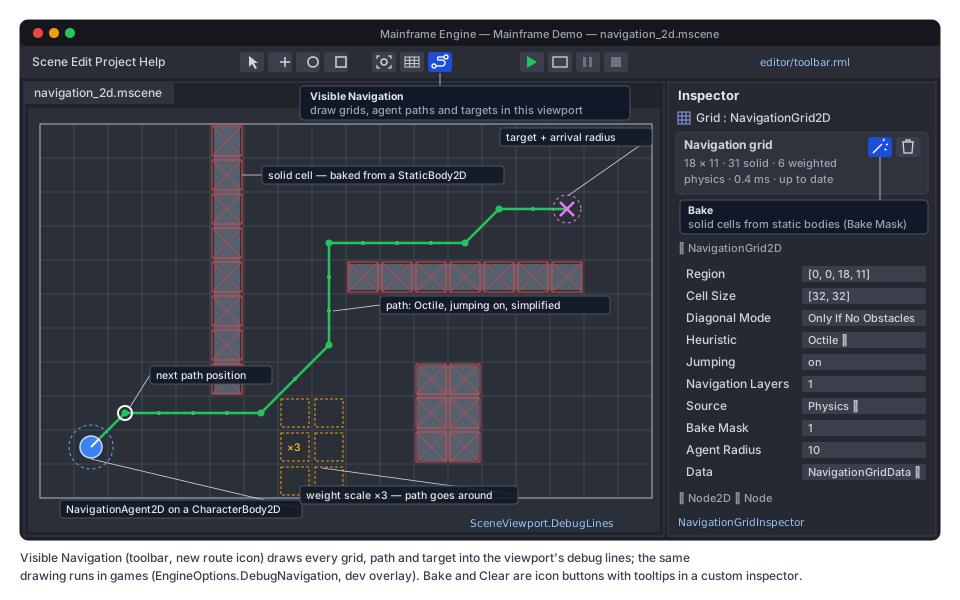
NavigationGrid2D and NavigationGridData
Section titled “NavigationGrid2D and NavigationGridData”A Node2D that owns an AStarGrid2D and registers it with the map of its viewport’s World2D in OnEnterTree
(unregisters in OnExitTree). The constructor only sets defaults.
[EditorIcon("grid-3x3", Family = EditorIconFamily.Space2D)]public class NavigationGrid2D : Node2D{    [Export] public Rect2I Region { get; set; } = new(0, 0, 32, 32);    [Export] public Vector2 CellSize { get; set; } = new(32, 32);    [Export] public GridDiagonalMode DiagonalMode { get; set; } = GridDiagonalMode.OnlyIfNoObstacles;    [Export] public GridHeuristic Heuristic { get; set; } = GridHeuristic.Octile;    [Export] public bool JumpingEnabled { get; set; }    [Export(Flags = true)] public uint NavigationLayers { get; set; } = 1;
    [ExportGroup("Bake")]    [Export] public NavigationGridSource Source { get; set; } = NavigationGridSource.Physics; // Manual, Physics, TileMapLayer    [Export(Flags = true)] public uint BakeCollisionMask { get; set; } = CollisionLayers.Default;    [Export(Range = "0,256,0.5")] public float AgentRadius { get; set; }    [Export(NodeType = typeof(TileMapLayer))] public NodePath TileMapLayerPath { get; set; }  // G3.6, type from G2    [Export] public int TilePhysicsLayer { get; set; }    [Export] public string SolidDataLayer { get; set; } = "solid";    [Export] public string WeightDataLayer { get; set; } = "";    [Export] public bool BakeOnReady { get; set; }    [Export] public NavigationGridData? Data { get; set; }
public AStarGrid2D Grid { get; } public void Bake(); // main thread; replaces Data public void SetCellSolid(Vector2I cell, bool solid); // runtime edits (doors, destroyed walls); applied at sync public void SetCellWeight(Vector2I cell, float weightScale);}- Defaults differ from
AStarGrid2Don purpose: a body cannot squeeze between two diagonal wall corners, so the node defaults toOnlyIfNoObstaclesandOctile(exact for 8-way grids). - Placement. Cell
(x, y)coversGlobalPosition + (x, y) * CellSizeto+ CellSize. The node’s global rotation and scale are ignored (a warning is logged once); grids are axis-aligned like tile maps. - Data.
NavigationGridData : Resource(inline in the scene, or a.mres) holds the baked state. Large grids must not become 16 000-line JSON arrays (the writer puts one array element per line), so cells are a compact string: run-length-encoded solid bits in base64, and weights as(run, value)pairs only where they differ from 1.
{ "format": 2, "uid": "res_3f2a9c0e1b7d", "type": "NavigationGridData", "props": { "Region": [0, 0, 18, 11], "Solid": "rle1:BQAIAAkHAA…", "Weights": "rle1:fwAD…:3", "BakedFrom": "Physics" }}A decode error, or a Region that does not match the node, logs a warning and leaves the grid empty (all
walkable) rather than failing the scene load. The codec is plain code (no reflection), so AOT/trimming is fine.
- Physics bake (
GridPhysicsBaker2D, main thread, allocates; edit time or a level load). For each cell it callsWorld2D.DirectSpaceState.IntersectShapewith one reusedRectangleShape2Dthe size of the cell grown byAgentRadiuson each side, masked byBakeCollisionMask. OnlyStaticBody2Dhits count by default (CollisionObject2D.cs:165), plusTileMapLayerhits once G2b.3 widens query results fromCollisionObject2DtoNode2D(tile bodies report their layer); moving bodies are dynamic obstacles (avoidance, G3.7). Areas are never reported by queries. A 128 × 128 grid is 16 384 overlap tests, a few milliseconds.BakeOnReadybakes once in a deferred call after the scene’s bodies entered the tree (procedural levels). - Runtime edits.
SetCellSolid/SetCellWeightchange the live grid (notData), queue a sync and so make agents repath on the next tick.
NavigationAgent2D
Section titled “NavigationAgent2D”A Node child of the body it steers (Godot’s model). It does not move anything: the body’s own
OnPhysicsProcess asks it where to go and calls MoveAndSlide. It reads the parent Node2D’s GlobalPosition,
which is the simulation position inside OnPhysicsProcess (interpolated render poses apply only outside it).
[EditorIcon("route", Family = EditorIconFamily.Space2D)]public class NavigationAgent2D : Node{    [Export] public Vector2 TargetPosition { get; set; }    [Export(Range = "0.1,1000,0.1")] public float PathDesiredDistance { get; set; } = 20f;   // px, Godot's default    [Export(Range = "0.1,1000,0.1")] public float TargetDesiredDistance { get; set; } = 10f;    [Export(Range = "10,1000,1")] public float PathMaxDistance { get; set; } = 100f;    [Export(Range = "0,1000,0.1")] public float TargetRepathDistance { get; set; }           // new; 0 = Godot behaviour    [Export(Flags = true)] public uint NavigationLayers { get; set; } = 1;    [Export] public NavigationPathPostprocessing PathPostprocessing { get; set; } = NavigationPathPostprocessing.CorridorFunnel;    [Export] public bool DebugEnabled { get; set; }
    public Vector2 GetNextPathPosition();       // repaths if needed, advances waypoints, raises signals    public bool IsNavigationFinished();    public bool IsTargetReached();    public bool IsTargetReachable();    public float DistanceToTarget();    public Vector2 GetFinalPosition();    public ReadOnlySpan<Vector2> GetCurrentNavigationPath();    public int GetCurrentNavigationPathIndex();    public void SetVelocity(Vector2 velocity);  // → VelocityComputed (pass-through until avoidance, G3.7)
    [Signal] public event Action? PathChanged;    [Signal] public event Action<NavigationWaypoint2D>? WaypointReached;   // struct: position, index, cell    [Signal] public event Action? TargetReached;    [Signal] public event Action? NavigationFinished;    [Signal] public event Action<Vector2>? VelocityComputed;}
Use from a body (the whole pattern):
public sealed class Chaser : CharacterBody2D{    [Export] public float Speed { get; set; } = 140f;    private NavigationAgent2D _agent = null!;
    protected override void OnReady() => _agent = GetNode<NavigationAgent2D>("Agent");
protected override void OnPhysicsProcess(float delta) { if (_agent.IsNavigationFinished()) return; Velocity = GlobalPosition.DirectionTo(_agent.GetNextPathPosition()) * Speed; MoveAndSlide(); }}- Repath (lazy, inside
GetNextPathPosition, like Godot): whenTargetPositionchanged (by more thanTargetRepathDistance, which keeps chasers that set the target every tick from searching every tick), when the map’sIterationIdchanged, when the agent is farther thanPathMaxDistancefrom its current path segment, or afterRequestRepath(). An idle agent costs nothing per frame. - Waypoints. While the agent is within
PathDesiredDistanceof the current point it advances (raisingWaypointReached). WithinTargetDesiredDistanceof the target it raisesTargetReached; at the end of the path it raisesNavigationFinishedonce. Signals fire on the main thread from the caller’sOnPhysicsProcess. - Signals are
[Signal]C# events likeArea3D.BodyEntered(MainframeEngine/Src/Physics/3D/Area3D.cs:24-25). Godot’swaypoint_reachedpasses aDictionary; here it is a struct, so raising it does not allocate. - Path storage. Each agent owns one
NavigationPath2D; it grows when a longer path appears and is reused after that, so steady state allocates nothing. SetVelocityraisesVelocityComputedwith the same velocity until avoidance exists, so code written for avoidance (move in theVelocityComputedhandler) works before and after G3.7.
TileMapLayer integration (with G2)
Section titled “TileMapLayer integration (with G2)”2D content (G2b) adds TileSet/TileMapLayer and reserves this hook (“Navigation hook (G3)”
there): navigation reads a layer only through its public API (GetUsedCells, GetUsedRect, GetCellTileData,
MapToLocal, TileSet.TileSize, the Changed signal) and G2 adds no navigation fields. With
Source = TileMapLayer the grid:
- copies
TileSet.TileSizeasCellSize, the layer’s position as its own, andGetUsedRect()asRegion(unlessRegionwas set by hand). Grid cell(x, y)is map cell(x, y), soMapToLocalandGetPointPositionagree; - marks a cell solid when its tile has collision on the physics layer
TilePhysicsLayer(new export, default 0), or when its tile’s bool custom data layer namedSolidDataLayer(default"solid", G2’s own example) is true; empty cells are walkable; - reads weights from an optional float custom data layer
WeightDataLayer(default empty = all 1); - re-reads the layer when it raises
Changed, at most once per sync. With G2’s signal as designed (no dirty rect) that is O(used cells) with a reusedList<Vector2I>, allocation-free once sized; a 256 × 256 layer re-reads in well under a millisecond. If that proves too slow for games that dig every frame, aCellsChanged(Rect2I)signal is the one addition navigation would ask of G2 (Open questions).
Only TileShape.Square layers are accepted (the only shape G2 ships); others log a warning and leave the grid empty.
Per-tile navigation polygons (Godot’s TileSetNavigationLayer, a name G2 reserves) belong to 2D navmeshes (G3.9).
Editor
Section titled “Editor”- Visible Navigation toggle on the toolbar, in the view group after Grid (
toolbar.rml:69-70): an icon button (new Tabler iconroute) with the tooltip “Visible Navigation — draw grids, agent paths and targets in this viewport”. It setsNavigationServer2D.DebugDrawEnabledof the edited scene’s tree. Default on, like collision shapes (MainframeEngine.Editor/Src/EditorApp.cs:91). NavigationGridInspector([CustomInspector(typeof(NavigationGrid2D))]): a header with icon buttons Bake (new iconwand; “Bake — solid cells from static bodies (Bake Mask)” or “…from the TileMapLayer”) and Clear (trash; “Clear — make every cell walkable”), and a status line: size, solid and weighted counts, source, bake time, and “out of date” when a body in the region moved since the bake. Bake and Clear replaceDatathrough the inspector context, so they undo.- Agent gizmo. The selected
NavigationAgent2Ddraws itsTargetDesiredDistanceandPathDesiredDistancecircles intoOverlayLines. Dragging theRegionedges uses G7.3’s handle API (Editor viewport tools) once it exists; until thenRegionis edited in the inspector. - Icons.
routeandwandare added toMainframeEngine.Editor/Content/icons/icons.txt(just editor-icons-fetch, thenjust editor-icons);grid-3x3andtrashalready exist. - Running games use the dev overlay: a “Navigation” checkbox in the Physics panel next to “Collision shapes”
(
DevOverlayPanels.cs:243), andEngineOptions.DebugNavigation(new) to start with it on.
Threading
Section titled “Threading”- G3.1–G3.8: main thread. Queries run inside the caller’s
OnPhysicsProcess; bakes run on the main thread because physics queries are main-thread only. A 128 × 128 query is expected well under 0.1 ms (benchmarked in G3.1), so most games never need more. - G3.10: async queries (opt-in).
NavigationMap2D.QueryPathAsync(in query, NavigationPath2D result)returns aNavigationPathRequesthandle (a struct). Workers run on the .NET thread pool through a cachedIThreadPoolWorkItem(no per-request allocation), each with its ownGridSearchscratch, against an immutable snapshot of the grid taken at the last sync (copy-on-write: a changed grid allocates a new snapshot only on the tick it changed). Results are delivered at the next sync point, which waits for requests submitted before it. Delivery therefore always lands exactly one tick later, so async queries stay deterministic. Agents withAsyncPath = truekeep following the old path until the new one arrives, then raisePathChanged. Anavigationsection inproject.mfproj(format bump + migration) holds the worker count and the default.
Networking and determinism
Section titled “Networking and determinism”- Movement is server-authoritative (ADR 0041).
Agents run where the body’s movement runs: on the server (or the host). Clients get replicated positions; their
agents stay idle. The usual gate is
if (Multiplayer is { IsServer: false }) return;(MainframeEngine/Src/Scene/Node.Network.cs:30,MainframeEngine/Src/Networking/Replication/MultiplayerApi.cs:119). - Paths depend only on the map state at the last sync and the query, never on frame timing or thread scheduling
(see
AStarGrid2Ddeterminism and the async delivery rule). Lockstep games and replays get identical paths on every machine. Physics itself is deterministic only on one machine/build (physics.md), so bit-identical movement across machines is not promised; identical paths are. - Dedicated servers (
--headless) register the navigation server like the physics servers; nothing in navigation needs a window or GPU.
Later phases
Section titled “Later phases”- Avoidance (G3.7). ORCA/RVO for agents and
NavigationObstacle2D(radius or polygon, static or moving), run in the server’sFixedStepafter paths:AvoidanceEnabled,Radius,MaxSpeed,NeighborDistance,MaxNeighbors,TimeHorizonAgents,TimeHorizonObstacles,AvoidanceLayers/Mask,AvoidancePriority(Godot names). Results raiseVelocityComputedbefore the next tick’sOnPhysicsProcess. Neighbour search uses a uniform grid owned by the map (no allocation). The algorithm source is an open question. - 2D navmesh polygons (G3.9).
NavigationPolygon : Resource(outlines → convex polygons) andNavigationRegion2D(Godot names), A* over polygon adjacency plus the funnel algorithm,NavigationLink2Dfor jumps and teleports, regions joined by shared edges. Baking from physics shapes and tile outlines with agent-radius offsetting. This is the step between grids and 3D navmeshes, and it tests the map/region/agent split on non-grid data. - 3D (G3.11–G3.12).
NavigationServer3Dwith the same map/region/agent split,NavigationAgent3D(Vector3, plusPathHeightOffset), and first aNavigationGrid3D: anAStarGrid2Don the XZ plane at a height, baked withIntersectShapeagainst 3D static bodies — enough for top-down 3D games, tower defence and RTS. ThenNavigationMesh+NavigationRegion3Dwith baking from collision shapes and meshes; the baking library is undecided (Open questions).
Testing
Section titled “Testing”- Unit,
Tests/MainframeEngine.Tests/Navigation/:AStarGrid2DTests: each diagonal mode’s corner rules on hand-made grids (expected id lists); each heuristic; weights reroute a path; solid start (InvalidPoint), solid/unreachable target (NotFound,Partial); out-of-region points;BufferTooSmallreports the needed size; dirty grid throws untilUpdate();GetPointAt/GetPointPositionround trip; stamp wrap-around.- Optimality: on 200 seeded random grids the path cost equals a brute-force Dijkstra cost for every admissible heuristic/diagonal-mode pair; JPS cost equals plain A* cost (uniform weights).
- Determinism: a fixed maze gives a golden id list and hash, the same with JPS expanded, on all three CI OSes.
AStar2DTests/AStar3DTests: connect/disconnect, disabled points, closest point and segment, partial paths.NavigationGrid2DTests: physics bake of rectangle/circle/capsule/polygon static bodies (expected cells),AgentRadiusclearance, mask filtering, rigid and character bodies ignored;NavigationGridDataRLE round trip through.mres, corrupt data → empty grid + warning; runtimeSetCellSolidbumpsIterationIdat sync; (G3.6)TileMapLayersource from tile collision, a"solid"bool and a float weight custom data layer, re-read onChanged, non-square layers rejected.NavigationAgent2DTests(headless tree, fixed delta): aCharacterBody2Dreaches the target; signal order (PathChanged,WaypointReached…,TargetReached,NavigationFinishedonce); repath on map change, on target move beyondTargetRepathDistance, on being pushed pastPathMaxDistance; unreachable target →IsTargetReachable() == falseand a partial path.NavigationAllocationTests: 0 bytes over 300 ticks after warm-up with 64 agents chasing moving targets on a 128 × 128 grid, runtime cell edits every 30 ticks, and debug draw on (AllocationGate.SmallestWindow).
- Editor,
Tests/MainframeEngine.Editor.Tests/:NavigationGridInspectorBake/Clear changeDataand undo; the Visible Navigation command toggles the server flag. - Benchmarks (
Tests/MainframeEngine.Benchmarks, newNavigationBenchmarks, added tobaseline.json): 256 × 256 open field and maze, A* vs JPS, 8-way and 4-way; 64-agent repath tick. - Render tests: no new goldens; debug lines are already covered. The allocation gate’s
showcasescene is unchanged. - QA:
Tests/QA/editor-walkthrough.qaopens the Demo’snavigation_2dscene, toggles Visible Navigation, bakes, undoes, and screenshots the viewport. - Demo (
Examples/Demo): anavigation_2dtab (iconroute): a walled maze (StaticBody2Dwalls, baked grid saved inline), mud patches (weight 3), a dozenChaserbodies with agents that follow the clicked point, and a side panel for diagonal mode, heuristic, jumping, Visible Navigation, and “click to add a wall” (runtimeSetCellSolid→ everyone repaths).Demo.Testschecks that headless chasers reach a target. The nav bar’s number keys stop at 8 (Examples/Demo/Demo/Src/Nav/DemoNav.cs:102). They extend to 1–9 then 0 andnavigation_2dtakes the next free key (scheme in 2D content).
Acceptance
Section titled “Acceptance”AStarGrid2Dmatches Godot’s results on the test grids for every diagonal mode and heuristic, queries allocate nothing, and paths are identical on Windows, Linux and macOS.- A
CharacterBody2Dwith aNavigationAgent2Dwalks around baked walls to a target in the Demo, repaths when a wall is added, and the 64-agent allocation gate passes. - The editor shows the grid, paths and targets with Visible Navigation on, and Bake/Clear work and undo.
- With G2 shipped: painting a solid tile updates the grid and agents repath.
- Docs updated when this ships: new
docs/design/navigation.md(current state);docs/design/physics.md(bake via queries),docs/design/editor.md(toggle, inspector, icons),docs/design/dev-overlay.md(Navigation checkbox),docs/design/demo.md(new tab and its key),docs/design/scene-graph-and-nodes.md(new nodes),docs/design/architecture-overview.md(server list),docs/design/testing.md(allocation gate row), and the project structure inCLAUDE.md(Src/Navigation/).
Task list
Section titled “Task list”G3.1–G3.6 are the core of the milestone item (what 2D content calls “G3a”); G3.7 onwards are the later phases.
- G3.1 Grid A.*
AStarGrid2D+GridSearch(A*, diagonal modes, heuristics, weights, partial paths, spans, determinism); unit tests, optimality and golden tests; benchmarks. - G3.2 JPS and graphs. Jump point search;
AStar2D,AStar3D; tests. - G3.3 Server and grid node.
NavigationServer2D,NavigationMap2D(sync, query, post-processing),NavigationGrid2D,NavigationGridData(RLE codec), physics bake, debug draw,EngineOptions.DebugNavigation, dev overlay checkbox; registration inEngineandHeadlessHost; tests. - G3.4 Agent.
NavigationAgent2D(repath rules, waypoints, signals,SetVelocitypass-through); agent tests; allocation gate; Demonavigation_2dscene, panel,Demo.Tests, nav key;just demo-screenshots. - G3.5 Editor. Visible Navigation toggle,
NavigationGridInspector(Bake/Clear/status, undo), agent gizmo, iconsroute/wand; editor tests; QA script step; docs (navigation.mdand the list in Acceptance). - G3.6 TileMapLayer source (after G2b.2/G2b.3): solid/weight from tile collision and custom data layers,
re-read on
Changed; tests; a navigating enemy in G2’stiles_2dDemo scene. - G3.7 Avoidance. ORCA for agents,
NavigationObstacle2D; tests (head-on pairs, crowds, allocation gate). - G3.8 Grid polish. Isometric cell shapes if G2 needs them; HPA* only if a game needs it.
- G3.9 2D navmesh polygons.
NavigationPolygon,NavigationRegion2D, funnel,NavigationLink2D, bake. - G3.10 Async queries. Snapshots, worker scratch, next-sync delivery,
project.mfprojsection; tests. - G3.11 3D grid.
NavigationServer3D,NavigationGrid3D,NavigationAgent3D; Demo 3D variant. - G3.12 3D navmesh.
NavigationMesh,NavigationRegion3D, baking — after the dependency decision.
Open questions
Section titled “Open questions”- 3D navmesh baking library. Candidates, none assumed:
- Recast/Detour (C++, zlib licence, actively maintained by the recastnavigation project; Godot bakes with
Recast). Needs a native shim built per RID in
natives.ymllikemfrmlui(natives.md), and static linking for iOS (mobile.md). - DotRecast (C# port of Recast/Detour, zlib licence, NuGet; mostly one maintainer). No native build; check AOT and trimming, per-query allocation, and release cadence before relying on it.
- Our own voxel/region/contour pipeline: no dependency, but months of work.
- Recast/Detour (C++, zlib licence, actively maintained by the recastnavigation project; Godot bakes with
Recast). Needs a native shim built per RID in
- Polygon clipping for 2D navmeshes (agent-radius offsetting, merging obstacles): Clipper2 (Boost Software Licence, C# version on NuGet, maintained by Angus Johnson) or simpler in-house code (ear clipping, no offsetting).
- Avoidance algorithm source. Write ORCA from the paper, or port RVO2 (Apache 2.0, the library Godot uses) with attribution. Either way it is plain C#; the question is licence notice and test vectors.
- Weights with JPS. Follow Godot (ignore weights silently) or fall back to plain A* when any weight is set?
- Rotated grids. Is axis-aligned enough, or should
NavigationGrid2Dhonour its global rotation? - Painting cells in the editor without a
TileMapLayeror bodies (a small paint mode in the inspector)? - Pixel defaults. Godot’s 20/10 px
PathDesiredDistance/TargetDesiredDistanceassume small tiles; should the agent derive them from the grid’sCellSizewhen left at default? - Tile map dirty rects. Is G2’s plain
Changedsignal enough (re-read the used cells), or should G2 addCellsChanged(Rect2I)for games that dig or build every frame? - Visible Navigation in played games. Should the editor’s toggle also switch the running game’s debug draw over the editor link (Godot’s Debug menu does), or is the dev overlay enough?
Related
Section titled “Related”- Physics, Scene graph and nodes, Networking, Dev overlay, Editor, Demo
- Gameplay toolkit siblings: 2D content (G2), Editor viewport tools (G7), Save games and settings (G4: agents hold no saved state; save the target), Keyframe animation (G1)