
Proposal: Terrain (Terrain3D, sculpt and paint tools, scatter, faceted and realistic profiles)
Milestone: Gameplay toolkit (G8a) · Status: ⬜ planned ·
Depends on: M6 physics (trimesh collision), M10 editor (viewport, undo, save);
the Realistic profile also on Rendering features G6.1/G6.2 (PBR, IBL; Blinn-Phong fallback
until then) and G6.4 (index-only LODs) · Related: Procedural trees (G8b:
FoliageMaterial3D, wind, Tree3D scatter), Water (G8c: renders the water layer),
Forest showcase (G8d: the Realistic profile’s first user),
Editor viewport tools (G7),
ADR 0149
Problem
Section titled “Problem”The engine has no terrain. A 3D game today builds its ground from MeshInstance3D boxes or one hand-made mesh, and
has no way to sculpt, paint or scatter in the editor. This design was first written for a low-poly game built on the
engine, modelled on TerraBrush (MIT). This proposal upstreams it as a
generic engine feature with two looks.
What exists, and what is missing:
- Height fields.
HeightMapShape3D(MainframeEngine/Src/Physics/3D/Shapes3D.cs:306-311) is a trimesh (“Jitter2 has no native height field”), static only, centred, on a 1-unit grid, with one fixed diagonal (GetFaces,:373), and has no render side.ConcavePolygonShape3D(:258) adds one Jitter2TriangleShapeper face (:280; physics.md). - Vertices.
MeshVertexis a fixed 32 bytes: position, normal, UV (MainframeEngine/Src/Rendering/Meshes/MeshVertex.cs:12-21), with one vertex layout (:45-49).MeshSurfacehas no colours or custom data (MainframeEngine/Src/Rendering/Resources/Mesh.cs:83-120). - Materials. 3D draws built-in materials only. Set 2 is one 80-byte block, one sampler and three images
(
MainframeEngine/Content/Shaders/include/material.slang:24-29,MainframeEngine/Src/Rendering/Meshes/MeshRenderer.cs:158-171).OutlineMaterial3D(MainframeEngine/Src/Rendering/Resources/Material.cs:351) shows how a built-in type adds a shader set (MainframeEngine/Src/Rendering/Meshes/PipelineStateCache.cs:6-16, ADR 0132). Lighting is Blinn-Phong (MainframeEngine/Content/Shaders/include/lights.slang:99). - Textures. There is no texture-array resource, but the GPU side can make them:
GpuImageDesc.ArrayLayers(MainframeEngine/Src/Rendering/Vulkan/Memory/GpuImage.cs:8), the shadow cascades (MainframeEngine/Src/Rendering/Shadows/ShadowSystem.cs:581) and the layer count ofGpuTexture.Create(MainframeEngine/Src/Rendering/Vulkan/Memory/GpuTexture.cs:84, used for cubes at:70). - Texture updates.
Texture2D.SetPixelsreplaces the whole image (MainframeEngine/Src/Rendering/Resources/Texture2D.cs:293),TextureGpu.Updatere-creates the GPU image on every change (MainframeEngine/Src/Rendering/Meshes/MeshGpuResources.cs:148-170) andUploadImagecopies whole images (MainframeEngine/Src/Rendering/Vulkan/Memory/UploadQueue.cs:96). A painted map would be re-created every frame. - PNG. The codec handles 8-bit RGB/RGBA only (
MainframeEngine/Src/Imaging/Png.cs:206-208). Heights need 16. - Instancing. Batching is automatic (ADR 0015), but every instance is a node and the shared
InstanceBufferis rewritten every frame (MainframeEngine/Src/Rendering/Meshes/InstanceBuffer.cs:5-11): about 0.19 ms of CPU per 10,000 instances (materials-and-meshes.md → Performance), before node costs. Foliage needs hundreds of thousands. There is noMultiMesh. - Editor. No API lets a tool own the viewport while a node is selected: input goes to the gizmo and picking
(
MainframeEngine.Editor/Src/Viewport/ViewportController.cs:285), andEditorSession.Savewrites only the scene (MainframeEngine.Editor/Src/Session/EditorSession.cs:340-357), so a tool has no hook to write its images.
Terrain3D+TerrainData: a square heightmap terrain with its layers as PNG files next to the scene, chunked meshes, collision built from the render triangles, exact queries and an analytic raycast.- Two profiles, picked when the data is created: Faceted (flat palette colours, 2 m facets, today’s renderer) and Realistic (smooth normals, 0.5–1 m spacing, chunk LOD, PBR texture layers with splat weights).
- A runtime paint API for games (surface, user channels, foliage, objects) with 0 B per frame and sub-rect uploads.
- A generic editor viewport-tool API (
IEditorViewportTool) and a Terrain dock with Sculpt, Paint, Foliage, Objects and Water modes, brushes, per-stroke undo and a save hook. MultiMesh+MultiMeshInstance3D(Godot’s API subset) for foliage and other mass instancing.- Prerequisites as engine features in their own right:
Texture2DArray, a second vertex stream (MeshSurface.Colors/Custom0), 16-bit grey PNG,Texture2D.SetPixelsRect. - The Faceted profile ships first, on the Blinn-Phong renderer.
Non-goals
Section titled “Non-goals”- Streaming, zones or world partition. One terrain per scene, loaded whole (Realistic maps up to 2 km at 1 m).
- Holes, caves, overhangs, voxel terrain. Tunnels are meshes.
- A camera-centred clipmap or GPU height sampling (TerraBrush’s approach). Heights stay on the CPU for queries.
- Runtime erosion or procedural generation tools beyond the brushes. Import a 16-bit PNG from another tool instead.
- Custom terrain shaders. The two materials are built-in types (ADR 0149).
- Water rendering, rivers and flow (Water, G8c). This proposal owns the water layer only.
- Tree generation and wind (Procedural trees, G8b).
Design
Section titled “Design”Coordinates, grid and chunks
Section titled “Coordinates, grid and chunks”- Origin at the map corner. Terrain-local X and Z run from 0 to
SizeMeters. World =GlobalPosition+ local. Rotation and scale on the node are ignored, with an editor configuration warning. - Height vertices sit at
(i·Spacing, h(i, j), j·Spacing),i, jin0..NwithN = SizeMeters / Spacing. - Cells are squares of
CellSize([u, u+1) × [v, v+1)cells). Surface, splat, user and foliage maps have one texel per cell. Images: column x runs along +X, row y along +Z, row 0 first. - Chunks are
ChunkQuads × ChunkQuadsquads. Neighbours repeat their shared edge vertices from the same heights, so edges match bit for bit.ChunkQuadsmust be even and divideN(validated on load).
| Knob | Faceted default | Realistic default | Notes |
|---|---|---|---|
SizeMeters | 512 | 1024 | max 1024 (Faceted), 2048 (Realistic) |
Spacing | 2 m | 1 m | Realistic 0.5–1 m; ≤ 2049 × 2049 vertices |
CellSize | 1 m | = Spacing | Faceted cells are half a quad, for crisper paint edges |
ChunkQuads | 16 (32 m) | 64 (64 m at 1 m) | 256 chunks either way at the defaults |
HeightMin/HeightMax | −16 / +48 m | −64 / +192 m | 16-bit decode range (1 mm / 4 mm steps) |
Diagonal | Checkerboard | Checkerboard | below |
Profile, SizeMeters, Spacing, CellSize and ChunkQuads are fixed once the data is created. To change them,
import a resampled heightmap into new data.
The diagonal rule. Each quad (i, j) splits along a fixed diagonal. Checkerboard gives diamond facets that look
the same in every direction and keep ramps symmetric; Uniform uses diagonal A everywhere (as HeightMapShape3D).
Chunk origins are multiples of an even quad count, so local and global parity agree and every chunk shares one index
pattern.
| Quad | Diagonal | Triangles (counter-clockwise from above) |
|---|---|---|
Uniform, or Checkerboard with (i + j) even | A: (i+1, j)–(i, j+1) | (00, 01, 10), (10, 01, 11) |
Checkerboard with (i + j) odd | B: (i, j)–(i+1, j+1) | (00, 11, 10), (00, 01, 11) |
HeightAt interpolates on the triangle that contains the point (fractions fx, fz in the quad): A with
fx + fz ≤ 1 gives h00 + (h10−h00)·fx + (h01−h00)·fz, otherwise h11 + (h01−h11)·(1−fx) + (h10−h11)·(1−fz); B
with fx ≥ fz gives h00 + (h10−h00)·fx + (h11−h10)·fz, otherwise h00 + (h01−h00)·fz + (h11−h01)·fx. This is
exact on the drawn LOD 0 triangle. It is not nearest-pixel (TerraBrush) and not bilinear, which would disagree with
the surface by up to half a quad’s twist.
Data and files
Section titled “Data and files”TerrainData : Resource (terrain.mres, JSON like any resource, ADR 0011) holds the knobs above, Profile,
Surfaces (Faceted) or Layers (Realistic), UserChannels, FoliageTypes, ObjectTypes, the water settings
(MaxWaterDepth, default 1.2 m), Material (inline), CollisionLayer/CollisionMask (1, 0), CollisionMode and
CastShadows. It holds no pixels: those are images in its folder. A new terrain’s folder is <scene>_terrain/ next to
the scene, for example Content/Scenes/world_terrain/.
| File | Profile | Format, size | Contents |
|---|---|---|---|
terrain.mres | both | JSON | the knobs and resource lists |
heightmap.png | both | 16-bit grey, (N+1)² | h = HeightMin + v / 65535 · (HeightMax − HeightMin) |
surface.png | Faceted | RGBA8, cells | R = surface id; G, B, A reserved (0) |
splat-0.png, splat-1.png | Realistic | RGBA8, cells | weights of layers 0–3 and 4–7 (sum 255) |
user.png | both | RGBA8, cells | four game-defined channels |
water.png | both | RGBA8, (N+1)² | R = depth fraction; G, B flow (reserved for G8c); A reserved |
foliage-0.png, foliage-1.png | both | RGBA8, cells | density of foliage types 0–3 and 4–7 |
objects.mres | both | JSON | ScatterObjectList: NextId + instances {Id, Type, X, Z, Yaw, Scale} |
*.png.meta | both | sidecar | linear, no mipmaps, nearest, clamp (TextureImportSettings) |
- Only dirty layers are written (temp file, then rename) on scene save; layers at their defaults are not written, and a
missing file loads as its default, so a new folder works with only
terrain.mres. - Heights are quantised at once. Every height written is rounded to the 16-bit step, so save and load give back the same floats and the editor and the game stand on the same ground.
- User channels replace game-specific layers.
TerrainUserChannel { Name, Kind, Legend }:Kind = Valueblends (a cut-grass state, wetness, snow cover) andKind = Idpaints crisp ids (named areas, with a legend of names and editor colours). What a channel means is game data. - Ids are append-only. Surface, layer, foliage-type and object-type indices are stored in images and lists, so they are never reordered or reused.
Terrain3D, chunks and collision
Section titled “Terrain3D, chunks and collision”Terrain3D : Node3D ([EditorIcon("mountain")]) is an engine type, so its enter and ready callbacks also run in edit
mode (ADR 0127). It has no per-frame callback of its own.
- Chunks are internal
TerrainChunk3D : GeometryInstance3Dchildren with noOwner, so the scene writer skips them (MainframeEngine/Src/Serialization/SceneWriter.cs:227) and a viewport click selects the terrain (EditedScene.SelectableFor,MainframeEngine.Editor/Src/Session/EditedScene.cs:80). Each overridesGetRenderMeshasSprite3Ddoes (MainframeEngine/Src/Scene/Nodes3D/GeometryInstance3D.cs:181), so the normal mesh renderer culls, sorts, shadows and ID-picks them. OneArrayMeshper chunk with chunk-local positions; UV = terrain-local XZ ÷SizeMeters. A height edit rewrites the chunk’s arrays in place and re-uploads it. - Collision is one internal
StaticBody3Dper chunk with aConcavePolygonShape3Dwhose faces are exactly the chunk’s LOD 0 triangles: same heights, same diagonal, same winding.HeightMapShape3Dis not used: its diagonal and origin differ, and it is a trimesh anyway. Collision is rebuilt at the end of an editor stroke for the touched chunks, and at once after a runtimeSetHeights. Static shapes exist in edit mode, so physics rays work there. - Collision modes. Jitter2 makes one shape per triangle. Faceted at 512 m is 131k triangles; Realistic at 1 km
and 1 m is 2.1M, too many to keep.
CollisionMode.All(default up to 0.6M triangles, so 512 m at 1 m) builds every chunk.CollisionMode.NearBodies(default above) keeps chunk shapes only withinCollisionRadius(96 m) of a moving body, from a pool, built on the fixed tick before the step. The moving-body bounds come from a new read call inSrc/Physics, so no Jitter2 code leaves it.Terrain3D.Raycaststays exact everywhere; physics ray queries far from bodies test terrains analytically (decision 2).
Queries and the runtime API
Section titled “Queries and the runtime API”public enum TerrainProfile : byte { Faceted, Realistic }public enum TerrainDiagonal : byte { Checkerboard, Uniform }[Flags] public enum TerrainLayers : ushort{ None = 0, Height = 1, Surface = 2, User = 4, Foliage = 8, Water = 16, Objects = 32 }
[EditorIcon("mountain")]public sealed class Terrain3D : Node3D{ public const int WaterSurface = 255; [Export] public TerrainData? Data { get; set; } [Export(Range = "0.25,4,0.05")] public float LodBias { get; set; } = 1f; // Realistic chunk LOD
// Queries: world space, metres; outside the map they clamp to the edge. Main thread, 0 B. public bool Contains(float x, float z); public float HeightAt(float x, float z); // exact on the LOD 0 triangle public Vector3 NormalAt(float x, float z); // that triangle's face normal (what physics sees) public Vector3 SmoothNormalAt(float x, float z); // interpolated vertex normal (placement, shading) public int SurfaceAt(float x, float z, bool ignoreWater = false); // id / strongest layer / WaterSurface public float LayerWeightAt(int layer, float x, float z); // Realistic, 0..1 public byte UserChannelAt(int channel, float x, float z); public float WaterDepthAt(float x, float z); // metres above the bed; 0 when dry public bool Raycast(Vector3 origin, Vector3 direction, float maxDistance, out TerrainHit hit);
// Paint: clamp, mark the layer dirty, queue a sub-rect upload, raise Changed. 0 B. public void PaintSurface(Vector2 centerXZ, float radius, int surface, float strength = 1f); public void SetUserChannel(int channel, Vector2 centerXZ, float radius, byte value); public void SetFoliageDensity(int type, Vector2 centerXZ, float radius, float density); public void GetHeights(Rect2I vertices, Span<float> destination); public void SetHeights(Rect2I vertices, ReadOnlySpan<float> heights); public void GetCells(TerrainLayers layer, int image, Rect2I cells, Span<uint> destination); // packed RGBA public void SetCells(TerrainLayers layer, int image, Rect2I cells, ReadOnlySpan<uint> source);
// Scattered objects (below): Objects, TryGetObject(id), GetObjectNode(id), RemoveObject(id), ObjectTypeIndex(name).
public event Action<TerrainChange>? Changed;}
public readonly record struct TerrainHit(Vector3 Position, Vector3 Normal, float Distance);public readonly record struct TerrainChange(TerrainLayers Layers, Rect2I Cells, Rect2I Chunks, bool FromUndo);Raycastclips the ray to the terrain box, walks chunks with a 2D DDA (each chunk’s min/max box rejects most), then quads, testing the quad’s two triangles. A vertical ray readsHeightAtdirectly. It replaces TerraBrush’s 0.1 m CPU ray march, and the editor’s brush picking uses it.PaintSurfacecovers the cells whose centre is withinradius. Faceted:strengthbelow 1 is a coverage; a cell is painted only where a 4 × 4 ordered-dither threshold at its global coordinates is understrength, so repeated calls do not creep. Realistic: the layer’s weight moves toward 1 bystrengthand the other seven are scaled to keep the sum at 255.Changedis raised synchronously with a struct payload. Foliage, objects, water (G8c) and game caches listen.- Writes in Play are not undoable and not saved; the scene’s images keep the authored state. A game that saves terrain changes stores them itself (Save games).
GPU uploads
Section titled “GPU uploads”Texture2D.SetPixelsRect(x, y, width, height, ReadOnlySpan<byte> source, int sourceStride) (new) copies a rectangle
into the CPU pixels and widens a pending dirty rectangle; the terrain passes its whole map with its stride, so there
is no scratch buffer. TextureGpu.Update then uploads only that rectangle into the existing image (a new
UploadQueue.UploadImageRegion with offset, extent and layer) and keeps Generation, so descriptor sets stay valid.
Writes in one frame merge into one copy: a 1 m runtime brush uploads a few dozen bytes, a 128 m editor brush at most
64 KB. Size or format changes still re-create the image.
Load, rebuild and budget
Section titled “Load, rebuild and budget”OnReady decodes the layer files (Data.EnsureLoaded()), builds the GPU maps for Data.Material, the chunk meshes,
collision, then foliage and objects. Replacing Data (inspector, undo) tears down and rebuilds; a palette or layer
change updates the material only. Every change applies live, with no “Update terrain” button. OnExitTree frees the
chunks; the layers stay in the cached resource, so unsaved edits survive a code reload.
| What | Budget (reference desktop) |
|---|---|
| Steady-state frame, nothing changing | 0 B managed; no terrain CPU work |
SetUserChannel every physics tick | 0 B, < 0.02 ms, one sub-rect upload per frame |
HeightAt, NormalAt, SurfaceAt, UserChannelAt | < 50 ns each, 0 B |
Raycast across the whole map | < 20 µs, 0 B |
| Editor stroke tick, 20 m brush | < 2 ms (≤ 4 chunk rebuilds and uploads) |
| Load, Faceted 512 m (256 meshes, 256 bodies) | < 400 ms |
| Load, Realistic 1 km at 1 m (256 meshes with LODs, collision near bodies) | < 1.5 s |
| Memory, Realistic 1 km at 1 m | heights 4 MB, maps ≈ 24 MB, chunk meshes ≈ 70 MB (CPU + GPU, MeshVertex) |
Faceted profile: TerrainMaterial3D
Section titled “Faceted profile: TerrainMaterial3D”A built-in material, added like OutlineMaterial3D (ADR 0132): ShaderSetId.MeshTerrain = the standard
Mesh/Mesh.vk.vert.slang + a new Mesh/Terrain.vk.frag.slang, on the existing set 2 layout. Per fragment:
- Facet normal
normalize(cross(ddx(worldPos), ddy(worldPos))), flipped up: the exact face normal, with shared vertices (289 per chunk, not 1,536); it is also the geometric normal for the shadow offset. - Surface cell with a texel fetch of the surface map (albedo slot): the 1 m cell containing the fragment (
Cell, default; matchesSurfaceAt), or the cell at the triangle’s centroid (Triangle, coarser low-poly edges). - Palette:
TerrainMaterial3D.SetPalette(ReadOnlySpan<TerrainSurface>)packs a 32 × 2 sRGB texture (normal slot): row 0 each surface’sColor, row 1 itsStripeColor, alpha = “has bands”. A texture, not a uniform block, so no new set layout is needed. Unused ids are magenta. - Optional bands and tint. Surfaces with a stripe colour show world-aligned two-tone bands (
StripeWidth,StripeAngleDegrees; lawns, crop rows), box-filtered so they fade to the average instead of shimmering far away.TintChannel(−1 = off) names a user channel (emission slot) that tints towardTintColorand gates the bands (BandStart): long grass that turns banded when cut, scorched ground, wet sand. - Editor overlays behind flag bits: an Id-channel tint in legend colours, and a soft brush disc on the ground.
- Lighting through
shadeLightsBlinnPhongexactly asStandardMaterial3D(matte: specular 0.05, shininess 8). Flat palette colours look the same under PBR, so this profile does not wait for G6.
The 80-byte parameter block keeps its C# layout and is reinterpreted, as the outline packs its width into flags.w;
include/terrain.slang documents the fields. Casters and the ID pass need no change (opaque, position only).
Realistic profile
Section titled “Realistic profile”Smooth normals and chunk LOD
Section titled “Smooth normals and chunk LOD”- Vertex normals come from central differences of the full heightmap, so neighbouring chunks agree at their seams.
- LOD scheme: geomipmapping with skirts. Each chunk keeps its LOD 0 vertices; coarser levels (every 2nd, 4th, 8th, 16th vertex: 5 levels for 64-quad chunks) are index lists over the same vertices. A ring of skirt vertices hangs below the chunk edge by the coarsest level’s error plus a margin, and every level’s indices include the skirt, so a chunk can sit next to any level without cracks or stitching.
- Selection is G6.4’s: chunks store their levels as
MeshSurface.Lods(index-onlyMeshLod), each withError= the largest height difference between the level and LOD 0 over the chunk.MeshRendererpicks the coarsest level whose projected error is ≤ 1 px (Terrain3D.LodBiasfeeds the instance’sLodBias), and shadow casters draw the camera’s level. If the Realistic profile lands before G6.4, G8a.13 builds G6.4.1–G6.4.2 first (the same code). - Why not CDLOD. CDLOD morphs vertices in the vertex shader from a height texture: smooth transitions, but a new vertex shader, a height texture next to the CPU heights, and casters and the ID pass that would need it too. Geomipmapping keeps the standard vertex shader and every existing pass, reuses the G6.4 data and sort-key bits, and at a 1 px error threshold the pops are below a pixel. LOD cross-fade stays a G6 non-goal.
- Collision and queries stay at full resolution (LOD 0). A far chunk at LOD 3 differs from its collision by less than a pixel on screen. Every level keeps the LOD 0 vertex normals, so distant lighting keeps the detail.
TerrainLayer and TerrainSplatMaterial3D
Section titled “TerrainLayer and TerrainSplatMaterial3D”public sealed class TerrainLayer : Resource // up to 8 per terrain; index = splat channel{ [Export] public string Name { get; set; } = ""; [Export] public string Tag { get; set; } = ""; // game key for SurfaceAt (footsteps, friction) [Export] public Texture2D? Albedo { get; set; } // sRGB [Export] public Texture2D? Normal { get; set; } // OpenGL convention, linear [Export] public Texture2D? Orm { get; set; } // occlusion R, roughness G, metallic B (glTF packing) [Export] public Texture2D? Height { get; set; } // optional; packed into the albedo array's alpha [Export(Range = "0.25,64,0.05")] public float TilingMeters { get; set; } = 4f; [Export(Range = "0,1,0.01")] public float HeightBlendContrast { get; set; } = 0.2f; [Export] public bool Triplanar { get; set; } // rock: project on steep slopes [Export] public bool AntiTiling { get; set; } = true;}TerrainSplatMaterial3D : Material has LayerTextureSize (1024), TriplanarStartDegrees/EndDegrees (35°/45°),
DetailDistance (60 m), FarDistance (150 m), FarTilingScale (4), MacroStrength (0.15) and an optional
MacroColor map. It packs the layers into three Texture2DArrays at load (albedo + height in A, normal, ORM), each
with a mip chain, and binds the two splat maps as a two-layer array. Per fragment:
- Weights. Sample both splat maps (bilinear) and keep the four strongest of the eight weights (two in the far band). Sampling all eight would cost 24+ fetches before triplanar.
- Height blending. With
hᵢfrom the albedo alpha:wᵢ' = max(hᵢ + wᵢ − (maxⱼ(hⱼ + wⱼ) − contrastᵢ), 0), normalised, so gravel fills the gaps between cobbles instead of fading over them. - Anti-tiling. Hex-tiling (Mikkelsen 2022, “Practical Real-Time Hex-Tiling”, JCGT): three rotated, offset
samples per lookup blended on a hex grid, in the near band and on
AntiTilinglayers only. - Triplanar for
Triplanarlayers where the slope is between the start and end angles and beyond; elsewhere one planar sample with an analytic tangent frame (UV = world XZ, so T = +X and B = +Z, no derivative frame). - Distance: the near band does all of the above; the far band two layers with planar samples at
FarTilingScale; betweenDetailDistanceandFarDistanceboth are computed and blended (a dynamic branch, so only the transition band pays twice).MacroStrengthnoise andMacroColorbreak up repetition at every distance. - Lighting with
PbrSurfacethrough G6.1’sshadeLightsPbrand G6.2’s IBL.
Blinn-Phong fallback (before G6.1 lands). The profile works on today’s renderer: weights, height blending, normal
maps, triplanar and hex-tiling are all fragment work. Lighting goes through shadeLightsBlinnPhong, with AO
multiplying the albedo, roughness r mapped to Specular = 0.5·(1 − r)² and Shininess = 2/max(r⁴, 0.002) − 2,
and metallic ignored. There is no image-based light, so it looks flatter than the target. The Realistic golden is
re-recorded when G6.2 switches it to PBR.
Its own pipeline and descriptor set
Section titled “Its own pipeline and descriptor set”TerrainSplatMaterial3D does not fit the 3-image set 2, so it gets ShaderSetId.MeshTerrainSplat
(Mesh/Mesh.vk.vert.slang + Mesh/TerrainSplat.vk.frag.slang), its own set 2 layout, a second pipeline layout in
MeshRenderer (sets 0 and 1 shared) and its own descriptor allocator. Draws sort by pipeline first, so the layout
switches once per frame. Casters and the ID pass are unchanged.
| Set 2 (terrain splat) binding | Contents |
|---|---|
| 0 | TerrainSplatParams UBO: per-layer tiling, contrast and flags; bands; macro; terrain size |
| 1, 2 | samplers: linear repeat with anisotropy (layers); linear clamp (maps) |
| 3, 4, 5 | Texture2DArray: albedo + height, normal, ORM (8 layers) |
| 6 | Texture2DArray: splat weights (2 layers) |
| 7 | MacroColor or a 1 × 1 fallback |
Fragment-stage budget (G6 binding budget: ≤ 16 sampled images and ≤ 16 samplers per stage, ≤ 4 sets): shadows 6 images / 6 samplers, frame set with every G6 feature 4 / 1, terrain 5 / 2: 15 images, 9 samplers, 3 sets. Before G6: 11 and 8. Set 3 stays free.
Prerequisite engine features
Section titled “Prerequisite engine features”None of these exist today (a search for each name in MainframeEngine/Src, MainframeEngine.Editor/Src and
MainframeEngine/Content/Shaders finds nothing):
| Feature | What it adds | Users |
|---|---|---|
| 16-bit PNG | Png.WriteGray16(stream, w, h, ReadOnlySpan<ushort>), Png.ReadGray16 (also reads 8-bit grey and 16-bit RGB/RGBA via R; refuses interlaced, as ReadRgba8 does) | heightmaps, import from other tools |
Texture2D.SetPixelsRect | the dirty rectangle and in-place region upload (above) | every painted map; G8c flow maps |
Texture2DArray | resource (Godot’s name): FromPixels(w, h, layers, rgba), FromImages(Texture2D[]) (same size required), SetLayerPixels, SetPixelsRect(layer, …), colour space, mipmaps; GpuTexture.Create2DArray over the existing private Create | splat material |
| Second vertex stream | MeshSurface.Colors (Color[], stored RGBA8) and MeshSurface.Custom0 (Vector4[]), Godot’s ARRAY_COLOR/ARRAY_CUSTOM0; binding 2, 20 B per vertex, present only when either is set; VertexLayoutId.MeshInstancedStream2; StandardMaterial3D.VertexColorUseAsAlbedo | grass (wind weight, AO), G8b trees; MeshVertex stays 32 B and casters still read binding 0 only |
| Viewport-tools API | IEditorViewportTool and its host (next section) | the Terrain dock; G8c River3D editing |
MultiMesh | below | foliage, object scatter in MultiMesh mode, G8b impostors |
Editor: IEditorViewportTool
Section titled “Editor: IEditorViewportTool”All in MainframeEngine.Editor/Src/Viewport/ (new files IEditorViewportTool.cs, ViewportTools.cs,
ViewportToolHost.cs). A tool takes over the viewport while a node of its type is the only selected node, like
Godot’s EditorPlugin._handles/_forward_3d_gui_input.
public interface IEditorViewportTool{    bool Handles(Node node);                                  // e.g. node is Terrain3D (even with no Data)    void Activate(IViewportToolContext ctx, Node node);    void Deactivate();    ViewportToolResult OnInput(in ViewportToolInput input);   // Consumed: no gizmo, no pick    void DrawOverlay(IViewportOverlay overlay);               // rings, lines (OverlayLines / DebugLines)    string? DockDocument { get; }                             // RmlUi document, bound to the "viewport_tool" model    void SaveExternalData();                                  // on scene save, before the scene file is written}
public enum ViewportToolResult : byte { Pass, Consumed }public readonly struct ViewportToolInput { /* Kind (Press, Release, Motion, Wheel, KeyDown, KeyUp, Cancel), Button,    Key, WheelDelta, MousePixel, RayOrigin, RayDirection (EditorCamera.Ray), Modifiers (Shift, Alt, Command), InView,    Captured */ }public interface IViewportToolContext { EditedScene Scene { get; } UndoRedo History { get; } EditorCamera Camera { get; }    RmlDataModel? DockModel { get; } void SetCursorLabel(string? text); void SetStatus(string? text); }
[AttributeUsage(AttributeTargets.Class, Inherited = false)]public sealed class EditorViewportToolAttribute(Type nodeType) : Attribute{ public Type NodeType { get; } = nodeType; public string Title { get; init; } = ""; // dock tab title public string Icon { get; init; } = ""; // editor icon atlas name}- Activation follows the selection: one instance per tab per tool type, kept until the tab closes so the save hook reaches a tool that was deactivated. The node’s gizmo is hidden while its tool is active. Every tool has a None state (Esc) that passes all input, so clicks pick as usual.
- Routing in
ViewportController.OnInput, after dialogs and camera drags: reserved navigation never reaches a tool (Alt+left, middle, right, the plain wheel, any key with Command), then a captured tool drag, then the tool, then the gizmo and picking, then workspace shortcuts. A consumed left press captures the mouse until release; an interrupted capture sendsCancel, and the tool commits what it already applied. Keys reach the tool only while the pointer is over the view.ViewportToolInputis a readonly struct passed byin: routing allocates nothing. - Dock: the right dock gets a tab strip, Inspector | Terrain, sharing the inspector’s rectangle. The host
creates the
viewport_tooldata model before the document loads (RmlUi binds on load) and disposes it on deactivation. Icon buttons havedata-tooltips (the editor’s icon lint). - Undo goes through the tab’s
UndoRedo(ADR 0082): a stroke is applied live and committed once on release withCommit(action, alreadyApplied: true)(MainframeEngine.Editor/Src/Undo/UndoRedo.cs:94), the gizmo’s pattern (ViewportController.cs:642). Actions reference the node, never the tool, so Cmd+Z works after deselecting. - Save hook:
EditorSession.SavecallsSaveExternalData()on every tool instance of the tab beforeSceneSaver.Save(EditorSession.cs:357). A throwing tool fails the save: the scene file is not written and the tab stays dirty, so a new scene never points at old data. Autosave goes through the same path. - Discovery scans for
[EditorViewportTool]the wayCustomInspectorsscans for[CustomInspector](MainframeEngine.Editor/Src/Inspector/InspectorModel.cs:198-204), reset on code reload.
Overlap with G7. Editor viewport tools (G7) adds IHandleProvider point handles
(G7.3), box selection (G7.4) and Simulate (G7.5), not a tool that owns the viewport. The two meet in five places, and
whichever lands first builds the shared piece: one attribute scan for [CustomInspector], [HandleProvider] and
[EditorViewportTool]; one drag/cursor label element in viewport.rml; the routing order (a captured tool drag
comes before DragKind.Handle and DragKind.Box, and a tool’s node shows no handles); single selection only (G7.1’s
multi-node gizmo applies when no tool is active); and Simulate deactivates tools until Stop. This API could be
listed as G7.6; it is specified here because the terrain is its first user.
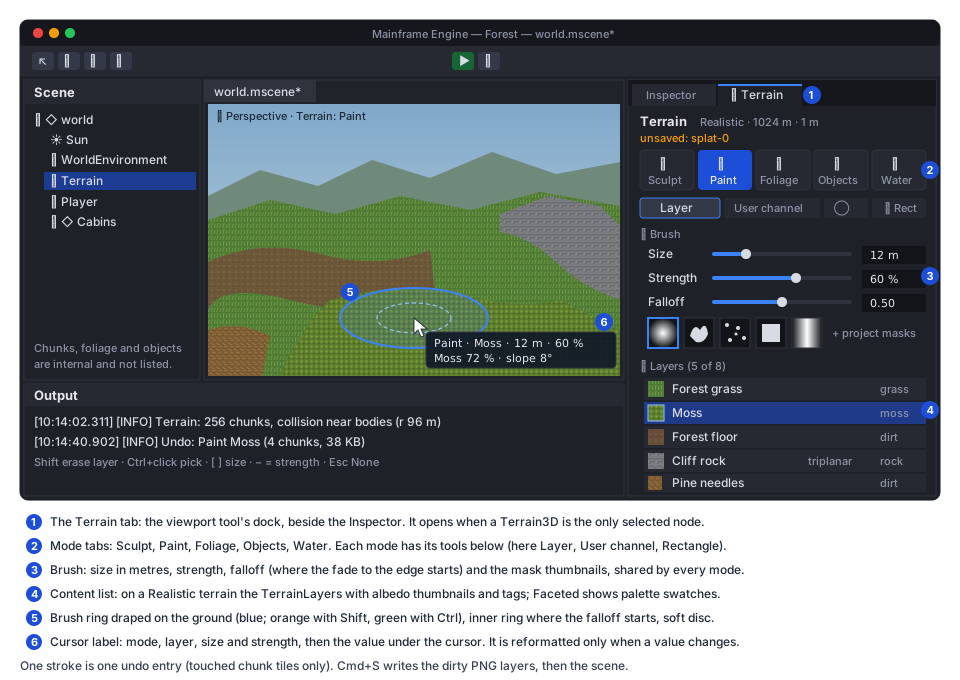
The Terrain dock
Section titled “The Terrain dock”TerrainEditorTool ([EditorViewportTool(typeof(Terrain3D), Title = "Terrain", Icon = "mountain")],
MainframeEngine.Editor/Src/Terrain/) is one tool with modes; every mode shares the brush, ring, label, stroke and
undo. A terrain with no Data shows only Create terrain data (profile, size and spacing; writes the folder and
terrain.mres, sets Data through an undoable property action).
| Mode tab (icon) | Tools | Content list |
|---|---|---|
Sculpt (mountain) | Raise, Lower, Smooth, Flatten, Set height, Ramp | — |
Paint (brush) | Surface (Faceted) or Layer (Realistic); User channel | surfaces as swatches, or layers with albedo thumbnails; user channels |
Foliage (plant-2, new) | Paint density | foliage types with counts |
Objects (cube) | Scatter, Single | object types with counts |
Water (droplet) | Depth, with Level | — |
Brush. An alpha mask (built-in circle and square, or a greyscale PNG: five masks regenerated by us under
TerraBrush’s names, plus a project’s own in Content/Editor/TerrainBrushes/), with:
| Setting | Range | Default | Notes |
|---|---|---|---|
| Size | 1–256 m | 16 m | diameter in metres |
| Strength | 1–100 % | Sculpt 25 %, Paint 100 % | remembered per mode group |
| Falloff | 0–1 | 0.5 | fraction of the radius where a smoothstep fade to the edge begins; multiplies the mask |
| Slope limits | 0–90° | off | samples outside are skipped |
| Spacing | 5–100 % | 25 % | stamps along the path, not one per frame; leftover distance carries over |
w = mask · falloff · strength · slopePass per sample. Stamps are spaced along the drag and capped at 32 per frame,
so results do not depend on the frame rate (TerraBrush stamps once per frame). Height modes repeat at 10 Hz while the
mouse is held still; paint modes converge in one pass and do not.
Sculpt. Each stamp reads its rectangle with GetHeights, computes from that copy (no in-place order bias) and
writes once with SetHeights. Raise and Lower add ±w·0.5 m then a light smooth; Smooth lerps to the 5-point mean;
Flatten holds the first stamp’s weighted mean for the whole stroke; Set height lerps to a target (Ctrl+click picks it,
Ctrl+wheel steps ±1 m, Ctrl+Alt+wheel ±0.1 m); Ramp takes two clicks and lerps a band one brush wide between the two
heights, with two edge smoothing passes and a grade label. Shift turns Raise, Lower, Flatten and Set height into
Smooth.
Paint. Faceted surfaces are crisp: a cell takes the id where mask ≥ max(1 − strength, 0.05), with an optional
dithered Scatter edge; Shift paints a chosen eraser surface. Realistic layers blend weights toward the chosen layer
and renormalise; Shift is the eraser layer. User channels lerp (Value) or write crisp ids (Id, mask ≥ 0.5); Shift
writes 0. A Rectangle shape (snapped to cells) fills all paint modes. Ctrl+click picks what is under the cursor.
Cursor. A 48-point ring draped on the terrain (lifted 5 cm, no depth test) plus an inner ring where the falloff
starts; blue, orange when Shift inverts, green while Ctrl picks. The material draws a soft disc on the ground. The
cursor label (SetCursorLabel) shows mode, size, strength and context (“h 3.4 m · slope 12°”), reformatted only when
a value changes. Hotkeys while the pointer is over the view: [/] size, -/= strength, X/Z axis lock, Esc
steps out (ramp start, axis lock, then None).
Undo of layer rectangles. TerrainEdit.Begin(layers) (engine) records, the first time a stroke touches a chunk,
that chunk’s tile of every recorded layer from a pool: heights (ChunkQuads + 1)², cells ChunkQuads² per image.
End() rebuilds collision for the touched chunks and returns before and after tiles. TerrainEditAction : IDiscardableAction (editor) holds them Deflate-compressed (a typical stroke < 100 KB, not whole images as
TerraBrush), writes them back on undo and redo, rebuilds meshes and collision, uploads the rectangles and raises
Changed with FromUndo, so foliage and objects follow. One stroke, ramp or rectangle is one history entry.
SaveExternalData calls Data.SaveLayers().
Scatter
Section titled “Scatter”MultiMesh and MultiMeshInstance3D
Section titled “MultiMesh and MultiMeshInstance3D”public sealed class MultiMesh : Resource // MainframeEngine/Src/Rendering/Resources/ (new){ [Export] public Mesh? Mesh { get; set; } [Export] public int InstanceCount { get; set; } // resizing clears the transforms [Export] public int VisibleInstanceCount { get; set; } = -1; // -1 = all; draws [0, n) public void SetInstanceTransform(int index, in Transform3D transform); public Transform3D GetInstanceTransform(int index); public void SetTransforms(ReadOnlySpan<Transform3D> transforms, int start = 0); // bulk (Mainframe addition) [Export] public Aabb CustomAabb { get; set; } // default: computed from the instances public Aabb GetAabb();}
[EditorIcon("stack-2")]public class MultiMeshInstance3D : GeometryInstance3D { [Export] public MultiMesh? Multimesh { get; set; } }- A
MultiMeshInstance3Dis one render item, frustum-culled as one world AABB. EachMultiMeshowns a persistent device-local instance buffer in the existingMeshInstanceDatalayout (80 B,MeshVertex.cs:28-42), updated only when transforms change, through staging at frame start. Nothing is rewritten per frame. One instanced draw per surface withinstanceCount = VisibleInstanceCount, so every existing material and the caster and ID pipelines work unchanged. When G6.3 claims the padding for colour, multimeshes get it. - Shadows follow
CastShadows; picking selects the node. Small multimeshes serialise their transforms; terrain multimeshes are built at load and never saved (noOwner). Not in v1: per-instance custom data, 2D, GPU culling.
FoliageType and deterministic placement
Section titled “FoliageType and deterministic placement”FoliageType field | Default | Notes |
|---|---|---|
Name, Mesh, Material | — | Material overrides the mesh’s; Realistic grass uses FoliageMaterial3D (G8b) |
DensityPerCell | 1.0 | instances per cell at full density |
Jitter, RandomYaw | 0.5, true | offset within the cell (fraction), rotation about up |
ScaleMin/ScaleMax | 0.8 / 1.25 | uniform |
AlignToNormal, SinkMeters | 0.3, 0.03 | tilt toward SmoothNormalAt; push the base into the ground |
SlopeMaxDegrees, HeightMin/HeightMax | 40°, off | placement limits |
AutoSurfaces, AutoDensity | none, 0 | grows on these surfaces/layers without painting |
ChannelCutoff | off | (channel, value): absent where a user channel is at or above the value (cut grass) |
FullDensityDistance, MaxDistance | 40 m, 80 m | thinning band |
CastShadows | false |
effective = 0 in water, above the slope or height limits, or past the channel cutoff; otherwise
max(painted, AutoDensity on AutoSurfaces). An internal TerrainFoliage3D child keeps one MultiMeshInstance3D per
(chunk, type). Building a chunk walks its cells in one fixed shuffled order shared by all chunks; per cell
n = DensityPerCell · effective gives floor(n) instances plus one if hash01(seed, type, cell, 0) < frac(n); offset,
yaw, scale and tilt come from further hash01 values (SplitMix64, no System.Random). The same images always give
the same instances, and any prefix of a chunk’s list is an even sample of the whole chunk.
- Distance thinning with no line.
TerrainFoliage3Dis the terrain’s only per-frame callback. Per chunk it setsVisibleInstanceCount = count · f,f= 1 up toFullDensityDistancefalling to 0.15 atMaxDistance(written only on > 2 % change), and hides chunks beyond. Single instances drop out across a 40 m band rather than at an edge. WithFoliageMaterial3D, instances also shrink to nothing over their last 15 % of distance, ordered by a per-instance hash, so nothing pops. - Build radius. Only chunks within
MaxDistance + one chunkof the camera are built, from a pool of buffers, nearest first, at most two per frame (also for edits:Changedqueues touched chunks). Realistic grass at four clumps per square metre would be millions of instances over a 1 km map; built near the camera it is a few hundred thousand. - Faceted foliage is low-poly tufts and flowers from primitives with
StandardMaterial3D(no wind). Realistic grass is a procedural clump mesh (GrassMesh.Clump, writing wind weight and AO intoCustom0as G8b does) drawn withFoliageMaterial3D(G8b), which reads the sharedWorldEnvironmentwind.
ScatterObjectType and ITerrainObject
Section titled “ScatterObjectType and ITerrainObject”Objects that need collision, scripts or removal (rocks, stumps, trees, crates) are an explicit list with stable ids in
objects.mres, not implicit presence images (TerraBrush), so a saved id always means the same object.
ScatterObjectType has Name (the stable key games pass to ObjectTypeIndex), Scenes (PackedScene variants;
variant = hash(Id) % Scenes.Length), SpacingMeters (4 m) and Jitter (0.4, at most 0.45 so occupancy is exact),
RandomYaw, ScaleMin/ScaleMax, AlignToNormal, SinkMeters, SlopeMaxDegrees, AvoidWater and RenderMode
(Nodes or MultiMesh).
- Painting. Scatter: each grid node in the brush gets an instance when
mask · strength > hash01(type, node)and it has none yet, so repainting adds nothing; Shift removes the chosen type (or all). Single: one click, one instance. Undo stores the added and removed records; undo restores removed instances with their original ids, andNextIdnever moves back. - Spawning. In
Nodesmode each instance is its scene, instantiated under an unownedObjects/c<chunk>container (not saved), at(X, HeightAt − SinkMeters, Z). If the scene root implementsITerrainObject { int TerrainObjectId { get; set; } Terrain3D? Terrain { get; set; } }, both are set before it enters the tree. Y is not stored, so on everyHeightorWaterchange the touched chunks’ instances are moved onto the new ground. MultiMeshmode for forests: the scene’s meshes are flattened into per-chunk multimeshes, and each chunk gets one unownedStaticBody3Dwith every instance’s collision shapes (a trunk capsule each). No node per instance, so 10,000 trees cost 256 bodies, not 10,000 scenes.RemoveObjectswap-removes the instance and rewrites its chunk;GetObjectNodereturns null. G8b’s impostors plug in as the meshes’ far LOD.RemoveObject(id)removes the instance from the live list, frees its node (or rewrites its chunk) and raisesChanged. 0 B. InNodesmode keep to about 2,000 objects; the dock turns the count red above that.
The water layer
Section titled “The water layer”water.png holds a depth fraction d per height vertex. The bed (rendered, collided, HeightAt) is
h − d·MaxWaterDepth; the water surface is h; WaterDepthAt = d·MaxWaterDepth interpolated on the same triangle, so
HeightAt + WaterDepthAt is the surface exactly. This is TerraBrush’s model. SurfaceAt returns
Terrain3D.WaterSurface where the depth is above 0 (the bed’s surface with ignoreWater). Foliage is absent in water;
objects with AvoidWater are not placed there.
The Water mode lerps d toward a target depth. Level (on by default) moves h toward a picked water level
with the same weight, so a pond painted into a dip comes out flat and full. Shift removes water; Ctrl+click picks the
level. Undo records Water | Height. G8c reads the layer and Changed to build and draw the water surface, and may
use G and B for flow; this proposal draws nothing on top of the bed.
Attribution
Section titled “Attribution”The design is modelled on TerraBrush (MIT, © 2023 spimort): the layers as images next to the scene written on save,
the tool set and dock, Shift to invert and Ctrl to pick, the foliage and object definition fields, and the water depth
model. No TerraBrush source or art is copied. Its octree MultiMesh code (BSD-2) and its anti-tiling (from Zylann’s
HTerrain, MIT) are not used. Left out on purpose: the camera-centred clipmap and zones, whole-texture re-uploads,
stamping once per frame, the 0.1 m ray march, nearest-pixel heights, HeightMapShape3D per zone, the manual “Update
terrain” button, whole-image undo, EXR heights, and the hole, snow, lock, colour and interaction-point tools. Hex-tiling
is written from Mikkelsen’s paper. If any third-party code or asset is ported later (TerraBrush’s brush masks, a
hex-tiling sample), its notice goes into THIRD_PARTY_NOTICES.md and the file gets a header like
MainframeEngine/Src/Audio/Synthesis/Zzfx.cs:1-14. The engine’s docs/design/terrain.md credits TerraBrush either way.
Testing
Section titled “Testing”- Unit (
Tests/MainframeEngine.Tests/Terrain/and beside the features):TerrainGridTests:HeightAtequals vertex heights, is continuous across quad and chunk edges and lies on each triangle’s plane for both diagonals;NormalAtis the face normal; queries clamp;Raycastagrees withHeightAtwithin 1e-4 m for random, grazing, vertical, from-below and missing rays.PngGray16Tests(round trip, a fixture from another encoder, 8-bit grey and 16-bit RGBA in, interlaced refused);TerrainDataIoTests(exact save/load, idempotent quantising, defaults, dirty-only writes, RGB kept under zero alpha, validation);SplatPaintTests(weights sum to 255;SurfaceAtis the strongest layer).ChunkLodTests(level errors are the real deviations, skirts cover every edge, winding, selection andLodBias);FoliageBuilderTests(bit-identical twice, density 0.5 → 50 % ± 3 %, even prefixes, exclusions);ObjectPlacementTests;MultiMeshTests;Texture2DArrayTests;MeshStream2Tests; andTexturePartialUploadTestson the render host (sub-rect uploads equal a full upload;Generationunchanged).
- Headless tree:
Terrain3DTests: 256 unowned, unsaved chunks; collision faces equal LOD 0 render triangles bit for bit;Changedrectangles;CollisionMode.NearBodiesbuilds chunks around a moving body and releases them;RemoveObjectandITerrainObjectid hand-off beforeOnReady; a sphere rests atHeightAt + r. Editor (Tests/MainframeEngine.Editor.Tests/):ViewportTools/with aMarkerPlacerTool(discovery, routing, capture andCancel, lifecycle, undo, save order and failure);Terrain/(brush sampling and falloff, stroke spacing at any event rate, every sculpt op, ramp, paint rules, rectangle fill, undo bit-exact per layer,CodeReloadKeepsUnsavedTerrainLayers). - Render goldens (
Tests/MainframeEngine.RenderTests/SceneTests.cs, moltenvk and lavapipe):terrain-faceted(hill and ramp facets, four surfaces, bands, a box shadow beside aStandardMaterial3Dplane),terrain-realistic(four layers with height blending, a triplanar cliff, near/far bands, chunk LODs with skirts at a grazing view; recorded on Blinn-Phong, re-recorded at G6.2),multimesh(10,000 instances match 10,000 nodes, one draw, culled as a whole), and an editor golden of the brush ring and dock. - Allocation gate: 600 frames flying over a Realistic terrain with foliage thinning and build-radius churn, and a
scripted
SetUserChannelbrush every physics tick: 0 B after warm-up. - Benchmarks (
Tests/MainframeEngine.Benchmarks, added tobaseline.json): 1MHeightAt, 10,000 raycasts, a chunk rebuild, both loads, a foliage chunk build. - QA:
Tests/QA/editor-walkthrough.qacreates terrain data, sculpts, paints, undoes and saves.
Acceptance
Section titled “Acceptance”- In the editor, a
Terrain3Dgets data from the dock; sculpting, painting, foliage, objects and water work with the brush ring, per-stroke undo and redo, and Cmd+S writes only the changed PNGs, byte-identical after reopening. - A character stands exactly on the drawn triangles in both profiles; physics,
HeightAtandRaycastagree. - Faceted shows crisp palette facets on today’s renderer; Realistic shows height-blended, anti-tiled layers with no cracks between LODs, on Blinn-Phong first and PBR after G6.2.
- Painting at runtime uploads only sub-rectangles and allocates nothing; the gates and goldens are green.
- Docs: a new
docs/design/terrain.md(crediting TerraBrush);materials-and-meshes.md,physics.md,editor.md,shaders.md,testing.md,scene-graph-and-nodes.md; ADRs for the viewport-tools API,MultiMeshand the terrain.
Task list
Section titled “Task list”G8a.1–G8a.10 are the Faceted profile, on today’s Blinn-Phong renderer. G8a.11–G8a.16 are the Realistic profile.
- G8a.1 Image plumbing.
Png.WriteGray16/ReadGray16;Texture2D.SetPixelsRect,UploadImageRegionand the in-placeTextureGpu.Update; tests. - G8a.2 Viewport-tools API.
IEditorViewportTool, discovery, host, routing, overlay wrapper, cursor label, dock tab strip, save hook inEditorSession.Save;MarkerPlacerTooltests and editor golden; ADR;editor.md. - G8a.3 Terrain core.
TerrainData(profiles, knobs, validation, layer I/O),Terrain3D, grid math, chunks, collision (All), queries,Raycast, paint API, user channels,Changed,TerrainEdit; unit and headless tests; benchmarks. - G8a.4
TerrainMaterial3D. Slang shader, palette, bands and channel tint, overlays;terrain-facetedgolden. - G8a.5 Terrain dock and Sculpt. Create terrain data, brushes and falloff, stroke spacing, the six sculpt tools,
ring and label, hotkeys,
TerrainEditAction; editor tests; QA steps. - G8a.6 Paint. Surfaces, user channels, rectangle fill, eraser and pick; tests.
- G8a.7
MultiMesh. Resource, node, persistent buffer, culling, casters;multimeshgolden; benchmark; ADR. - G8a.8 Foliage.
FoliageType, Foliage mode, placement, thinning, build radius; tests; allocation gate. - G8a.9 Objects.
ScatterObjectType,objects.mres,ITerrainObject, Objects mode,NodesandMultiMeshrender modes, re-heighting,RemoveObject; tests. - G8a.10 Water layer. Bed lowering in meshes, collision and queries;
WaterDepthAt; Water mode with Level; tests. (G8c renders it.) - G8a.11 Second vertex stream.
MeshSurface.Colors/Custom0, binding 2,VertexColorUseAsAlbedo; tests. It has no terrain dependency and moves earlier if G8b starts first. - G8a.12
Texture2DArray. Resource, importer from images, per-layer mips and sub-rect uploads, inspector preview; tests. - G8a.13 Realistic core. Profile creation, smooth normals, geomipmap levels with skirts on G6.4 LODs (building
G6.4.1–G6.4.2 if needed),
CollisionMode.NearBodies;ChunkLodTests; load and memory benchmarks. - G8a.14
TerrainSplatMaterial3D. Own set layout and pipeline layout,TerrainLayer, array packing, weights, height blending, hex-tiling, triplanar, near/far bands, macro variation, Blinn-Phong fallback;terrain-realisticgolden. - G8a.15 Realistic editing. Layer painting with thumbnails, splat sub-rect uploads; switch the profile to
shadeLightsPbrand re-record the golden once G6.1/G6.2 land. - G8a.16 Realistic grass.
GrassMesh.Clump,FoliageMaterial3Dfoliage (after G8b), distance shrink; forest-scale benchmark; docs.
Decisions
Section titled “Decisions”Decided by the user on 2026-10-08, who accepted every default, and recorded in ADR 0149. Each entry keeps the question it settled; Decision: is what to build.
- Realistic LOD scheme. Geomipmapping with skirts (proposed) or CDLOD with vertex morphing? Decision: geomipmapping; it reuses G6.4 and every existing pass. Revisit CDLOD if pops show in G8d.
- Collision on large maps. Per-chunk trimesh near moving bodies, or a heightfield proxy in
Src/Physicsthat makes triangle contacts on demand? And inNearBodiesmodeDirectSpaceState.RayCastmisses unbuilt chunks. Decision: trimesh near bodies, plus a registration inSrc/Physicsso ray queries also test terrains analytically and report the terrain’s collision body. - Compact terrain vertex. An 8-byte vertex (height + octahedral normal, XZ from the index) would cut chunk memory
by four but needs its own vertex shader and caster pipeline. Decision:
MeshVertexin v1; measure at 2 km. - Splat layout. Two RGBA8 weight maps (8 layers) or an index + weight map (up to 16 layers, 4 per texel)? Decision: 8 layers.
- Anti-tiling method. Hex-tiling or stochastic texturing (Heitz and Neyret)? Decision: hex-tiling; it keeps the texture’s contrast and needs no precomputed histogram.
- Texture compression. Three RGBA8 arrays of 8 layers at 1024² with mips are about 128 MB of GPU memory.
Decision: RGBA8 now (
LayerTextureSize512 halves it twice); BC7/ASTC with the M12 KTX2 work. - Several terrains per scene (tiles that stitch). Decision: one per scene in v1; several
Terrain3Dnodes work but do not share edges or LOD. - Brush masks. Regenerate TerraBrush’s five masks under the same names, or copy them under MIT with a notice? Decision: regenerate; they are simple shapes.
Related
Section titled “Related”- Procedural trees (G8b), Water (G8c), Forest showcase (G8d), ADR 0149
- Rendering features (G6: PBR, IBL, LOD, binding budget), Editor viewport tools (G7: handles, box selection, simulate)
- Physics, Materials & meshes, Shaders, Editor, Scene serialization, Save games and settings (G4)