
Physics
Purpose
Section titled “Purpose”Godot-style physics nodes on two pure-C# engines: Jitter2 for 3D and Box2D.NET (a C# port of Box2D v3)
for 2D, because Jitter2 is 3D-only. Both run on the scene tree’s fixed timestep with interpolated rendering,
collision layers and masks, contact/area signals, raycast and shape-cast queries, a character controller
(MoveAndSlide) and collision-shape debug drawing. Nodes and queries look the same in 2D and 3D; everything
library-specific stays inside the physics servers.
Libraries
Section titled “Libraries”| 3D | 2D | |
|---|---|---|
| Package | Jitter2 2.9.0 (pinned exactly; the API changes between minors) | Box2D.NET 3.1.654 (ikpil’s port of Box2D v3.1) |
| Repo / licence | notgiven688/jitterphysics2, MIT | ikpil/Box2D.NET, MIT |
| Native code | none (pure C#) | none (pure C#) |
| Precision | float | float |
| Threading | process-wide worker pool (PhysicsSettings3D.MultiThreaded) | single-threaded |
| Determinism | non-deterministic by default; Deterministic = island solver, reproducible on one machine/build | deterministic on one machine/build |
Both are pinned in Directory.Packages.props; read the pinned version’s API (the NuGet packages lag their repos).
Physics is single precision and offers no cross-platform lockstep mode
(ADR 0020).
Key types
Section titled “Key types”| Type | File | Notes |
|---|---|---|
PhysicsServer3D, PhysicsSpace3D, PhysicsDirectSpaceState3D | Physics/3D/ | one Jitter2 World per World3D |
PhysicsServer2D, PhysicsSpace2D, PhysicsDirectSpaceState2D | Physics/2D/ | one Box2D world per World2D |
CollisionObject3D → StaticBody3D, RigidBody3D, CharacterBody3D, Area3D; CollisionShape3D | Physics/3D/ | PhysicsBody3D is the base of the colliding ones |
CollisionObject2D → StaticBody2D, RigidBody2D, CharacterBody2D, Area2D; CollisionShape2D | Physics/2D/ | pixels |
Shape3D: BoxShape3D, SphereShape3D, CapsuleShape3D, CylinderShape3D, ConvexPolygonShape3D, ConcavePolygonShape3D, HeightMapShape3D | Physics/3D/Shapes3D.cs | Resources |
Shape2D: RectangleShape2D, CircleShape2D, CapsuleShape2D, ConvexPolygonShape2D, SegmentShape2D, ConcavePolygonShape2D | Physics/2D/Shapes2D.cs | Resources |
PhysicsMaterial, PhysicsSettings3D/2D, CollisionLayers, AxisLock, RigidBodyMode | Physics/ | |
DebugLines, DebugLinesRenderer | Rendering/Debug/ | per-viewport line batch + line-list pipeline |
Node model
Section titled “Node model”classDiagram
class CollisionObject3D {
<<abstract>>
+uint CollisionLayer
+uint CollisionMask
+bool PhysicsInterpolation
+PhysicsSpace3D? Space
}
class StaticBody3D { +PhysicsMaterial? PhysicsMaterial }
class RigidBody3D {
+RigidBodyMode Mode
+float Mass, GravityScale, LinearDamp, AngularDamp
+Vector3 LinearVelocity, AngularVelocity
+bool ContactMonitor, Ccd, CanSleep, Sleeping
+AxisLock AxisLocks
+ApplyForce / ApplyImpulse / ApplyTorque / Teleport
+event BodyEntered, BodyExited, SleepingStateChanged
}
class CharacterBody3D {
+Vector3 Velocity, UpDirection
+float FloorMaxAngle, FloorSnapLength, SafeMargin
+bool FloorStopOnSlope
+MoveAndSlide() bool
+IsOnFloor() / IsOnWall() / IsOnCeiling()
+GetSlideCollision(i)
}
class Area3D {
+bool Monitoring
+event BodyEntered, BodyExited
+GetOverlappingBodies(List)
}
class CollisionShape3D { +Shape3D? Shape +bool Disabled }
CollisionObject3D <|-- PhysicsBody3D
PhysicsBody3D <|-- StaticBody3D
PhysicsBody3D <|-- RigidBody3D
PhysicsBody3D <|-- CharacterBody3D
CollisionObject3D <|-- Area3D
CollisionObject3D o-- CollisionShape3D : direct children
The 2D side mirrors this in pixels (Vector2, rotation in radians, angular velocity a float). All bodies derive
from Node3D/Node2D; every property above is [Export]ed (scene files) and the signals are [Signal]s.
- Shapes are
Resources: shareable between bodies and saved inline or as.mres. Changing a shape property, aCollisionShape*child’s transform,Disabled, or the body’s global scale rebuilds that body’s shapes at the next step. Scale is baked into the library shapes. - Concave shapes (
ConcavePolygonShape3D,HeightMapShape3D,SegmentShape2D,ConcavePolygonShape2D) have no volume: static and kinematic bodies only (a dynamic body logs an error once and ignores them). Jitter2 has no height field, soHeightMapShape3Dis a triangle mesh (MapWidth × MapDepthsamples on a 1-unit grid centred on the origin; scale the shape node for other cell sizes). - Mass:
RigidBody*.Mass(kg) with inertia from the shapes (Jitter2SetMassInertia(mass); Box2D mass data scaled to the mass). - Damping is per second (Godot): Jitter2 gets
1 − e^(−d·dt)per step; Box2D takes it directly. - Sphere contacts (ADR 0134): every overlapping pair with a sphere gets one contact on the line through the
sphere’s centre, registered by
SphereContactFilter(chained after Jitter2’s triangle edge filter) instead of Jitter2’s auxiliary-point manifold, whose points sit ~1 % of the radius off that line and made resting balls spin away. Sphere against box is exact (closest point on the box); speculative contacts are Jitter2’s. - Gravity scale: native in Box2D; in Jitter2 bodies with a scale other than 0/1 opt out of world gravity and get
mass · g · scaleas a force each step.
Shape resources → library shapes
Section titled “Shape resources → library shapes”| Resource (3D) | Jitter2 | Resource (2D, px) | Box2D.NET |
|---|---|---|---|
BoxShape3D(Size) | BoxShape(size) (full extents) | RectangleShape2D(Size) | polygon from the 4 transformed corners |
SphereShape3D(Radius) | SphereShape(r) | CircleShape2D(Radius) | b2CreateCircleShape |
CapsuleShape3D(Radius, Height) | CapsuleShape(r, height − 2r) (Y axis) | CapsuleShape2D(Radius, Height) | b2CreateCapsuleShape (Y axis) |
CylinderShape3D(Radius, Height) | CylinderShape(height, radius) (note the order) | — | — |
ConvexPolygonShape3D(Points) | PointCloudShape(points) | ConvexPolygonShape2D(Points) | b2ComputeHull + b2MakePolygon (≤ 8 points) |
ConcavePolygonShape3D(Faces) | TriangleMesh + one TriangleShape per triangle | ConcavePolygonShape2D(Segments) / SegmentShape2D | one b2CreateSegmentShape per segment |
HeightMapShape3D | triangle mesh (as above) | — | — |
A CollisionShape3D that is not at the body’s origin (or scaled) becomes a TransformedShape(shape, translation, rotation·scale); several shape children add several shapes to one Jitter2 body (Jitter2 has no compound type).
In 2D the transform is applied to the geometry before it is handed to Box2D.
Servers and spaces
Section titled “Servers and spaces”flowchart LR
subgraph Engine
PS3["PhysicsServer3D<br/>(IFixedStepServer, IFrameServer)"]
PS2["PhysicsServer2D"]
end
PS3 --> S3["PhysicsSpace3D per World3D<br/>Jitter2 World"]
PS2 --> S2["PhysicsSpace2D per World2D<br/>Box2D world (b2WorldId)"]
N3["CollisionObject3D nodes"] -- "OnEnterTree: AddObject / OnExitTree: RemoveObject" --> S3
N2["CollisionObject2D nodes"] --> S2
S3 -- "after each step: poses, contacts, overlaps, sleep → signals" --> N3
S2 --> N2
Engine.OnLoadregistersPhysicsServer3D(EngineOptions.Physics3D)andPhysicsServer2D(EngineOptions.Physics2D)after the render server. Trees without them (tools, tests) get a default server fromPhysicsServer3D.For(tree)when the first body enters.- A space is created for a viewport’s
World3D/World2Dwhen the first collision object enters it and lives until the server is disposed.World3D.PhysicsSpace/World2D.PhysicsSpacepoint at it. - Body type mapping:
StaticBody→ static;RigidBody→ dynamic or kinematic (Mode);CharacterBody→ kinematic (moved by the engine);Area3D→ no Jitter2 body (overlaps are queried, see below);Area2D→ a kinematic body with sensor shapes that never sleeps. - Settings (
PhysicsSettings3D):Gravity(−9.81 Y),SubstepCount(1),SolverIterations(6) andRelaxationIterations(4),AllowDeactivation,MultiThreaded,Deterministic. (PhysicsSettings2D):Gravity(+980 px/s² Y: 2D is Y-down, ADR 0110),PixelsPerMeter(100),SubstepCount(4),AllowSleep,EnableContinuous. - Units: 3D is metres. Box2D is tuned for 0.1–10 m objects, so 2D nodes work in pixels and the space converts
with
PixelsPerMeter(fixed per space) at its boundary — positions, velocities, forces (kg·px/s²), torques and query results. - All Jitter2 / Box2D calls live in
PhysicsSpace*(plus the shape resources’Create*methods).
Fixed timestep and interpolation
Section titled “Fixed timestep and interpolation”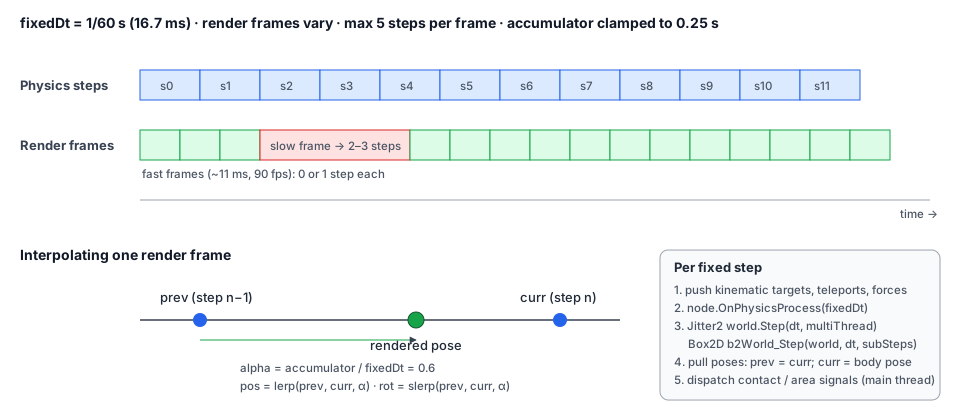
The scene tree owns the clock (Scene graph & nodes): up to 5
steps of 1/60 s per frame, frame deltas clamped to 0.25 s. Physics servers are IFixedStepServers:
frame (not paused): if a step will run: BeforeFixedSteps() restore moving bodies from the render pose to the physics pose per step: node.OnPhysicsProcess(dt) (tree order; bodies show their physics pose) FixedStep(dt): push node changes → step → pull poses → contacts/areas/sleep → signals always: AfterFixedSteps(alpha) write lerp(prev, curr, alpha) / slerp into moving bodies then OnProcess, deferred calls, transform sync, frame servers (debug draw)- Interpolation is done on the node transform (Unity-style): outside the fixed steps a dynamic, kinematic or
character body’s transform is its interpolated render pose (so visual children just follow); inside
OnPhysicsProcessit is the physics pose.PhysicsInterpolation = falsekeeps the physics pose (ADR 0024). At a whole-step frame (alpha = 0) the render pose is the previous step’s pose. - Pose writes from the server do not count as user moves. User moves are detected with a Node3D/Node2D hook
(
OnGlobalTransformInvalidated, also fired when an ancestor moves) and pushed before the next step (or before a query): static bodies and areas move, dynamic bodies are teleported (velocity kept, interpolation restarted), and kinematic/character bodies get the velocity that reaches the new pose in one step (Jitter2 velocity, Box2Db2Body_SetTargetTransform), so they push what they touch instead of tunnelling into it. RigidBody*.Teleport(transform)moves the body now and restarts interpolation from there.- While the tree is paused nothing steps or interpolates.
Collision layers and masks
Section titled “Collision layers and masks”32-bit CollisionLayer/CollisionMask, Godot semantics: two bodies collide if
(A.layer & B.mask) != 0 || (B.layer & A.mask) != 0 (either one scanning the other’s layer is enough); an area
detects a body when (area.mask & body.layer) != 0; areas never detect areas
(ADR 0021).
- Jitter2: an
IBroadPhaseFilterreads layer/mask from the shapes’RigidBody.Tagrecord. It runs on worker threads, so it only reads record fields (changed on the main thread between steps). Changing a layer or mask drops the body’s cached contacts (ClearContactCache) and wakes what it touched, because Jitter2 keeps resting contacts until they break. - Box2D: its built-in test is an AND (
(A.category & B.mask) && (B.category & A.mask)), so every shape passes it (maskBits = ~0) and carrieslayer | mask << 32incategoryBits; a custom filter callback (enableCustomFilteringon every shape) applies the OR rule, the one-way area rule and “no area-area”. Queries usemaskBits = collisionMask, which matches the layer in the low 32 bits.b2Shape_SetFilterre-runs pairing when a layer changes.
Contacts, areas and signals
Section titled “Contacts, areas and signals”Signals are computed after each step and dispatched on the main thread after it, so user code never runs inside a solver (ADR 0022):
| Signal | 3D | 2D |
|---|---|---|
RigidBody.BodyEntered/BodyExited (ContactMonitor = true) | scan the body’s arbiters (RigidBody.Contacts) with intact contact points | b2Body_GetContactData (touching contacts with manifold points) |
Area.BodyEntered/BodyExited | per area: tree query of its AABB, then NarrowPhase.Overlap against each candidate (sees static, rigid and character bodies) | b2Shape_GetSensorData of the area’s sensor shapes |
RigidBody.SleepingStateChanged | RigidBody.IsActive changes | b2Body_IsAwake changes |
- Current overlaps are diffed against the previous step’s (per-receiver dictionaries stamped with the step), so
events never depend on library begin/end callbacks (Jitter2’s
EndCollidedoes not fire when a body is removed or its contact cache cleared). Contacts that begin and end within one step are not reported. - Order: all exits (contact exits, then area exits) before all enters (contact, then area), then sleep changes;
within each group by the receiver’s creation order, then the other body’s. A body leaving one area for another in
one step gets
exitbeforeenter. - Disabled nodes (ADR 0130): a body or area whose resolved
ProcessModeisDisabledis out of the space — it neither moves, collides, signals nor shows up in queries (Godot’s defaultDisableMode.Remove). It joins again, at its node’s transform and with the velocity it had, when it is enabled; leaving counts as a removal below. - Removal: when a body leaves the tree (freed or removed), every area containing it and every monitoring body
touching it gets
BodyExitedimmediately — unless that pair’sBodyEnteredwas still queued in the same dispatch, in which case neither is reported. Queued events of removed bodies are skipped, soFree()/QueueFree()inside a signal handler orOnPhysicsProcessis safe.
Queries
Section titled “Queries”World3D.DirectSpaceState / World2D.DirectSpaceState (also PhysicsSpace*.DirectSpaceState):
var space = GetWorld3D()!.DirectSpaceState;if (space.RayCast(from, to, out RayHit3D hit, collisionMask: CollisionLayers.Layer(1), exclude: this)) Log.Info($"hit {hit.Collider.Name} at {hit.Position}, n={hit.Normal}, shape {hit.Shape?.Name}");space.ShapeCast(new SphereShape3D { Radius = 0.5f }, from, motion, out ShapeCastHit3D cast);space.IntersectShape(shape, transform, results); // List<CollisionObject3D>, each body oncespace.IntersectPoint(point, results);- Results report the body, the
CollisionShape*hit, the position, the surface normal (zero when the query starts inside a shape) and the fraction along the motion.RayCast(..., hitFromInside: false)skips convex shapes that contain the ray’s origin instead (Godot’s default forintersect_ray; ADR 0131). - Queries see the bodies as of the last step plus node moves made since (pending static/dynamic moves are pushed first; kinematic and character moves apply at the next step). Areas are never reported. Shape queries use the shape at scale 1; concave shapes cannot be query shapes. Queries are main-thread only and allocation-free.
- Jitter2 queries go through
DynamicTree.RayCast/SweepCast/Querywith cached filter delegates; Box2D queries throughb2World_CastRay/CastShape/OverlapShape/OverlapAABBwith static callbacks (the space is the context object). Box2D.NET 3.1 ray casts do hit sensors, so the callbacks skip area shapes.
RayCast3D node
Section titled “RayCast3D node”Godot’s RayCast3D (ADR 0131): a Node3D casting from its origin to TargetPosition (local) once per physics step in
its own OnPhysicsProcess (so in tree order, after the nodes before it moved; subclasses call the base), or now with
ForceRaycastUpdate(). Godot’s names and defaults: Enabled, TargetPosition (0, −1, 0), CollisionMask,
ExcludeParent (true), CollideWithBodies, CollideWithAreas (stored only: areas are never reported),
HitFromInside (false); results IsColliding(), GetCollider(), GetColliderShape(), GetCollisionPoint(),
GetCollisionNormal(). Only the parent can be excluded (no exception list yet).
CharacterBody (MoveAndSlide)
Section titled “CharacterBody (MoveAndSlide)”Neither library ships a character controller, so it is the engine’s. Call MoveAndSlide() from
OnPhysicsProcess after updating Velocity; it uses the tree’s physics step as dt:
- Recover: find everything within two
SafeMargins (Jitter2NarrowPhase.Collision, EPA’s signed distance for touching, separated and overlapping shapes alike, thenDistance/MprEpaif EPA fails, ADR 0128; Box2D manifold functions, which report penetration and nearby contacts) and push the body back out to one margin. Those contacts count (a body resting on the floor is a contact within the margin), so floor detection doesn’t flicker. Up to 4 passes while anything was pushed. - Slide (up to
MaxSlides): sweep every shape of the body along the remaining motion extended by the margin (Jitter2SweepCast, Box2Db2World_CastShape), move to the contact minus the margin, classify the normal, remove the velocity going into the surface and project the remaining motion onto it. When the sweep reports “already touching” (no normal), the normal comes from a distance/penetration query. - Classify each contact against
UpDirectionandFloorMaxAngle(45°): floor, ceiling (within the same angle of down) or wall.IsOnFloor/Wall/Ceiling,GetFloorNormal,GetWallNormal,GetSlideCollision(i)(up to 16),GetPositionDelta,GetRealVelocity. - Stop on slope: standing on a floor with no sideways intent (only gravity) doesn’t slide down it
(
FloorStopOnSlope). - Snap: if the body was on the floor, is no longer, and isn’t moving up, it is pulled down up to
FloorSnapLength(0.1 m / 1 px) onto floor geometry — sticks to slopes and small steps down. - On the floor, vertical velocity gained by sliding along it is dropped (walking up a slope and stopping doesn’t
launch the body); a jump (upward
Velocity) is kept. - Settle (3D, ADR 0128): when a sweep or the snap found the floor, the body is moved onto exactly one margin from
it with EPA’s distance (Jitter2’s sweeps stop a few millimetres short on large shapes). A body resting or walking on
the floor then holds its height to the float (Godot’s 1 mm
safe_margingives the same resting height as Godot).
The final position is written to the node, which turns into a kinematic move of the body for this step, so dynamic bodies in its way are pushed (the body collides with what its layer meets, even outside its own mask).
EPA warnings. The casts, the recovery and the settle run with Jitter2’s log listener detached (JitterLogMute):
EPA not converging is expected there (the next query takes over), and Jitter2 formats its warning string whenever a
listener is set. On dense trimeshes (the Forest’s 524k-triangle terrain) a walking character hit it every few seconds,
which broke the 0 B frame. These queries run on the main thread outside the world step, so nothing else is muted.
Margins (ADR 0025): Jitter2’s sweeps resolve contacts
to a few millimetres (closer reports “overlapping”), so CharacterBody3D.SafeMargin defaults to 1 cm;
CharacterBody2D.SafeMargin is 1 px (Box2D casts are exact; 1 px = 1 cm at 100 px/m).
Debug drawing
Section titled “Debug drawing”PhysicsServer3D/2D.DebugDrawEnabled(orEngineOptions.DebugCollisionShapes) draws every enabled collision shape each frame (after interpolation, so lines match what is rendered) into the viewport’sSceneViewport.DebugLines. Colours: static green, dynamic orange, sleeping grey, kinematic/character blue, areas cyan. 2D shapes are drawn in the z = 0 plane in pixels (whereCamera2Dlooks). The Demo’s Physics panels have a toggle.DebugLinesis an immediate-mode batch of coloured segments (boxes, circles, spheres, capsules, cylinders, triangle lists, 2D polygons); the render server draws a viewport’s batch after its visuals and clears it every frame (also when nothing could be drawn). At most 2¹⁸ lines per frame; more are dropped (DroppedLines).DebugLinesRendererdraws the batch in the HDR scene pass with its own line-list pipeline (Shaders/Debug/DebugLines, built throughPipelineBuilder/the pipeline cache): camera from the shared set 0 (FrameContext), depth-tested but not depth-writing, alpha-blended. Line colours are sRGB-authored and converted to linear in the fragment shader (no distance fade, unlike the scene grid), then tonemapped with the scene. Vertex buffers are dynamicGpuBuffers fromIVulkanContext.Allocator, keyed by frame slot; a slot’s buffer doubles when a frame has more lines (the old one goes to the deletion queue). The pipeline and buffers are released through the deletion queue when the render server is disposed.
Terrain collision
Section titled “Terrain collision”A Terrain3D collides through ordinary nodes, so no Jitter2 code leaves Src/Physics: one internal,
unsaved StaticBody3D per chunk (at the chunk origin, CollisionLayer/CollisionMask from the TerrainData) with a
CollisionShape3D holding a ConcavePolygonShape3D whose Faces are the chunk’s LOD 0 render triangles, copied from
its mesh (bit-for-bit the drawn surface; HeightMapShape3D is not used — its origin and diagonal differ). A height or
water edit rewrites the faces in place and reassigns them; the body rebuilds at the next step (inside a TerrainEdit,
at End()). CollisionMode.All builds every chunk; NearBodies is still a stub that does the same; None builds no
bodies. Physics rays and Terrain3D.Raycast agree; a CharacterBody3D rests its safe margin (1 cm) above the
surface. Jitter2 makes one TriangleShape per triangle: the forest’s 256 m at 0.5 m (524k triangles) costs ≈ 2.1 s in
the first step after the terrain enters (and ≈ 0.65 s more over the next second), ≈ 0.03 ms per step afterwards.
Performance
Section titled “Performance”- 3D: zero managed allocations in steady-state physics frames (≈ 500 bodies, contact monitors, areas, characters, debug draw and every query kind, single- and multi-threaded) — unit-tested, and the render-test allocation gate’s showcase scene steps a crate stack (single-threaded: Jitter2’s worker pool itself allocates 56 B about once per 5 000 multi-threaded steps, so the multi-threaded unit test excludes the library’s share). Per-step work is O(moving bodies + monitors + areas); sleeping bodies cost no pose writes.
- 2D: the engine’s code allocates nothing, but Box2D.NET 3.1.654 allocates inside
b2World_Step(aB2StepContextand solver arrays per step, ~350 B + per-island; ADR 0023). The 2D allocation test subtracts what the library allocated inside its steps and requires the rest to be zero. - Benchmarks (baseline.json, Apple M5): one step of 1 000 awake boxes resting on a floor — 3D ≈ 0.50 ms (0 B), 2D ≈ 0.92 ms (352 B, Box2D’s own) — and 10 000 raycasts ≈ 0.96 ms (0 B).
Threading
Section titled “Threading”- Steps run on the main thread inside the scene tree’s fixed-step loop. Jitter2 uses its process-wide worker pool when
MultiThreaded(steps of several worlds are serialized inside Jitter2); Box2D runs single-threaded (no task callbacks). - Bodies, queries and nodes are main-thread only. Box2D keeps its worlds in a process-wide table, so 2D worlds must not be created or destroyed concurrently (the unit tests that use them share a non-parallel collection).
Testing
Section titled “Testing”Unit tests in Tests/MainframeEngine.Tests/Physics/: gravity, rest and
sleep; layer/mask semantics (incl. runtime changes on resting bodies); gravity scale and axis locks; contact, area and
sleep signals (ordering, main thread, removal and QueueFree mid-dispatch); queries (rays, shape casts, overlaps,
concave/height-map shapes, every shape type with scale); MoveAndSlide (floor, walls, 30° slopes, steep slopes,
ceilings, snap down a 5 cm step, recovery, pushing crates); interpolation (exact lerp, physics pose in
OnPhysicsProcess, teleport, pause); serialization round-trips of every body and shape; server lifecycle; debug
draw; the fixed-step hooks; allocation gates (3D and 2D). Render tests: physics (frames 30 and 150),
physics-debug (collision shapes) goldens and a determinism check (deterministic solver, one thread). See
Testing.
Known issues
Section titled “Known issues”- Areas don’t detect other areas (Box2D 3.1 sensors don’t see sensors; 3D matches); no
AreaEnteredsignal yet. - No joints, soft bodies, vehicles or ragdoll tooling; no per-shape signals (
body_shape_entered). - Contacts that begin and end within one step aren’t reported;
ContactMonitorreports touching bodies, not impulses. - Queries ignore a query shape’s scale and never report areas; 2D has no height field, and chain shapes aren’t used.
- Kinematic/character moves made outside
OnPhysicsProcessreach queries only after the next step. - Resting bodies settle up to 1 cm into what they rest on (Jitter2’s
ContactData.Contact.AllowedPenetrationis a 1 cm constant); Godot’s margin is about a millimetre. MoveAndSlidedoesn’t climb steps (only snaps down) and has no constant-speed-on-slopes option.HeightMapShape3Dis a triangle mesh (memory grows with the map). Jitter2’s sweeps have a few-millimetre tolerance.DebugLinesRendererdraws one batch per frame (one viewport); editor views will need per-call buffer offsets.- Spaces of sub-viewports are released once the viewport left the tree and has no bodies.
- No physics-aware replication yet (M5): bodies simulate wherever they run, so a networked game simulates on the
server and replicates poses through its own
[Replicated]members; clients should freeze or not simulate their copies. Client-side prediction forCharacterBodyis a later concern (Networking). - The Editor draws collision shapes in its edit-mode worlds; shape handles and “create collision from mesh” are open items.
Related docs
Section titled “Related docs”Milestones · Scene graph & nodes ·
Scene serialization · Testing · Editor ·
Networking · Water (World3D.Water: depth, surface and flow queries for wading characters)
CharacterBody2D.MotionMode = Floating (Godot’s motion_mode 1, top-down games) runs Godot’s floating slide instead:
every hit is a wall, Velocity is never changed by collisions, and hits within WallMinSlideAngleDegrees (15°) of
head-on stop the motion instead of sliding.