
Proposal: Procedural trees (an Ez Tree port: Tree3D, presets, wind, impostors)
Milestone: Gameplay toolkit (G8b) · Status: ⬜ planned ·
Depends on: M3 materials & meshes, M4 shadows (cutout
casters), M10 editor (custom inspectors); later phases on Rendering features
(G6.1 PBR for bark, G6.4 LOD for impostors) and Terrain (G8a: the Custom0 vertex stream, scatter,
MultiMesh) · Related: Water (G8c reads the same wind), Forest showcase (G8d, the
main user), Shaders (Slang, ADR 0144),
ADR 0149
Problem
Section titled “Problem”The engine cannot make a tree. A game that wants a forest has to model trees in a DCC tool, import them as glTF and place every one as a node. Several parts are missing:
- No generator. Nothing in
MainframeEngine/Srcbuilds branching geometry.ArrayMeshandMeshSurface(MainframeEngine/Src/Rendering/Resources/Mesh.cs:83,:192) can hold procedural geometry, but nobody fills them with trees. - No foliage material.
StandardMaterial3Dhas alpha cutout and double-sided lighting (MainframeEngine/Src/Rendering/Resources/Material.cs:9-19,:251-310), but every vertex stays where the mesh put it. The 3D renderer draws only built-in materials:MeshRendererpicksMeshLitorMeshOutline(MainframeEngine/Src/Rendering/Meshes/MeshRenderer.cs:418-419,ShaderSetIdinMainframeEngine/Src/Rendering/Meshes/PipelineStateCache.cs:6). There is no 3D shader material in which to write a wind shader, and no shared wind value. - No per-vertex data beyond position, normal and UV.
MeshVertexis a fixed 32 bytes (MainframeEngine/Src/Rendering/Meshes/MeshVertex.cs:12-21). Wind needs a weight and a phase per vertex. G8a adds an optional second stream (MeshSurface.Colors,MeshSurface.Custom0), which this proposal fills. - Lighting is Blinn-Phong only (ADR 0014). Leaves get no light through them, and
DoubleSidedflips the normal on back faces (Material.cs:301-304), which turns a leaf card’s rounded canopy normals inside out. - No LOD and no impostors. G6.4 plans mesh LODs. Impostors are one of its non-goals and are picked up here.
- Shadows cut out, but do not move. Cutout casters exist (ADR 0074,
ShadowSystem.GetInstancedCasterPipeline,MainframeEngine/Src/Rendering/Shadows/ShadowSystem.cs:1215), but their vertex shaders read only the position and UV, so a swaying leaf would cast a still shadow.
Ez Tree (MIT, © 2024 Daniel Greenheck) solves the generation part well. It is
a small three.js library: src/lib/tree.js (1203 lines), options.js, a 22-line seeded RNG, 16 preset JSON files and a
leaf wind shader. It has a seed-stable skeleton, LODs meshed from one skeleton, and a browser app in which artists tune
presets and save them as JSON. This proposal ports it to C# and adds what a game engine needs around it.
TreeGenerator: a faithful C# port of Ez Tree’s generator. It is pure C# (no engine types; System.Numerics for its output), bit-exact in its RNG, and matches Ez Tree’s vertex and index counts exactly and its positions within 1e-4 for every preset.TreeOptions(resource) mirroring Ez Tree’s option groups, and the 15 tree and bush presets as.mres. Ez Tree JSON saved from its web app imports directly.Tree3D([Tool]node): preset, seed and style, live regeneration in the editor, and Bake to.mresso shipped games do not run the generator at load.- Two styles.
TreeStyle.Realistic: PBR bark and alpha-cut leaf cards.TreeStyle.LowPoly: flat-shaded palette bark and blob canopies. LowPoly runs on today’s Blinn-PhongStandardMaterial3D, so it can ship before G6. FoliageMaterial3D: a built-in material with a Slang shader. It sways with the wind (Ez Tree’s model), cuts out, lights both sides and lets light through, and casts shadows that sway the same way. Grass (G8a) uses it too.- Shared wind on
WorldEnvironment(WindDirection,WindStrength,WindFrequency,WindTurbulence). TreeImpostor: octahedral impostors baked in the editor, chained after the mesh LODs.- Trees scatter as G8a
ScatterObjectTypescenes (as nodes near the player or asMultiMeshforests, each with a trunk capsule), drawn as impostors far away. - Per-frame cost on the CPU is zero: wind runs in the shaders and baked trees allocate nothing per frame.
Non-goals
Section titled “Non-goals”- Other generators (space colonisation, L-systems, SpeedTree import). The
TreeGeneratorseam allows them later. - Physically simulated branches (bending under contact, breaking, falling trees). Wind is a vertex-shader effect.
- Growth animation or seasons (leaf colour over time, bare winter trees). A game can swap materials itself.
- Interaction with the wind (characters pushing foliage, wind zones). One global wind per world in G8b.
- Ez Tree’s web UI, GLB export and PNG export. The editor inspector replaces the UI, and Bake replaces export.
- Ez Tree’s trellis geometry (see decision 3).
- A generic mesh simplifier. LowPoly blobs are built simplified rather than decimated afterwards.
Design
Section titled “Design”flowchart LR
P["TreeOptions (.mres)<br/>preset or inline"] --> G["TreeGenerator<br/>(pure C#)"]
S["seed"] --> G
G --> K["TreeSkeleton<br/>(all RNG use)"]
K --> MR["Mesher: Realistic<br/>rings + leaf cards"]
K --> ML["Mesher: LowPoly<br/>faceted rings + blobs"]
MR --> O["TreeMeshData × LODs<br/>bark, leaves, Custom0"]
ML --> O
O --> T["Tree3D (editor: live)"]
T -->|Bake| B["ArrayMesh .mres<br/>+ TreeImpostor + trunk shape"]
B --> N["ScatterObjectType scene<br/>(Nodes or MultiMesh, trunk capsule)"]
B --> F["FoliageType<br/>(backdrop, no collision)"]
Code layout
Section titled “Code layout”| Where | What |
|---|---|
MainframeEngine/Src/Trees/Generation/ | TreeGenerator, TreeParams, EzRng, ThreeMath (double-precision Vec3d, Quatd, EulerXyz matching three.js), TreeSkeleton, BarkMesher, LeafCardMesher, LeafBlobMesher, TreeMeshData |
MainframeEngine/Src/Trees/ | TreeOptions, TreeLevel, TreeStyle, Tree3D, TreePresets, TreeImpostor, EzTreeJson (importer) |
MainframeEngine/Src/Rendering/Resources/ | FoliageMaterial3D, ImpostorMaterial3D (internal to TreeImpostor) |
MainframeEngine/Content/Shaders/ | Foliage/Foliage.vk.{vert,frag}.slang, Impostor/Impostor.vk.{vert,frag}.slang, include/wind.slang, Shadows/Shadow{,Point}FoliageInstanced.vk.vert.slang |
MainframeEngine/Content/Trees/Presets/ | 15 preset .mres files (about 2 KB each) |
MainframeEngine.Editor/Src/Trees/ | Tree3DInspector, TreeImpostorBaker, TreeBaker; bark and leaf textures in MainframeEngine.Editor/Content/Trees/ |
build/ez-tree-reference.mjs | parity fixture generator (by hand, not CI), like build/zzfx-reference.mjs |
The generator lives in the engine assembly but uses no engine types, so it can move to its own assembly (for a command line tool or a server) without changes.
TreeGenerator
Section titled “TreeGenerator”public sealed class TreeGenerator // reusable: keeps its scratch lists between calls{ public TreeSkeleton GrowSkeleton(TreeParams p, int seed); // all RNG use happens here public TreeMeshData Mesh(TreeSkeleton s, TreeParams p, in TreeMeshDetail d); // no RNG: run once per LOD}
public readonly record struct TreeMeshDetail( // Ez Tree's LODDetail, plus the style int SectionStride = 1, double SegmentFactor = 1, int LeafStride = 1, double LeafScale = 1, TreeBillboard? Billboard = null, TreeStyle Style = TreeStyle.Realistic, int BlobDetail = 1);
public sealed class TreeMeshData // plain arrays; Tree3D turns them into MeshSurfaces{ public TreeSurfaceData Bark, Leaves; // Positions, Normals, UVs, Custom0, Indices (arrays) public double GeometricError; // for G6.4 MeshLod.Error (below)}Algorithm
Section titled “Algorithm”The port follows tree.js at the pinned commit function by function. Names in brackets are Ez Tree’s.
- Skeleton (
#generateSkeleton,tree.js:247). Seed the RNG and push the trunk: origin 0, orientation 0, level 0,length[0],radius[0],sections[0],segments[0]. Pop branches from a FIFO queue (branchQueue.shift()) until it is empty. The queue order is the RNG order, so the port must useQueue<T>, not recursion. - Branch sections (
#growBranch,:319). Fori = 0 … sectionCount:- The radius tapers:
radius · (1 − taper[level] · i/n)for deciduous trees,radius · (1 − i/n)for evergreens. The last section of the last level gets 0.001. - Record
(origin, orientation, radius), then step the origin bylength/nalong the section’s +Y. - Perturb the orientation:
x += rng(g, −g),z += rng(g, −g), withg = max(1, 1/√radius) · gnarliness[level]. - Apply the twist (
twist[level]about +Y). Then rotate toward the growth force byclamp(strength / radius, ±angle)aboutup × direction. When the trellis is on, slerp toward the nearest trellis point.
- The radius tapers:
- Terminal and child branches.
- A deciduous tree continues each branch from its last section, one level up, with the parent’s section and segment counts. On the last level it records a leaf there instead.
- Below the last level,
generateChildBranches(:468) placeschildren[level]children:- one
rng()radial offset, then a Fisher-Yates shuffle of the angle slots (shuffledIndices,:736); - per child, a stratified start
start + (i + rng()) · (1 − start)/countalong the parent; - the origin and radius are lerped between the two sections around that point, and the orientation is slerped between them;
- the child is turned by
angle[level]about X and by a jittered slot angle about Y (onerng(0.5, −0.5)); - evergreens shorten children by
1 − start.
- one
- Leaves (
generateLeaves,:563). On the last level,leaves.countleaves are placed the same way, withleaves.angle.#recordLeaf(:632) draws the size variance, so meshing uses no RNG. - Meshing (
#meshSkeleton,:279). This step uses no RNG, so it can run once per LOD on the same skeleton.- Bark (
#meshBranch,:752) keeps everysectionStride-th ring plus the last. A ring hasmax(3, round(segments · segmentFactor))vertices plus a seam duplicate; U isj/segments · wrapsXwithwrapsX = max(1, round(baseRadius · textureScale.x)), and V alternates 0/1 by ring. No end caps; triangles are(v1, v3, v2), (v2, v3, v4). - Leaves (
#meshLeaf,:655) keep everyleafStride-th leaf, scaled byleafScale: a quad of sidesizewith its base at the leaf origin, plus a second quad turned 90° about Y forDoublebillboards. Rounded normals arenormalize(n + v − origin).
- Bark (
The LOD levels are Ez Tree’s defaultLODLevels (tree.js:91): LOD0 full detail; LOD1 sectionStride 3,
segmentFactor 0.75, leafStride 2, leafScale 1.25; LOD2 sectionStride 6, segmentFactor 0.4, leafStride 2,
leafScale 1.3 and single billboards. Ez Tree switches them at 100 and 250 units from the camera; the engine uses
G6.4’s screen-space error instead, so the mesher reports each level’s GeometricError: for bark, the largest distance
between a dropped ring centre and its interpolation between kept rings, plus the radius lost to fewer segments; for
leaves, the mean spacing of the dropped leaves.
RNG: bit-exact
Section titled “RNG: bit-exact”rng.js is a multiply-with-carry generator. It is not a textbook one: & 0xffffffff produces a signed int32 in
JavaScript, and >> 16 is an arithmetic shift, so negative states shift in ones. The C# port keeps both:
internal struct EzRng                                   // src/lib/rng.js, bit-exact{    private int _w, _z;                                 // signed, as JS keeps them after `& mask`    public EzRng(int seed) { _w = unchecked(123456789 + seed); _z = unchecked(987654321 - seed); }
    public double Next(double max = 1, double min = 0)  // rng.random(max, min)    {        _z = unchecked((int)(36969L * (_z & 65535) + (_z >> 16)));        _w = unchecked((int)(18000L * (_w & 65535) + (_w >> 16)));        var result = unchecked((uint)((_z << 16) + (_w & 65535)));   // JS: `>>> 0`        return (max - min) * (result / 4294967296.0) + min;    }}
This was checked against Node 22 while writing this proposal: seed 0 gives 0.732297654031, 0.058062777622, 0.821864804020, seed 35729 (Oak Medium) gives 0.925737335347, 0.001972383121, 0.291409873404, and a hash of one
million draws with seed 44166 matches. These vectors become the first unit test. Seeds are integers. Ez Tree’s demo
forest uses fractional seeds
(10000 * Math.random()), which & mask truncates differently for m_w and m_z. The port does not support them,
and no preset uses one.
Float determinism
Section titled “Float determinism”JavaScript numbers are doubles. Three.js Vector3, Quaternion and Euler compute in doubles, and only
Float32Array rounds to float at the end (#buildBufferGeometry).
- Use double where JS does. The skeleton and meshing run in
ThreeMathdoubles, and positions are cast to float only when written toTreeMeshData.TreeOptionsstores every generator input asdouble(Codecs.cs:194has aDoubleCodec). Values like69.60000000000001(Aspen Large) then reach the generator unchanged; a float field would change them. - Copy the three.js formulas, not System.Numerics. The pinned three.js is 0.167.1 (Ez Tree’s
package-lock.json).ThreeMathports exactly what the generator calls:Quaternion.setFromEuler(XYZ),setFromAxisAngle,multiply,premultiply,slerp,setFromUnitVectorsandrotateTowards;Euler.setFromQuaternionthrough the rotation matrix, including its0.9999999gimbal threshold;Vector3.applyQuaternion(the r150+ form),applyEulerandlerpVectors.System.Numerics.Quaternionis float-only and composes in another order, so it is not used here.
Math.roundis notMath.Round. JavaScript rounds halves up and .NET rounds them to even.round(6 · 0.75)is 5 in JavaScript and 4 in C#, which would change the LOD1 segment count. The port usesMath.Floor(x + 0.5)everywhere Ez Tree callsMath.round.- Transcendentals may differ by one ulp. V8 uses its own fdlibm port, and .NET calls the platform C library. RNG
draws, counts, indices and every branch decision are exact (they depend only on the RNG and
+ − × ÷). Positions can differ in the last bits, which is far below float precision after the cast. The parity test compares positions within 1e-4 Ez Tree units. Within one platform, generation is bit-reproducible. Baked meshes are identical everywhere. - Quirks kept on purpose, so seeds give the same trees as in Ez Tree:
#growBranchdivides the section length bylevels − 1whentype === 'Deciduous'(tree.js:325). Presets say"deciduous"in lower case, so the divisor is always 1. The port has no divisor and says so in a comment.- The orientation between two sections is
qB.slerp(qA, alpha)(:511,:601). It runs from B to A, the opposite of the origin lerp. - An evergreen’s last ring has radius 0. The force step then divides by zero, but the orientation it produces is
never used. .NET’s
Math.Max/Math.Minpropagate NaN like JavaScript, so nothing breaks.
Outputs and vertex data
Section titled “Outputs and vertex data”TreeMeshData becomes one ArrayMesh with two surfaces, bark and leaves. Each LOD is a G6.4 MeshLod with
its own geometry. Before G6.4 lands, only LOD0 is used.
| Stream | Bark | Leaf cards (Realistic) | Leaf blobs (LowPoly) |
|---|---|---|---|
| Position, normal | ring vertices, smooth normals (Realistic) or split face normals (LowPoly) | quad corners; rounded or flat normals | split face normals |
| UV | u = j/segments · wrapsX; v Ez Tree’s 0/1 ping-pong, or continuous by length (BarkUvMode) | (u, 1 − v): the engine’s UV origin is top-left (Mesh.cs:114-116) | (0, 1 − h), where h is the height within the blob, for flutter |
Custom0.x wind weight | 0 at the trunk base, rising along each branch to 1 at the twig tips (level and i/n) | the branch weight at the attachment point | the mean weight of the blob’s leaves |
Custom0.y branch level | level / (levels + 1) | 1 (marks foliage: flutter on) | 1 |
Custom0.z phase | hash(branch index) in [0, 1) | the parent branch’s phase | the blob’s phase |
Custom0.w AO | 0.6 + 0.4 · (height / tree height) | depth into the canopy: distance to the canopy hull, 0.4 … 1 | per vertex, like leaves |
The hash-based phase and AO consume no RNG, so they do not disturb parity. Custom0 comes from G8a’s optional second
stream (Godot’s ARRAY_CUSTOM0). Without that stream (before G8a ships it), the mesh simply has no wind data.
TreeOptions and TreeLevel
Section titled “TreeOptions and TreeLevel”Ez Tree keys its per-level values by level number: branch.angle[1..3], children[0..2], and gnarliness,
length, radius, sections, segments, taper and twist over [0..3]. Decision: TreeLevel sub-resources,
not parallel arrays.
- An artist edits one level at a time: its length, radius, sections and taper together. A level foldout in the
inspector shows exactly one
TreeLevel. With parallel arrays, one level’s values would be spread over nine array editors. - Nine parallel arrays can drift in length. Here the fixed four-entry array is checked in one place.
- A custom inspector can hide what does not apply at a level:
AngleandStartat level 0,Childrenat level 3. - The cost is four small inline sub-resources per
TreeOptions. That is negligible, and they are not shared.
public enum TreeType : byte { Deciduous, Evergreen }          // Ez Tree's TreeTypepublic enum TreeBillboard : byte { Single, Double }           // Ez Tree's Billboardpublic enum TreeStyle : byte { Realistic, LowPoly }public enum BarkUvMode : byte { Continuous, EzTree }          // EzTree = 0/1 ping-pong per ring (parity tests)
[EditorIcon("trees")]public sealed class TreeOptions : Resource                    // every generator input is double (parity){    [Export] public int Seed { get; set; }                                             // seed    [Export] public TreeType Type { get; set; }                                        // type    [Export(Range = "0.01,10,0.01")] public double Scale { get; set; } = 0.3;          // engine: Ez Tree units → metres
    [ExportGroup("Branches")]    [Export(Range = "0,3,1")] public int Levels { get; set; } = 3;                     // branch.levels    [Export] public TreeLevel[] Level { get; set; } = TreeLevel.EzTreeDefaults();      // branch.<x>[0..3]    [Export] public Vector3 GrowthDirection { get; set; } = Vector3.UnitY;             // branch.force.direction    [Export] public double GrowthForce { get; set; } = 0.01;                           // branch.force.strength
    [ExportGroup("Bark")]    [Export] public string BarkTexture { get; set; } = "Bark001";                      // bark.type    [Export] public DrawingColor BarkTint { get; set; } = DrawingColor.White;          // bark.tint (0xRRGGBB)    [Export] public bool BarkTextured { get; set; } = true;                            // bark.textured    [Export] public Vector2 BarkTextureScale { get; set; } = Vector2.One;              // bark.textureScale    [Export] public BarkUvMode BarkUv { get; set; }                                    // engine    [Export] public DrawingColor BarkPaletteColor { get; set; }                        // engine: LowPoly bark
    [ExportGroup("Leaves")]    [Export] public string LeafTexture { get; set; } = "oak";                          // leaves.type    [Export] public TreeBillboard LeafBillboard { get; set; } = TreeBillboard.Double;  // leaves.billboard    [Export] public double LeafAngle { get; set; } = 10;                               // leaves.angle (degrees)    [Export] public int LeafCount { get; set; } = 1;                                   // leaves.count    [Export] public double LeafStart { get; set; }                                     // leaves.start    [Export] public double LeafSize { get; set; } = 2.5;                               // leaves.size    [Export] public double LeafSizeVariance { get; set; } = 0.7;                       // leaves.sizeVariance    [Export] public DrawingColor LeafTint { get; set; } = DrawingColor.White;          // leaves.tint    [Export(Range = "0,1,0.01")] public float LeafAlphaCutoff { get; set; } = 0.5f;   // leaves.alphaTest    [Export] public bool LeafRoundedNormals { get; set; } = true;                      // leaves.roundedNormals    [Export] public DrawingColor LeafPaletteColor { get; set; }                        // engine: LowPoly blobs
    [ExportGroup("Low poly")]                                                          // engine only    [Export] public int LowPolySectionStride { get; set; } = 2;    [Export] public double LowPolySegmentFactor { get; set; } = 0.6;    [Export] public double LowPolyMinBranchRadius { get; set; } = 0.15;                // thinner twigs hide in blobs    [Export] public BlobShape BlobShape { get; set; }   [Export(Range = "0,1,1")] public int BlobDetail { get; set; } = 1;    [Export] public double BlobSize { get; set; } = 6;  [Export] public int MaxBlobs { get; set; } = 24;    [Export(Range = "0,0.5,0.01")] public double BlobJitter { get; set; } = 0.15;}
public sealed class TreeLevel : Resource                      // one branch level; saved inline{    [Export] public double Angle { get; set; }                // branch.angle[n] (degrees; n ≥ 1)    [Export] public int Children { get; set; }                // branch.children[n] (n ≤ 2)    [Export] public double Gnarliness { get; set; }           // branch.gnarliness[n]    [Export] public double Length { get; set; }               // branch.length[n]    [Export] public double Radius { get; set; }               // branch.radius[n]    [Export] public int Sections { get; set; }                // branch.sections[n]    [Export] public int Segments { get; set; }                // branch.segments[n]    [Export] public double Start { get; set; }                // branch.start[n] (n ≥ 1)    [Export] public double Taper { get; set; }                // branch.taper[n]    [Export] public double Twist { get; set; }                // branch.twist[n]}
Setters call Touch(), and the Ranges (most omitted here) are Ez Tree’s slider ranges (src/app/ui.js), so the
inspector offers the same limits. GrowthDirection can stay a float Vector3: every preset uses (0, 1, 0). TreeOptions.ToParams() produces the plain TreeParams for the generator. Scale multiplies positions
after meshing and never feeds the skeleton, so parity holds at any scale.
Units. Ez Tree units are not metres. Oak Medium’s chain of terminal branches is 37.24 + 11.08 + 12.39 + 7.16 = 68
units long. Scale = 0.3 gives a tree of about 20 m.
Presets
Section titled “Presets”The 15 tree and bush presets become MainframeEngine/Content/Trees/Presets/<file>.mres. The values are copied from
the JSON unchanged, as doubles. TreePresets lists them under Ez Tree’s display names (presets/index.js):
| Ez Tree name → file | Type, levels | Seed | Bark | Leaves | LOD0 triangles |
|---|---|---|---|---|---|
Ash Small / Medium / Large → ash_{small,medium,large} | deciduous, 2/3/3 | 26867 / 36330 / 29919 | Bark001 | ash | 11 072 / 20 000 / 21 512 |
Aspen Small / Medium / Large → aspen_* | deciduous, 2 | 36330 / 18020 / 30631 | Bark002 | aspen | 3 616 / 7 200 / 13 668 |
Oak Small / Medium / Large → oak_* | deciduous, 3 | 30895 / 35729 / 23399 | Bark001 | oak | 6 806 / 13 806 / 22 566 |
Pine Small / Medium / Large → pine_* | evergreen, 1 | 11744 / 13977 / 44166 | Bark003 | pine | 18 756 / 19 872 / 19 392 |
Bush 1 / 2 / 3 → bush_{1,2,3} | deciduous 3, deciduous 2, evergreen 3 | 45590 / 45590 / 31343 | Bark001 | ash / aspen / pine | 13 872 / 4 760 / 16 170 |
The triangle counts come from the algorithm’s counting rules applied to each preset (they do not depend on the RNG). The parity fixture confirms them. Oak Medium’s LOD1 and LOD2 have 6 694 and 3 782 triangles.
Name mapping: JSON keys "0"…"3" → Level[0..3]; "deciduous"/"evergreen" → TreeType; "single"/"double" →
TreeBillboard; integer tints (16774097 = #FFF2D1) → opaque DrawingColor; bark.type/leaves.type →
BarkTexture/LeafTexture (set names, resolved by the style); alphaTest → LeafAlphaCutoff. Keys missing from a JSON file (roundedNormals in every preset) keep Ez Tree’s defaults, as options.copy does.
EzTreeJson.Read(string) does this mapping, for the presets and for any JSON an artist saves from Ez Tree’s web app
(Save Preset), so a tree tuned in the browser imports with the same shape. trellis.json is not ported (open
question 3).
Tree3D
Section titled “Tree3D”[Tool, EditorIcon("tree", Family = EditorIconFamily.Space3D)]public class Tree3D : GeometryInstance3D{ [Export] public TreeOptions? Options { get; set; } // inline copy of a preset (edits never touch presets) [Export] public string Preset { get; set; } = ""; // display name it came from ("" once edited) [Export] public int Seed { get; set; } = -1; // −1 = Options.Seed; bake variants use other seeds [Export] public TreeStyle Style { get; set; } [Export] public Material? BarkMaterial { get; set; } // null = built from Style + Options [Export] public Material? LeafMaterial { get; set; } [Export] public ArrayMesh? BakedMesh { get; set; } // set by Bake: drawn as is, generator skipped [Export] public TreeRuntimeGeneration RuntimeGeneration { get; set; } = TreeRuntimeGeneration.WhenNotBaked; [Export(Range = "-1,3,1")] public int ForceLod { get; set; } = -1; // −1 = automatic (G6.4); before G6.4: 0
public CapsuleShape3D? TrunkShape { get; } // from the trunk, for colliders public void Regenerate(); // synchronous; editor debounces to one per frame}
public enum TreeRuntimeGeneration : byte { WhenNotBaked, Always, Never }- Preset and seed. Choosing a preset copies its
.mresinto an inlineTreeOptions(Resource.Duplicate(deep: true),MainframeEngine/Src/Resources/Resource.cs:80).Seedlives on the node, so many trees can share oneTreeOptionsand still differ. - Edit mode.
Tree3Dis[Tool], so in the editor it regenerates when its options change (editor.md → edit mode). It listens toOptions.Changedand regenerates at most once per frame. The inspector shows the time taken. - Draw.
GetRenderMesh()returnsBakedMeshor the generated mesh: oneArrayMesh, two surfaces, LODs on the surfaces. EveryTree3Dwith the same baked mesh and materials batches into one instanced draw (ADR 0015). - Trunk shape.
TrunkShapeis aCapsuleShape3D(MainframeEngine/Src/Physics/3D/Shapes3D.cs:114), the trunk capsule G8a’sMultiMeshscatter expects. Its radius is the trunk radius at 1 m, and its height runs to the first child branch.
Bake (an inspector icon button, also TreeBaker.Bake(tree, path) for scripts) writes one .mres per tree, by
default Content/Trees/<preset>_<seed>_<style>.mres, through ResourceSaver.Save
(MainframeEngine/Src/Resources/ResourceSaver.cs:48). It holds the ArrayMesh (bark and leaf surfaces with Custom0,
LODs, materials), the TreeImpostor (atlases as PNG next to it), the trunk capsule, and a BakeHash of options, seed,
style and generator version; when the hash no longer matches, the inspector marks the bake stale. A baked tree costs at
load what any mesh costs: read and upload.
Runtime generation
Section titled “Runtime generation”Generation is main-thread CPU work. Estimates, to be confirmed by the G8b.1 benchmark: Oak Medium (183 branches, 2 660 leaves, 24 060 vertices at LOD0) takes about 2–5 ms for the skeleton and three LODs on a desktop CPU, so 100 unique trees add 0.2–0.5 s to a load. LowPoly blobs add about 1 ms. The output arrays of three Realistic LODs are about 2.4 MB. Impostors need the GPU and are never baked at run time, so a tree generated at run time has none.
WhenNotBaked(the default): a game generates any unbaked tree at load and logs one warning per tree with the time.Always: for games that generate their worlds at run time (seeded forests). Use oneTreeGeneratorper worker thread and create theMeshSurfaces on the main thread.Never: an unbaked tree draws nothing and logs an error.
TreeStyle.Realistic
Section titled “TreeStyle.Realistic”- Bark. A
FoliageMaterial3D(opaque, wind on) with Ez Tree’s ambientCG CC0 maps (BarkNNN_1K-JPG:_Color,_NormalGL,_Roughness). From G6.1 it shades PBR, with the roughness in the ORM binding through G6.1’sOrmPacker; before that, Blinn-Phong with the colour and normal maps. NormalGL matches the engine’s +Y-up convention (MainframeEngine/Content/Shaders/include/material.slang:65).BarkTintmultiplies the albedo,BarkTextureScale.ysets the V repeat (Ez Tree:repeat.y = 1/scale.y), and U is already in the UVs (wrapsX). - Leaves. A
FoliageMaterial3DwithAlphaCutout,AlphaCutoff = LeafAlphaCutoff, translucency, and both sides lit. WithLeafRoundedNormals, back faces keep the mesh normal (BackFace = Keep): Ez Tree’suCustomNormalsfix, which skips three.js’snormal *= faceDirection. The textures are Ez Tree’s MIT leaf PNGs (ash,aspen,oak,pine, 1024²), imported withFixAlphaBorder(MainframeEngine/Src/Rendering/Resources/Texture2D.cs:61-65) so mipmaps get no dark fringes. Without MSAA there is no alpha-to-coverage, and plain mips make distant canopies go thin, so leaf textures also get coverage-preserving alpha mips: a new texture import setting (alphaCoverageCutoffin the.meta, default off) scales each mip’s alpha so the share of texels above the cutoff matches mip 0.LeafTintmultiplies the albedo. - Where the textures live. Engine
Content/is 1.2 MB today, and the three preset barks alone are about 7 MB. The textures ship with the editor (MainframeEngine.Editor/Content/Trees/), which copies a set into the project’sContent/Trees/the first time the project uses it. Games ship only the sets they use. - Before
FoliageMaterial3D(G8b.4), Realistic usesStandardMaterial3D(cutout, double-sided): flipped back-face normals, no translucency, no wind.
TreeStyle.LowPoly
Section titled “TreeStyle.LowPoly”LowPoly runs the same skeleton (same seed, same silhouette) through a different mesher.
- Fewer sections and segments. The bark uses
LowPolySectionStride(2) andLowPolySegmentFactor(0.6, at least 3 sides). Branches thinner thanLowPolyMinBranchRadiusare dropped, because they would be hidden inside the blobs. - Flat shading: split normals, not derivative facets. Each triangle gets its own three vertices with the face normal.
TerrainMaterial3D(G8a) computes facets from derivatives in its own shader. LowPoly cannot, because it must run on today’sStandardMaterial3D, which interpolates vertex normals.- Split normals also keep facets stable for impostor bakes and need no new material flag.
- The cost is about 3 vertices per triangle (rather than about 0.6). That is cheap at low-poly counts.
- Untextured palette colours. Bark uses
StandardMaterial3D { AlbedoColor = BarkPaletteColor }, opaque and with no textures. - Blob canopies. The leaf points become a few low-poly blobs (
LeafBlobMesher):- Bucket the skeleton’s leaf origins into a grid of
BlobSizecells. - Merge the closest pair of clusters until at most
MaxBlobsremain (greedy and deterministic: ties broken by index). - Each cluster becomes an icosphere (
BlobDetail0 → 20 triangles, 1 → 80) or aHemisphere(flat underside). It is centred on the cluster mean, sized from the spread of the points plus half a leaf size, and its vertices are pushed along their normals byhash(seed, blob, vertex) · BlobJitter. That gives hand-made lumps without using the RNG. - Drop triangles whose three vertices lie inside another blob (“merged”). The blobs are built at their final detail, so no mesh simplifier is needed (“decimated”).
- Split the normals for facets.
- Bucket the skeleton’s leaf origins into a grid of
- Shades.
LeafPaletteColorvaries by ±8 % lightness per blob. On today’s renderer the blobs are spread over up to three surfaces with three materials, all batched. Once G8a.11 lands, the shades becomeMeshSurface.Colorsin one surface (StandardMaterial3D.VertexColorUseAsAlbedo). - Budget. Oak Medium LowPoly is estimated at about 2 000 triangles at LOD0: about 24 blobs × 80 minus hidden
triangles, plus about 600 for the bark. LOD1 uses
BlobDetail0 and fewer blobs, and LOD2 halves the blobs again. - Materials. Without wind, LowPoly needs only
StandardMaterial3Dand ships in G8b.2, before G6 and before G8a’s vertex streams. With wind (G8b.4), LowPoly switches toFoliageMaterial3Dwith no textures and the same colours.
FoliageMaterial3D and wind
Section titled “FoliageMaterial3D and wind”Wind on WorldEnvironment
Section titled “Wind on WorldEnvironment”public class WorldEnvironment // additions to MainframeEngine/Src/Scene/Nodes3D/WorldEnvironment.cs{ [ExportGroup("Wind")] [Export] public Vector3 WindDirection { get; set; } = new(1, 0, 1); // world space, normalised on use [Export(Range = "0,4,0.01")] public float WindStrength { get; set; } = 0.2f; // m of leaf sway: Ez Tree's 0.707 × 0.3 [Export(Range = "0,4,0.01")] public float WindFrequency { get; set; } = 0.5f; // Ez Tree's uWindFrequency [Export(Range = "0,1,0.01")] public float WindTurbulence { get; set; } = 0.3f; // sideways share of the sway}FrameData (MainframeEngine/Content/Shaders/include/frame.slang:8-18, 368 bytes) gains
float4 wind (xyz = unit direction, w = strength) and float4 windParams (frequency, turbulence, 0, 0). It grows to
400 bytes. Time is already frame.clip.z. Grass (G8a), trees, and water ripples (G8c) all read this one wind. A world
without a WorldEnvironment has zero wind.
Wind model (include/wind.slang)
Section titled “Wind model (include/wind.slang)”The model is a port of Ez Tree’s leaf shader (#createLeafMaterial, tree.js:924; the project_vertex replacement,
:1052), plus a branch bend that Ez Tree does not have:
// flutter: Ez Tree's three sines with a simplex phase (ashima webgl-noise simplex3, MIT)float o = 2.0 * 3.14 * simplex3(worldPos / material.flutterScale); // Ez Tree: object space, scale 70float s = 0.5 * sin(t * f + o) + 0.3 * sin(2.0 * t * f + 1.3 * o) + 0.2 * sin(5.0 * t * f + 1.5 * o);float3 flutter = leafMask * (1.0 - uv.y) * strength * s * (dir + turbulence * cross(dir, up));// bend: low-frequency sway of the whole branch hierarchy, weighted by Custom0.x², phased by Custom0.zfloat3 bend = material.branchBend * custom0.x * custom0.x * strength * (0.6 + 0.4 * sin(0.37 * t * f + 6.2832 * custom0.z)) * dir;worldPos += material.windInfluence * (flutter * material.leafFlutter + bend);leafMask = step(0.999, custom0.y): only foliage flutters.1 − uv.yis Ez Tree’suv.y, flipped for the top-left UV origin. Grass blades use the same convention (tip at v = 0).- A deliberate deviation. Ez Tree samples the noise in object space, so every copy of a tree sways in step. The
port samples in world space, so instances differ even when they share a mesh (
MultiMeshbackdrops, scattered variants). - Ez Tree’s
uWindStrength(0.5, 0, 0.5) is a direction of (1, 0, 1) at strength 0.707 Ez Tree units. WithBranchBend = 0,WindTurbulence = 0,LeafFlutter = 1,FlutterScale = 70 · ScaleandWindStrength = 0.707 · Scale, a leaf moves as it does in Ez Tree, scaled byScale(thefoliage-windrender test uses these values). - Normals are not adjusted for the sway. The offset is small, and Ez Tree does not adjust them either.
Material
Section titled “Material”public enum FoliageBackFace : byte { Flip, Keep, Cull } // Keep = Ez Tree's uCustomNormals (rounded canopies)public enum FoliageFade : byte { None, Dither, Shrink } // Dither: impostor band; Shrink: grass (G8a)
[EditorIcon("leaf")]public sealed class FoliageMaterial3D : Material // setters call Touch(), as in StandardMaterial3D{ [ExportGroup("Albedo")] [Export] public DrawingColor AlbedoColor { get; set; } = DrawingColor.White; [Export] public Texture2D? AlbedoTexture { get; set; } [ExportGroup("Normal map")] [Export] public Texture2D? NormalTexture { get; set; } [Export] public float NormalScale { get; set; } = 1f; [ExportGroup("Roughness")] [Export] public float Roughness { get; set; } = 1f; // used from G6.1 (ORM) [Export] public Texture2D? RoughnessTexture { get; set; } [ExportGroup("Alpha")] [Export] public bool AlphaCutout { get; set; } [Export] public float AlphaCutoff { get; set; } = 0.5f; [ExportGroup("Lighting")] [Export] public FoliageBackFace BackFace { get; set; } [Export] public float Translucency { get; set; } = 0.5f; [Export] public DrawingColor TranslucencyColor { get; set; } = DrawingColor.YellowGreen; [Export] public float TranslucencyScatter { get; set; } = 4f; [ExportGroup("Wind")] [Export] public float WindInfluence { get; set; } = 1f; [Export] public float LeafFlutter { get; set; } = 1f; [Export] public float BranchBend { get; set; } = 0.3f; [Export] public float FlutterScale { get; set; } = 21f; // m: 70 Ez Tree units × 0.3 [ExportGroup("Distance fade")] [Export] public FoliageFade FadeMode { get; set; } [Export] public float FadeStart { get; set; } [Export] public float FadeEnd { get; set; }}-
Rendering. The material gets a new
ShaderSetId.MeshFoliage(Foliage/Foliage.vk.vert+.frag). It reuses theStandardMaterial3Dset-2 layout.MaterialParams(include/material.slang:14-22, 80 B; 112 B after G6.1) gains a 48-byte foliage block (zero for other materials):float4 foliage0: translucency, scatter, flutter, bend;float4 foliage1: translucency colour and back-face mode;float4 foliage2: wind influence, flutter scale, fade start, fade end.
One set layout means ADR 0074’s cutout caster pipelines bind foliage materials unchanged, and the fragment stage needs no new images (the binding budget of G6 is unchanged).
-
Vertex input. The foliage vertex shaders read G8a’s second vertex stream (
Custom0) at a new location. Without it they read zeros: no wind, AO 1. -
Lighting. The fragment shader calls the shared
shadeLightsBlinnPhong(orshadeLightsPbrafter G6.1). It adds a back-lit term per light, using the same attenuation and shadow helpers:albedo · TranslucencyColor · Translucency · pow(saturate(dot(V, −L)), TranslucencyScatter) · (1 − saturate(dot(N, L))) · shadow. AO (Custom0.w) darkens the ambient term. -
Shadow casters. Two new caster vertex shaders,
ShadowFoliageInstancedandShadowPointFoliageInstanced, run the samewind.slangfunction before the existing cutout fragment shaders (ADR 0074);GetInstancedCasterPipelinegains afoliageflag. They are the first casters to bind the second vertex stream. Casters cannot seeframe(set 0 of the caster layouts is the light matrix), so the per-sub-pass light-matrix entry gains the frame’s wind and time (32 B). Leaf shadows then sway with the leaves. -
Grass (G8a) uses
FoliageMaterial3DwithBranchBend = 0, its ownCustom0, andFadeMode = Shrink: instances shrink to nothing betweenFadeStartandFadeEnd, ordered by a hash of the instance origin, as G8a’s distance thinning asks.
TreeImpostor
Section titled “TreeImpostor”An octahedral impostor is a single camera-facing quad. Its texture atlas holds the tree as seen from a grid of directions, so it reads correctly from any angle.
-
Layout. Hemi-octahedral by default, with an 8 × 8 grid of 128 px views in one 1024² atlas (2048² with 256 px views as an option). Trees are rarely seen from below.
Fulloctahedral is an option, for games that look down cliffs or fly. -
Atlases. Two per tree: albedo + alpha (sRGB, cutout), and object-space normal + depth (linear; depth offsets the shadow lookup). They fill set 2’s albedo and normal slots, so there is no binding change. They are saved as PNG next to the
.mres. In memory, two 1024² RGBA8 atlases with mips take about 11 MB per baked variant (decision 6). -
Bake (
TreeImpostorBaker, editor only). It renders the tree’s LOD0 orthographically from each grid direction, with no lighting and no wind. It uses an offscreen view and the capture path of ADR 0136 (MainframeEngine/Src/Rendering/Meshes/SubViewportCapture.cs), extended with an untonemapped linear target and two bake output modes (albedo, normal + depth) selected by a specialization constant. Edges are dilated withImageOps.FixAlphaEdges(MainframeEngine/Src/Imaging/Svg.cs:106). -
Rendering (
Impostor.vk.vert/frag,ImpostorMaterial3D). The vertex shader turns the quad toward the camera and finds the grid cell for the view direction; the fragment shader blends the three nearest views (barycentric), or takes the nearest one at theSingleFramequality for low tiers. Casters pick the view from the light direction. -
Lighting match. The atlas stores unlit albedo and normals. The impostor is therefore lit live with the same light loop, shadows, ambient, AO and translucency term as the mesh, and moves with the sun. The baker multiplies albedo by the mesh’s mean
Custom0.w, so canopy darkening survives. Wind is a slow sway of the whole quad (the bend term at the canopy weight), so it does not freeze next to swaying meshes. -
Chaining with G6.4. The impostor is the coarsest
MeshLodof the bark surface. ItsGeometryis a one-quad surface whoseMaterialis theImpostorMaterial3D. The leaf surface’s matching LOD is empty (0 indices). The chain is LOD0 → LOD1 → LOD2 → impostor, at most 4 of G6.4’s 8 levels. Two small G6.4 additions are needed:- a LOD’s own
Geometry.Materialoverrides the surface material for that level; - an empty LOD draws nothing.
The impostor’s error is set so it takes over when the tree is
ImpostorScreenHeightpixels tall (default 120):Error = 2r · T / H, withrthe bounds radius,Tthe project’smeshLodThreshold(1 px) andHthe height. - a LOD’s own
-
Switch: dither fade or hard. G6 has no LOD cross-fade; G8b adds one only for the mesh-to-impostor step. Inside a band of ±10 % around the switch distance,
MeshRendereremits both the last mesh LOD and the impostor, and each discards fragments against a 4 × 4 Bayer threshold with complementary fades (FadeMode = Dither). The fade comes from the camera-to-instance-origin distance, computed in the shader, so no per-instance data is needed (G6.3 claims the instance padding). The dither is stable without TAA and resolves to a smooth fade with TAA (G8d).ImpostorTransition.Hardturns the band off.
Scatter integration (G8a)
Section titled “Scatter integration (G8a)”Trees scatter through G8a’s ScatterObjectType, whose Scenes are the variants (hash(Id) % Scenes.Length).
- Tree scenes. Bake variants on the inspector bakes N seeds of one preset in one go (
oak_medium_v0..3) and, with Create collider, wraps each in a scene: aStaticBody3Droot with the bakedTree3Dand aCollisionShape3Dholding its trunk capsule. - Near:
Nodesmode. Each instance is its scene, with a stable id (ITerrainObject): fine for the few hundred trees around a player, up to G8a’s limit of about 2 000. - Forests:
MultiMeshmode. G8a flattens the scene’s meshes into per-chunkMultiMeshes and puts every trunk capsule into one static body per chunk, so 10 000 trees are not 10 000 nodes (about 8.3 ms today). The baked mesh brings its LODs and impostor, so distant instances cost 2 triangles each. - Backdrops. Trees beyond the playable area can be a
FoliageTypewith the baked mesh: no collision, no ids. - Variety. Instances share meshes, so variety comes from 3–4 baked seeds per species, scale and yaw jitter, and the
wind phase, which
wind.slangtakes from the instance origin in world space (MultiMeshhas no per-instance custom data in v1).
Editor
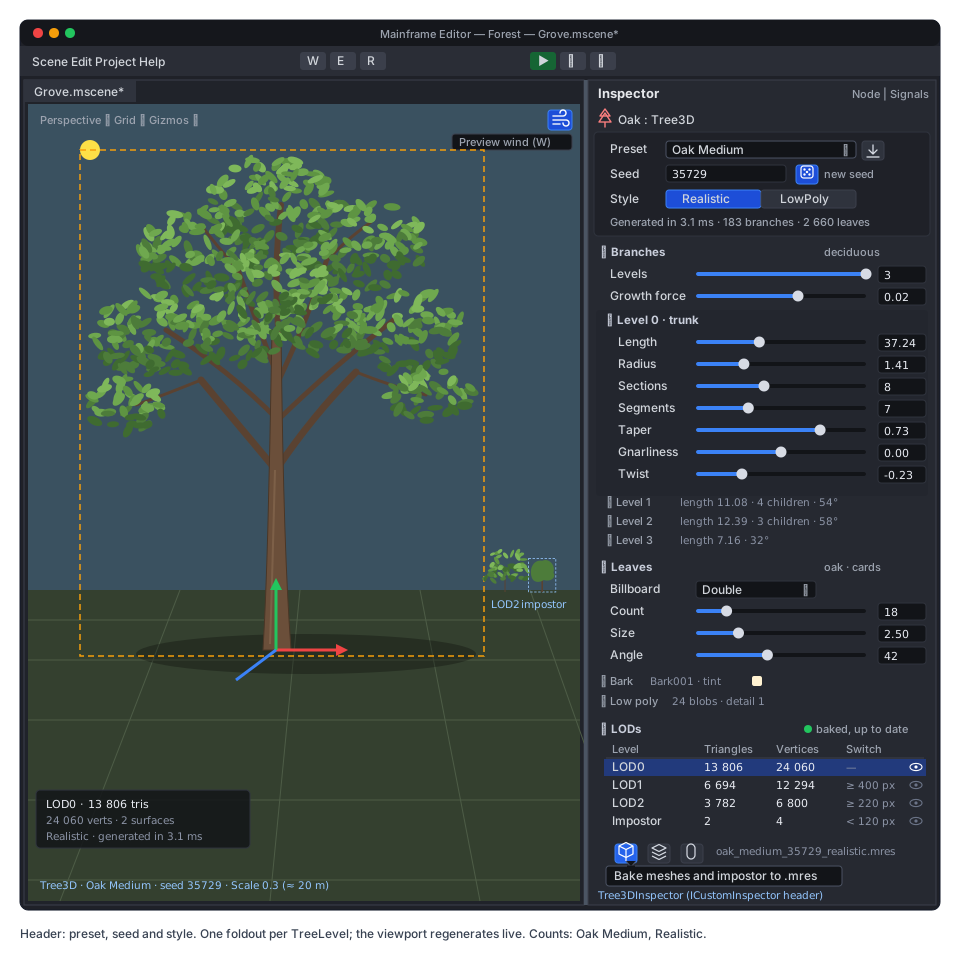
Section titled “Editor”The image at the top shows the layout. Tree3DInspector is an ICustomInspector
(MainframeEngine.Editor/Src/Inspector/InspectorModel.cs:162, like ZzfxStreamInspector). Its header RML holds:
- Preset dropdown with the 15 presets and Custom. An import icon button reads an Ez Tree
.json. - Seed field with a dice icon button (a new random seed, one undo entry).
- Style toggle: Realistic / LowPoly.
- Per-level foldouts, Level 0 · trunk to Level 3. Each is one
TreeLevel’s sliders, with the fields that do not apply hidden. Leaves, Bark and Low poly are foldouts too. Each foldout’s summary line shows its key values. - Live preview. The edited
Tree3Dregenerates in the viewport as sliders move (at most once per frame). A wind icon previews the wind in the edit viewport. It is off by default, so the scene holds still while editing. - LOD table. Triangles and vertices per LOD and the impostor, and the switch size in pixels. A row’s eye icon
forces that LOD in the viewport (
ForceLod). - Bake icon button (tooltip “Bake meshes and impostor to .mres”), Bake variants, Create collider, and the bake status (up to date / stale / not baked).
Following the editor rule, buttons are icons with tooltips: dice-5, file-import, package (bake),
stack-2 (variants), wind, eye. New Tabler icons: tree (Tree3D), trees (TreeOptions), leaf
(FoliageMaterial3D). Every change goes through the inspector context, so it can be undone.
Licence and attribution
Section titled “Licence and attribution”- Code header.
TreeGenerator.cs,EzRng.csandThreeMath.cscarry a header likeMainframeEngine/Src/Audio/Synthesis/Zzfx.cs:1-14: “A port of Ez Tree’s tree generator (src/lib/tree.js,rng.js; https://github.com/dgreenheck/ez-tree at commitdcf309bd86bd521083d9c70f01f2de45fdc7c457)”, then Ez Tree’s MIT licence text (© 2024 Daniel Greenheck).ThreeMath.csalso carries three.js’s MIT notice (© 2010–2024 three.js authors).wind.slangcredits Ez Tree and ashima webgl-noise (MIT, © 2011 Ashima Arts, Stefan Gustavson). THIRD_PARTY_NOTICES.md. When the code lands, add a table row and a section per component, like the ZzFX row: Ez Tree (MIT: generator, presets, leaf textures), three.js math (MIT), webgl-noise (MIT), and the ambientCG bark textures (CC0 1.0, credited as a courtesy with a link per set, as Ez Tree’ssrc/app/public/textures/LICENSE.mddoes).- Leaf textures are MIT, not CC0. They keep the Ez Tree notice wherever they are copied: the editor’s
Content/Trees/LICENSE.mdand the copy the editor makes into a project. - Pin. Ez Tree commit
dcf309bd86bd521083d9c70f01f2de45fdc7c457(2026-07-16, package version 1.1.0), with three.js 0.167.1 from itspackage-lock.json. Moving the pin means re-running the fixture script and reviewing the diff.
Testing
Section titled “Testing”- Unit (
Tests/MainframeEngine.Tests/Trees/)EzRng: the vectors above and the one-million-draw hash.- Parity.
build/ez-tree-reference.mjsis run by hand, not in CI, likebuild/zzfx-reference.mjs. From an Ez Tree checkout at the pin (npm ci), it calls#generateSkeletonand#meshSkeletonfor every preset and LOD and writesTests/Content/Trees/ez-tree-reference.json: vertex and index counts per surface, the indices, a position hash (float32 positions rounded to 1e-4, FNV-1a), and every 97th position and normal. The C# tests (BarkUv = EzTree,Scale = 1) match counts and indices exactly and positions and normals within 1e-4. A failure names the first diverging branch. ThreeMath: Euler ↔ quaternion round trips at the gimbal threshold, slerp edge cases,Math.roundhalves.- Determinism: the same bytes on two runs, on a second
TreeGeneratorand on a second thread. - Allocation budget: on a reused
TreeGenerator, Oak Medium with three LODs allocates at most its output arrays- 16 KB (
GC.GetAllocatedBytesForCurrentThread).
- 16 KB (
EzTreeJson: every preset JSON →TreeOptions→.mres→ load keeps the values as doubles; missing keys keep the defaults.- LowPoly: blob count ≤
MaxBlobs, no triangle fully inside another blob, closed blobs, triangle budgets per preset. Custom0weights rise monotonically along every branch, leaves havey = 1; LOD errors rise with the level.Tree3D: Bake round trip,BakeHashstaleness,Seed = −1, theRuntimeGenerationmodes.
- Render tests (goldens for
moltenvkandlavapipe):tree-lowpoly(Oak Medium and Pine Medium onStandardMaterial3D, G8b.2);tree-realistic(the same pair, cut-out leaves and shadows);foliage-wind(frame 120 under--fixed-fpswith a fixed wind; withWindStrength = 0the frame matches the still golden bit for bit);foliage-shadow(the leaf shadow differs from the still frame and matches its golden);tree-impostor(mesh vs impostor at the switch distance within a loose tolerance, and the dither band). - Allocation gate. 1 000 baked
Tree3Ds with wind, and aMultiMeshof 10 000 impostor trees, allocate 0 B per frame (theSceneTests.cs:433pattern). - Benchmarks.
TreeGeneratorBenchmarks.OakMedium3LodsandLowPolyOakMediuminbaseline.json. - Editor QA. Add a
Tree3D, pick a preset, roll the dice, switch style, bake, reload and compare.
Acceptance
Section titled “Acceptance”- Every one of the 15 presets generates in C# with Ez Tree’s exact vertex and index counts per LOD, and positions within 1e-4 of the reference fixture.
- A
Tree3Din LowPoly renders, faceted and palette-coloured, on today’s Blinn-PhongStandardMaterial3D. It bakes to.mres, and the baked scene loads without running the generator. - Realistic trees cut out their leaves, light both sides, let light through, and sway with
WorldEnvironment’s wind. Their shadows sway with them. - Grass (G8a) and trees share one wind. Water (G8c) reads it.
- Trees switch LOD0 → LOD1 → LOD2 → impostor by screen size, with a dither band before the impostor. Impostors are lit by the live sun.
- Trees scatter through
ScatterObjectTypein both modes with trunk capsules, and far instances draw as impostors. - Validation, allocation and render gates are green. Generation stays within its allocation budget and benchmark.
- Docs: a new
docs/design/trees.md, plus updates to materials-and-meshes.md (FoliageMaterial3D,Custom0use), shaders.md (foliage, impostor,wind.slang,FrameDatasize), shadow-system.md (foliage casters), lighting.md (translucency) and editor.md (the tree inspector).
Task list
Section titled “Task list”G8b.1–G8b.3 ship first: the generator, LowPoly, Bake and the inspector need neither G6 nor G8a.
- G8b.1 Generator.
EzRng,ThreeMath,TreeGenerator(skeleton, Realistic mesher, LODs and their errors),TreeMeshData, the licence header;build/ez-tree-reference.mjsand its fixture; parity, determinism and allocation tests; benchmark. - G8b.2 Options, presets, LowPoly, Tree3D and Bake.
TreeOptions,TreeLevel,EzTreeJson, the 15 preset.mresfiles;LeafBlobMesherand split-normal facets;Tree3D(edit-mode regeneration,StandardMaterial3Dfor both styles,ForceLod),TreeBaker,TrunkShape,RuntimeGeneration;THIRD_PARTY_NOTICES.mdrows; render testtree-lowpoly. - G8b.3 Inspector.
Tree3DInspector(preset, import, seed dice, style, level foldouts, live preview, LOD table, Bake, variants, collider); icons; editor tests; QA script step. - G8b.4 Wind and
FoliageMaterial3D(after G8a.11, the second vertex stream).WorldEnvironmentwind andFrameDataat 400 B;wind.slang,Foliage.vk.*,ShaderSetId.MeshFoliage, the foliage block inMaterialParams,FadeMode; foliage casters and wind in the light-matrix entry;.spvandshaders.lock; render testsfoliage-windandfoliage-shadow; allocation gate. - G8b.5 Realistic style. Bark and leaf sets in the editor content, copied into projects with
LICENSE.md; coverage-preserving alpha mips; translucency andBackFacemodes; render testtree-realistic; PBR bark once G6.1 lands. - G8b.6 Impostors (after G6.4).
TreeImpostorBaker(bake output modes, linear capture),ImpostorMaterial3D,Impostor.vk.*; the two G6.4 additions and the dither band; render testtree-impostor. - G8b.7 Scatter (with G8a’s object scatter and
MultiMesh). Bake variants, Create collider, the tree scenes in bothScatterObjectTypemodes and the backdropFoliageType; the 10k allocation gate; hand-over to Forest showcase (G8d).
Decisions
Section titled “Decisions”Decided by the user on 2026-10-08, who accepted every default, and recorded in ADR 0149. Each entry keeps the question it settled; Decision: is what to build.
- Port fidelity vs C# idioms. A literal port with three.js math in doubles keeps seeds and the presets’ look
identical, and lets artists use Ez Tree’s web app as a designer. An idiomatic rewrite (System.Numerics floats,
recursion) would be shorter, but every seed would give a different tree. Decision: literal port inside
Generation/, idiomatic C# around it (Tree3D, meshers for the engine’s styles). - Bark UV mode. Ez Tree’s V ping-pongs 0/1 per ring, so the bark texture mirrors at every section. Decision:
Continuous(V by arc length over the circumference) for new trees and presets.EzTreefor parity tests and imported JSON that wants the exact look. - Trellis. Ez Tree pulls branches toward a trellis grid (
trellis.js,calculateTrellisForce). It is useful for vines and espaliers, and not needed by forests or low-poly games. Decision: no in G8b. Keep a slot for the force inTreeParams, and port it withtrellis.jsonas preset 16 when a game asks. The trellis mesh itself stays a game asset. - Runtime generation default.
WhenNotBakedkeeps unbaked scenes working and warns.Nevermakes the cost visible. Decision:WhenNotBakedin the editor and debug builds. Exported release builds log an error per unbaked tree, but still generate it. Scaledefault. 0.3 makes Oak Medium up to about 20 m tall. Per-preset scales would be closer to real species, but the presets would no longer be pure Ez Tree values. Decision: one engine-wide 0.3, set in every preset.mresas a separate engine-only field.- Impostor memory. Two 2048² RGBA8 atlases with mips take about 45 MB per baked variant; at 1024² it is about 11 MB. The engine has no block compression yet. Decision: 1024² (8 × 8 at 128 px), 2048² as an option. Revisit with GPU texture compression (M12 mobile).
- Evergreen LowPoly shape. Pines read better as stacked cones than as icosphere blobs. Decision: add
BlobShape.Cone, chosen automatically forTreeType.EvergreenLowPoly. The cone is oriented along the parent branch. - Where the generator runs in the editor. Synchronous regeneration once per frame is simple. Large trees (Ash Large, 28 098 vertices) may make sliders stutter. Decision: synchronous; move to a worker with a “generating…” overlay if the benchmark exceeds 8 ms.
Related
Section titled “Related”Milestones · Terrain (G8a) · Water (G8c) · Forest showcase (G8d) · Rendering features (G6) · Materials & meshes · Shadow system · Shaders · Lighting · Editor · Editor viewport tools (G7) · ADR 0074 (cutout casters) · ADR 0144 (Slang) · ADR 0149 · Ez Tree